



 Chat with AI
Exam 9: The Family of Stars

Exam 1: Here and Now50 Questions
Exam 2: A Users Guide to the Sky68 Questions
Exam 3: Moon Phases and Eclipses68 Questions
Exam 4: Origins of Modern Astronomy64 Questions
Exam 5: Gravity76 Questions
Exam 6: Light and Telescopes69 Questions
Exam 7: Atoms and Spectra73 Questions
Exam 8: The Sun70 Questions
Exam 9: The Family of Stars70 Questions
Exam 10: The Interstellar Medium51 Questions
Exam 11: Formation and Structure of Stars44 Questions
Exam 12: Stellar Evolution51 Questions
Exam 13: Deaths of Stars74 Questions
Exam 14: Neutron Stars and Black Holes69 Questions
Exam 15: The Milky Way Galaxy72 Questions
Exam 16: Galaxies75 Questions
Exam 17: Supermassive Black Holes and Active Galaxies68 Questions
Exam 18: Modern Cosmology71 Questions
Exam 19: Origin of the Solar System and Extrasolar Planets69 Questions
Exam 20: Earth the Active Planet71 Questions
Exam 21: The Moon and Mercury70 Questions
Exam 22: Venus and Mars67 Questions
Exam 23: Jupiter and Saturn68 Questions
Exam 24: Uranus Neptune Pluto and the Kuiper Belt68 Questions
Exam 25: Meteorites Asteroids and Comets65 Questions
Exam 26: Astrobiology68 Questions
Select questions type


Stellar spectra started with the amount of hydrogen found in the star's spectrum and started with the letters A through Q. What are the current letters used to classify stellar spectra?
(Short Answer)
4.8/5  (98)
(98) A star's absolute brightness is calculated at a standard distance of 10 parsecs.
(True/False)
4.7/5 (90)
(90) Star A has an apparent visual magnitude of +5 and an absolute visual magnitude of -4. What is the distance to Star A?
(Essay)
4.7/5 (86)
(86) On the H-R diagram, 90 percent of all stars are _______________.
(Short Answer)
4.7/5 (80)
(80) 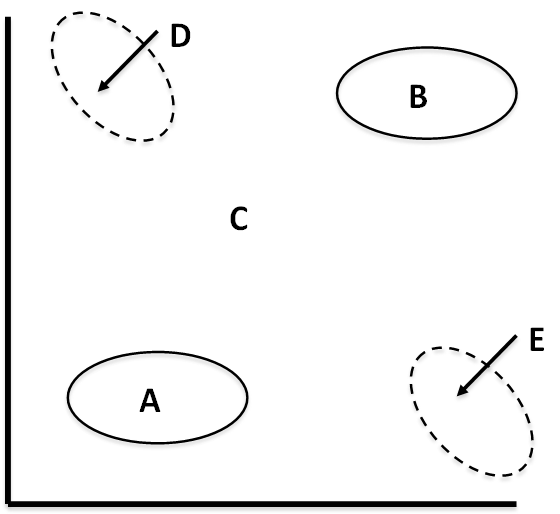 The vertical axis in the accompanying figure is labeled _____.
 (Multiple Choice)
4.8/5 (68)
(68) 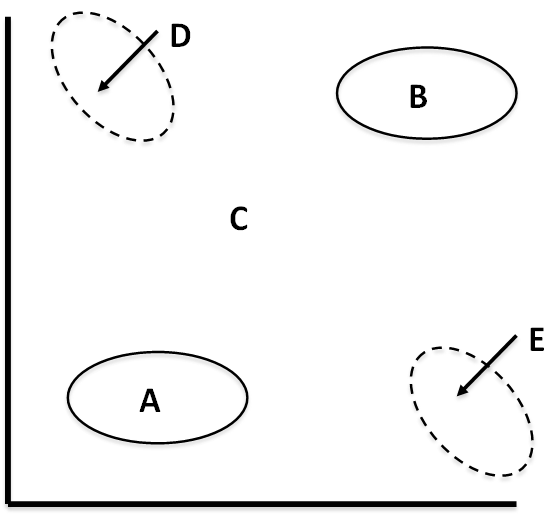 In the accompanying figure, which region represents supergiant stars? Note: (C) represents the entire main sequence while (D) and (E) represent only small parts of the main sequence.
 (Short Answer)
4.8/5 (82)
(82) A star's absolute visual magnitude depends only on the star's ______ and _____.
(Multiple Choice)
4.8/5 (79)
(79) 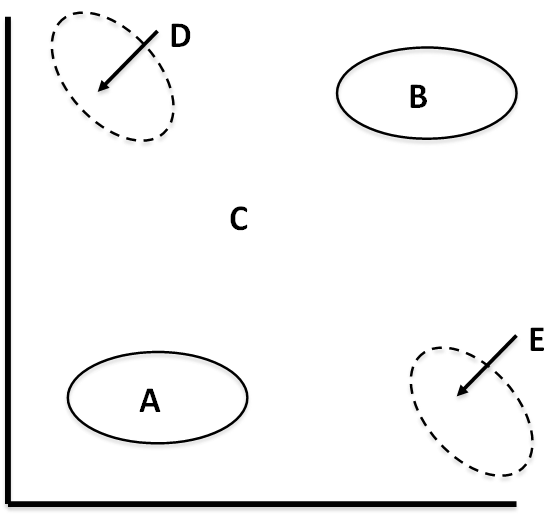 In the accompanying figure, which region represents approximately 80 percent of normal stars? Note: (C) represents the entire main sequence while (D) and (E) represent only small parts of the main sequence.
 (Short Answer)
4.9/5 (88)
(88) Groombridge 34 i s an M2 main sequence star . Base d o n thi s informatio n, whic h statement is true?
(Multiple Choice)
4.9/5 (71)
(71) How do astronomers determine the distance to stars that are farther than 100 parsecs away?
(Multiple Choice)
4.8/5 (86)
(86) If a star has an apparent magnitude of +5 and an absolute magnitude of -10, what can we say about that star?
(Multiple Choice)
4.7/5 (85)
(85) The horizontal axis (X-axis) of the Hertzsprung-Russell diagram is labeled with _______________.
(Short Answer)
4.9/5 (83)
(83) A star's apparent magnitude is a measure of how bright it appears to us if it is at its actual distance.
(True/False)
4.7/5 (62)
(62) The spectral classification of stars started with the amount of hydrogen present in their spectra, but a better method now uses the amount of oxygen in the star's spectra.
(True/False)
4.9/5 (77)
(77) Careful measurements reveal that a star maintains a steady apparent brightness at most times, except that at precise intervals of 93 hours. the star becomes dimmer for about 2 hours. The most likely explanation for this is that the star ________.
(Multiple Choice)
4.8/5 (76)
(76) Which type of binary system have pairs of stars that are so close together that they look like one single point?
(Multiple Choice)
4.8/5 (84)
(84) The vertical axis (Y-axis) of the Hertzsprung-Russell Diagram is labeled with _______________.
(Short Answer)
4.9/5 (84)
(84) A star's absolute visual magnitude depends on its _______________ and _______________.
(Short Answer)
4.8/5 (80)
(80) 
Filters
- Essay(0)
- Multiple Choice(0)
- Short Answer(0)
- True False(0)
- Matching(0)