



 Chat with AI
Exam 8: The Sun

Exam 1: Here and Now50 Questions
Exam 2: A Users Guide to the Sky68 Questions
Exam 3: Moon Phases and Eclipses68 Questions
Exam 4: Origins of Modern Astronomy64 Questions
Exam 5: Gravity76 Questions
Exam 6: Light and Telescopes69 Questions
Exam 7: Atoms and Spectra73 Questions
Exam 8: The Sun70 Questions
Exam 9: The Family of Stars70 Questions
Exam 10: The Interstellar Medium51 Questions
Exam 11: Formation and Structure of Stars44 Questions
Exam 12: Stellar Evolution51 Questions
Exam 13: Deaths of Stars74 Questions
Exam 14: Neutron Stars and Black Holes69 Questions
Exam 15: The Milky Way Galaxy72 Questions
Exam 16: Galaxies75 Questions
Exam 17: Supermassive Black Holes and Active Galaxies68 Questions
Exam 18: Modern Cosmology71 Questions
Exam 19: Origin of the Solar System and Extrasolar Planets69 Questions
Exam 20: Earth the Active Planet71 Questions
Exam 21: The Moon and Mercury70 Questions
Exam 22: Venus and Mars67 Questions
Exam 23: Jupiter and Saturn68 Questions
Exam 24: Uranus Neptune Pluto and the Kuiper Belt68 Questions
Exam 25: Meteorites Asteroids and Comets65 Questions
Exam 26: Astrobiology68 Questions
Select questions type


The _______________ predicts that pairs of sunspots should occur where magnetic tubes burst through the Sun's surface.
(Short Answer)
4.9/5  (85)
(85) What forms of electromagnetic radiation from the Sun's emissions do we experience here on Earth? Illustrate how we know this to be the case with one practical example for each form.
(Essay)
4.7/5 (72)
(72) Almost all the light we receive from the Sun escapes from underneath its photosphere.
(True/False)
4.8/5 (90)
(90) 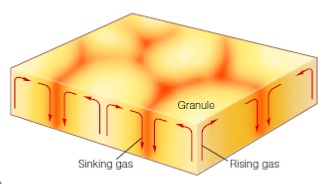 Figure 8-2b
What process on the Sun's photosphere does this figure represent?
Figure 8-2b
What process on the Sun's photosphere does this figure represent? (Multiple Choice)
4.7/5 (68)
(68) Granulation is evidence that energy in the photosphere ____.
(Multiple Choice)
4.9/5 (72)
(72) 
Filters
- Essay(0)
- Multiple Choice(0)
- Short Answer(0)
- True False(0)
- Matching(0)