



 Chat with AI
Exam 8: The Sun

Exam 1: Here and Now50 Questions
Exam 2: A Users Guide to the Sky68 Questions
Exam 3: Moon Phases and Eclipses68 Questions
Exam 4: Origins of Modern Astronomy64 Questions
Exam 5: Gravity76 Questions
Exam 6: Light and Telescopes69 Questions
Exam 7: Atoms and Spectra73 Questions
Exam 8: The Sun70 Questions
Exam 9: The Family of Stars70 Questions
Exam 10: The Interstellar Medium51 Questions
Exam 11: Formation and Structure of Stars44 Questions
Exam 12: Stellar Evolution51 Questions
Exam 13: Deaths of Stars74 Questions
Exam 14: Neutron Stars and Black Holes69 Questions
Exam 15: The Milky Way Galaxy72 Questions
Exam 16: Galaxies75 Questions
Exam 17: Supermassive Black Holes and Active Galaxies68 Questions
Exam 18: Modern Cosmology71 Questions
Exam 19: Origin of the Solar System and Extrasolar Planets69 Questions
Exam 20: Earth the Active Planet71 Questions
Exam 21: The Moon and Mercury70 Questions
Exam 22: Venus and Mars67 Questions
Exam 23: Jupiter and Saturn68 Questions
Exam 24: Uranus Neptune Pluto and the Kuiper Belt68 Questions
Exam 25: Meteorites Asteroids and Comets65 Questions
Exam 26: Astrobiology68 Questions
Select questions type


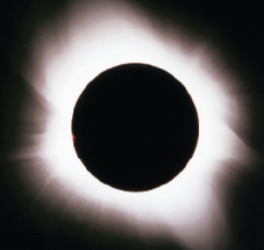 Figure 8-1b
Which layer of the Sun's atmosphere is represented in the accompanying visual-wavelength image?
Figure 8-1b
Which layer of the Sun's atmosphere is represented in the accompanying visual-wavelength image? (Multiple Choice)
4.9/5  (61)
(61) Stars, like our Sun, generate their energy by way of nuclear _______________.
(Short Answer)
4.8/5 (78)
(78) Which equation represents the overall nuclear fusion process of the Sun?
(Multiple Choice)
4.8/5 (86)
(86) The chromosphere is roughly _______________ times fainter than the photosphere.
(Short Answer)
4.8/5 (65)
(65) What is released from the proton-proton chain and is immediately absorbed by the surrounding gas, thereby heating it?
(Multiple Choice)
4.9/5 (80)
(80) What methodology do astronomers use to map the inside of the Sun?
(Multiple Choice)
4.8/5 (96)
(96) What are the dark regions that give the Sun's photosphere a mottled appearance?
(Multiple Choice)
4.8/5 (73)
(73) What occurs on the surface of the Sun during a solar cycle minimum?
(Multiple Choice)
4.8/5 (86)
(86) When the Sun generates its own energy, it uses weak forces to bind together atomic nuclei.
(True/False)
4.9/5 (84)
(84) Sunspots are parts of active solar regions dominated by magnetic fields that encompass all layers of the Sun's atmosphere.
(True/False)
4.8/5 (81)
(81) Consider the complete magnetic cycle of sunspot activity on the Sun. Approximately how many years is this cycle?
(Multiple Choice)
4.8/5 (79)
(79) When two arches in a magnetic field encounter each other, ____ can cause powerful eruptions called ____.
(Multiple Choice)
4.8/5 (84)
(84) Historical records show that there were very few sunspots from about 1645 to 1715, a phenomenon known as the _______________.
(Short Answer)
4.8/5 (87)
(87) Spicules can trigger communications blackouts and auroras on Earth.
(True/False)
4.8/5 (72)
(72) The _______________ of the solar disk is dimmer than the center, which is caused by the absorption of light in the photosphere.
(Short Answer)
4.8/5 (74)
(74) Nuclear fusion within the Sun proceeds step by step in a series of reactions called the neutron-neutron chain.
(True/False)
4.9/5 (80)
(80) The number of _______________ visible on the Sun varies in a cycle with a period of 11 years.
(Short Answer)
4.9/5 (95)
(95) Granulation is caused by convection currents just below the photosphere.
(True/False)
4.8/5 (85)
(85) 
Filters
- Essay(0)
- Multiple Choice(0)
- Short Answer(0)
- True False(0)
- Matching(0)