



 Chat with AI
Exam 5: Gravity

Exam 1: Here and Now50 Questions
Exam 2: A Users Guide to the Sky68 Questions
Exam 3: Moon Phases and Eclipses68 Questions
Exam 4: Origins of Modern Astronomy64 Questions
Exam 5: Gravity76 Questions
Exam 6: Light and Telescopes69 Questions
Exam 7: Atoms and Spectra73 Questions
Exam 8: The Sun70 Questions
Exam 9: The Family of Stars70 Questions
Exam 10: The Interstellar Medium51 Questions
Exam 11: Formation and Structure of Stars44 Questions
Exam 12: Stellar Evolution51 Questions
Exam 13: Deaths of Stars74 Questions
Exam 14: Neutron Stars and Black Holes69 Questions
Exam 15: The Milky Way Galaxy72 Questions
Exam 16: Galaxies75 Questions
Exam 17: Supermassive Black Holes and Active Galaxies68 Questions
Exam 18: Modern Cosmology71 Questions
Exam 19: Origin of the Solar System and Extrasolar Planets69 Questions
Exam 20: Earth the Active Planet71 Questions
Exam 21: The Moon and Mercury70 Questions
Exam 22: Venus and Mars67 Questions
Exam 23: Jupiter and Saturn68 Questions
Exam 24: Uranus Neptune Pluto and the Kuiper Belt68 Questions
Exam 25: Meteorites Asteroids and Comets65 Questions
Exam 26: Astrobiology68 Questions
Select questions type


Newton concluded that some force must act on the Moon because ____.
(Multiple Choice)
4.7/5  (90)
(90) Newton's third law states that forces occur in pairs acting in the same direction.
(True/False)
4.9/5 (87)
(87) How does gravity explain the presence of the tides we experience on Earth?
(Essay)
4.7/5 (82)
(82) Changing the direction of a moving body does not impact its velocity.
(True/False)
4.9/5 (74)
(74) According to Galileo, the acceleration of a freely falling object due to gravity is ____.
(Multiple Choice)
4.9/5 (74)
(74) The resistance of matter to changes in motion is known as _______________.
(Short Answer)
4.9/5 (68)
(68) 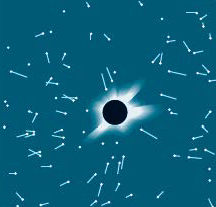 Figure 5-15
Consider the accompanying figure. Due to the curvature of space-time by the sun, light from stars that pass near the edge of the sun will ____.
Figure 5-15
Consider the accompanying figure. Due to the curvature of space-time by the sun, light from stars that pass near the edge of the sun will ____. (Multiple Choice)
4.8/5 (88)
(88) The first postulate of special relativity states that ____.
(Multiple Choice)
4.8/5 (71)
(71) What is the circular velocity of an object orbiting Earth at a distance of 100,000 km from Earth's center? Hint: ; G = 6.67 10 -11 m3 /s 2 /kg
(Multiple Choice)
4.7/5 (77)
(77) Newtonian physics tells us that Kepler's second law is a result of the conservation of ____.
(Multiple Choice)
4.8/5 (83)
(83) According to the theory of general relativity, gravity is caused by the ____.
(Multiple Choice)
4.9/5 (87)
(87) Why does the circular velocity of an Earth satellite depend on the distance from Earth's center?
(Essay)
4.9/5 (71)
(71) What is the escape velocity from the Moon for a lunar landing module sitting on the Moon's surface? Hints: ;
The mass of the Moon is 7.2 × 10²² kg; its radius is 1738 km; G = 6.67 10-11 m3/s2/kg
(Multiple Choice)
4.8/5 (76)
(76) 
Filters
- Essay(0)
- Multiple Choice(0)
- Short Answer(0)
- True False(0)
- Matching(0)