



 Chat with AI
Exam 14: Environmental Hazards and Human Health

Exam 1: The Environment and Sustainability91 Questions
Exam 2: Science, Matter, Energy and Systems89 Questions
Exam 3: Ecosystems: What Are They and How Do They Work100 Questions
Exam 4: Biodiversity and Evolution93 Questions
Exam 5: Species Interactions, Ecological Succession and Population Control93 Questions
Exam 6: The Human Population and Urbanization99 Questions
Exam 7: Climate and Biodiversity97 Questions
Exam 8: Sustaining Biodiversity: Saving Species100 Questions
Exam 9: Sustaining Biodiversity: Saving Ecosystems100 Questions
Exam 10: Food Production and the Environment100 Questions
Exam 11: Water Resources and Water Pollution100 Questions
Exam 12: Geology and Nonrenewable Mineral Resources92 Questions
Exam 13: Energy Resources100 Questions
Exam 14: Environmental Hazards and Human Health100 Questions
Exam 15: Air Pollution, Climate Change and Ozone Depletion100 Questions
Exam 16: Solid and Hazardous Waste100 Questions
Exam 17: Environmental Economics, Politics and Worldviews101 Questions
Select questions type


It is estimated that approximately one of every 12 women of childbearing age in the United States has enough ____________________ in her blood to harm a developing fetus.
(Short Answer)
4.9/5  (75)
(75) The overuse of ____________________ can cause bacteria to develop genetic resistance.
(Short Answer)
4.9/5 (61)
(61) Explain why infants and children are more susceptible to the effects of toxic substances than adults.
(Essay)
4.8/5 (82)
(82) 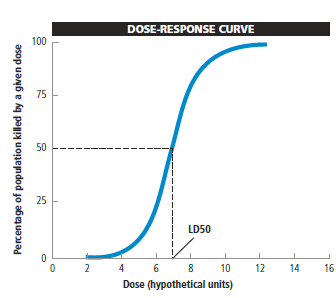 On the accompanying graph, explain what the designation LD50 means.
______ is an example of a bacterium that is highly resistant to antibiotics.
(Multiple Choice)
4.9/5 (93)
(93) A(n) ____________________ is a toxic agent that can cause birth defects.
(Short Answer)
4.8/5 (95)
(95) Why is it a concern that antibacterial hand soaps have become so popular?
(Multiple Choice)
5.0/5 (72)
(72) What percentage of synthetic chemicals commonly used today have been adequately tested to determine if they are mutagens, carcinogens, or teratogens?
(Multiple Choice)
4.8/5 (75)
(75) 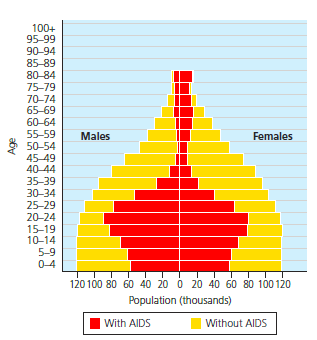 Figure 14.5 for questions 1-4
In the accompanying figure, how many more women between 20 and 24 years of age would survive if AIDS were eradicated?
Figure 14.5 for questions 1-4
In the accompanying figure, how many more women between 20 and 24 years of age would survive if AIDS were eradicated? (Short Answer)
4.8/5 (71)
(71) What is expected to happen to malaria-carrying mosquitoes in the coming century?
(Multiple Choice)
4.8/5 (81)
(81) What is the term for a toxic agent that causes harm or birth defects in a fetus or embryo?
(Multiple Choice)
4.7/5 (69)
(69) Nitrous acid (HNO2), formed by the digestion of nitrite (NO2) preservatives in foods, can cause ____________________ that are linked to increases in stomach cancer in people who consume large amounts of processed foods and wine containing such preservatives.
(Short Answer)
4.8/5 (80)
(80) Discuss at least one of the factors that explains why most people do a poor job at evaluating risk.
(Essay)
4.8/5 (77)
(77) What is a disease where malignant cells can multiply uncontrollably and form tumors?
(Multiple Choice)
4.8/5 (81)
(81) What is the preventive strategy that would contribute most to longer lifespans?
(Multiple Choice)
5.0/5 (77)
(77) Synthetic chemicals are always more harmful compared to natural chemicals.
(True/False)
4.9/5 (74)
(74) What is the leading cause of death worldwide for people ages 15-49?
(Multiple Choice)
4.9/5 (88)
(88) It is difficult to study all of the possible harmful effects caused by interactions of industrial chemicals. Such a study would be too expensive to be realistic even for a subset of several hundred chemicals.
(True/False)
4.9/5 (76)
(76) 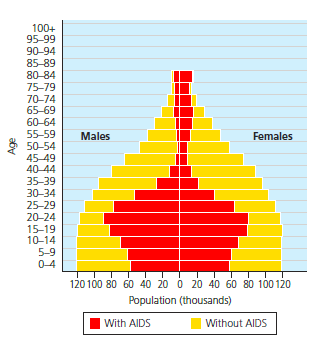 Figure 14.5 for questions 1-4
In the accompanying figure, in what age range are females more likely to die from AIDS than males?
Figure 14.5 for questions 1-4
In the accompanying figure, in what age range are females more likely to die from AIDS than males? (Short Answer)
4.9/5 (67)
(67) 
Filters
- Essay(0)
- Multiple Choice(0)
- Short Answer(0)
- True False(0)
- Matching(0)