



 Chat with AI
Exam 7: Climate and Biodiversity

Exam 1: The Environment and Sustainability91 Questions
Exam 2: Science, Matter, Energy and Systems89 Questions
Exam 3: Ecosystems: What Are They and How Do They Work100 Questions
Exam 4: Biodiversity and Evolution93 Questions
Exam 5: Species Interactions, Ecological Succession and Population Control93 Questions
Exam 6: The Human Population and Urbanization99 Questions
Exam 7: Climate and Biodiversity97 Questions
Exam 8: Sustaining Biodiversity: Saving Species100 Questions
Exam 9: Sustaining Biodiversity: Saving Ecosystems100 Questions
Exam 10: Food Production and the Environment100 Questions
Exam 11: Water Resources and Water Pollution100 Questions
Exam 12: Geology and Nonrenewable Mineral Resources92 Questions
Exam 13: Energy Resources100 Questions
Exam 14: Environmental Hazards and Human Health100 Questions
Exam 15: Air Pollution, Climate Change and Ozone Depletion100 Questions
Exam 16: Solid and Hazardous Waste100 Questions
Exam 17: Environmental Economics, Politics and Worldviews101 Questions
Select questions type


In the ocean, green algae grow in the ____________________ zone, but not in deeper zones.

Free
(Short Answer)
4.8/5  (88)
(88) Correct Answer: Verified
euphotic
Many inland wetlands have been drained or filled to grow crops or have been covered with concrete, asphalt, and buildings.
Free
(True/False)
5.0/5 (80)
(80) Correct Answer:Verified
VerifiedTrue
In ____________________, a type of grassland, ice and snow generally cover the ground.
Free
(Short Answer)
4.8/5 (83)
(83) Correct Answer:Verified
VerifiedArctic tundra
A connected loop of deep and shallow ocean currents transports warm and cool water to various parts of the earth.
(True/False)
4.9/5 (75)
(75) Marshes, swamps, and prairie potholes are all examples of ____________________.
(Short Answer)
4.9/5 (82)
(82) Some desert plants reduce evaporation by closing their pores during the day and opening them at night to take up ____________________.
(Short Answer)
4.8/5 (79)
(79) Overgrazing is a type of human activity that has a major impact human on grassland ecosystems.
(True/False)
4.8/5 (83)
(83) 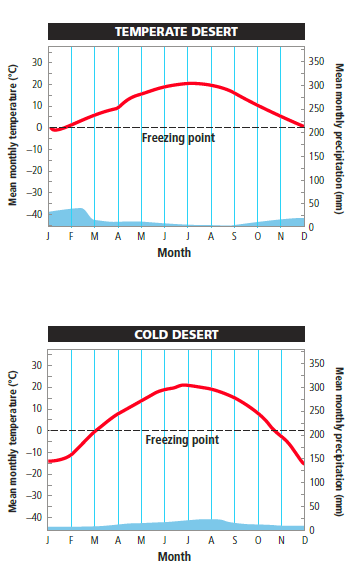 The second graph above shows temperature and precipitation in a cold desert. Wildflowers in temperate deserts typically bloom in March or April. What month of the year would you expect to see flowers bloom in the cold desert?
 (Essay)
4.9/5 (79)
(79) The Arctic, Atlantic, Pacific, Indian, and Southern Oceans are actually a single and continuous body of saltwater.
(True/False)
4.8/5 (88)
(88) On the evening news, there is a forecast of sunny weather for the next day with a high temperature 10°F warmer than today. This is an example of climate.
(True/False)
4.9/5 (87)
(87) When water temperature changes rapidly between two layers, that region of water is called a(n) ____________________.
(Short Answer)
4.8/5 (79)
(79) Oak, hickory, maple, poplar, and birch are typical tree species in the ____.
(Multiple Choice)
4.8/5 (77)
(77) Which one of the three major principles of sustainability is a driving force behind climate and biodiversity? Include in your answer an explanation of why this is true.
(Essay)
4.7/5 (67)
(67) In the western United States, an area called the Great Basin contains many mountain ranges that are separated from each other by high desert. Because these mountain ranges provide sanctuary for some species, they could be called ____.
(Multiple Choice)
5.0/5 (76)
(76) The transition zone between two ecosystems or biomes is called a(n) ____.
(Multiple Choice)
4.9/5 (87)
(87) Which of the following trees is characteristic of tropical coastal wetlands?
(Multiple Choice)
4.8/5 (71)
(71) 
Filters
- Essay(0)
- Multiple Choice(0)
- Short Answer(0)
- True False(0)
- Matching(0)