



 Chat with AI
Exam 7: Climate and Biodiversity

Exam 1: The Environment and Sustainability91 Questions
Exam 2: Science, Matter, Energy and Systems89 Questions
Exam 3: Ecosystems: What Are They and How Do They Work100 Questions
Exam 4: Biodiversity and Evolution93 Questions
Exam 5: Species Interactions, Ecological Succession and Population Control93 Questions
Exam 6: The Human Population and Urbanization99 Questions
Exam 7: Climate and Biodiversity97 Questions
Exam 8: Sustaining Biodiversity: Saving Species100 Questions
Exam 9: Sustaining Biodiversity: Saving Ecosystems100 Questions
Exam 10: Food Production and the Environment100 Questions
Exam 11: Water Resources and Water Pollution100 Questions
Exam 12: Geology and Nonrenewable Mineral Resources92 Questions
Exam 13: Energy Resources100 Questions
Exam 14: Environmental Hazards and Human Health100 Questions
Exam 15: Air Pollution, Climate Change and Ozone Depletion100 Questions
Exam 16: Solid and Hazardous Waste100 Questions
Exam 17: Environmental Economics, Politics and Worldviews101 Questions
Select questions type


There are ____ separate Hadley cells in which warm air rises and cools, then falls and heats up again in great rolling patterns.
(Multiple Choice)
4.8/5  (65)
(65) Compare and contrast the types of adaptations that plants and animals need in order to survive in the desert.
(Essay)
4.9/5 (68)
(68) The well-lit, uppermost zone of the sea, which contains large quantities of phytoplankton, is called the ____.
(Multiple Choice)
4.8/5 (69)
(69) Delta wetlands can help to protect human development from hurricanes because ____.
(Multiple Choice)
4.7/5 (63)
(63) Some animals living in tropical rainforests have stratified niches that are ____ to ____ competition for resources.
(Multiple Choice)
4.7/5 (68)
(68) One ecosystem service provided by oceans is that they help to moderate global climate.
(True/False)
4.8/5 (75)
(75) A lake with a large supply of nutrients is called a(n) ____________________ lake.
(Short Answer)
5.0/5 (78)
(78) Describe one way that human activities are disrupting and degrading freshwater systems.
(Essay)
4.8/5 (82)
(82) Water often stays at the surface in shallow seasonal wetlands when ____________________ prevents it from draining into the ground in cold grasslands.
(Short Answer)
4.8/5 (91)
(91) Net primary productivity (NPP) is quite low in the open sea except in upwelling areas where currents bring up nutrients from the ocean bottom.
(True/False)
4.8/5 (83)
(83) Explain the difference is between major climate zones and major biomes, then explain how these interact.
(Essay)
4.8/5 (79)
(79) Match the items listed below with the appropriate choice
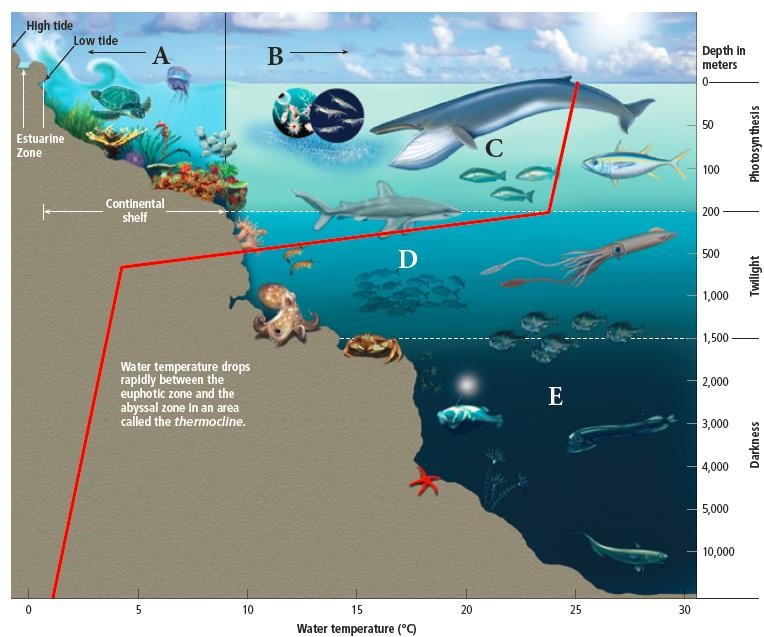
Correct Answer: Verified
Premises:
Responses:
(Matching)
4.8/5 (78)
(78) When the algae in coral reefs die off due to environmental stresses, the coral subsequently dies because of lack of food. This process is referred to as ____.
(Multiple Choice)
4.7/5 (92)
(92) Aquatic life zones are the aquatic equivalents of ____ on land.
(Multiple Choice)
4.9/5 (81)
(81) Temperate deciduous forests typically have very low precipitation.
(True/False)
4.9/5 (78)
(78) Aquatic life zones located in higher-salinity waters are called ____________________ life zones.
(Short Answer)
4.9/5 (74)
(74) ____________________ is the general pattern of atmospheric conditions in a given area over periods ranging from at least three decades to thousands of years.
(Short Answer)
4.8/5 (64)
(64) Taigas are found in scattered coastal temperate areas with ample rainfall and moisture from dense ocean fogs.
(True/False)
4.9/5 (78)
(78) 
Filters
- Essay(0)
- Multiple Choice(0)
- Short Answer(0)
- True False(0)
- Matching(0)