



 Chat with AI
Exam 14: Environmental Hazards and Human Health

Exam 1: The Environment and Sustainability91 Questions
Exam 2: Science, Matter, Energy and Systems89 Questions
Exam 3: Ecosystems: What Are They and How Do They Work100 Questions
Exam 4: Biodiversity and Evolution93 Questions
Exam 5: Species Interactions, Ecological Succession and Population Control93 Questions
Exam 6: The Human Population and Urbanization99 Questions
Exam 7: Climate and Biodiversity97 Questions
Exam 8: Sustaining Biodiversity: Saving Species100 Questions
Exam 9: Sustaining Biodiversity: Saving Ecosystems100 Questions
Exam 10: Food Production and the Environment100 Questions
Exam 11: Water Resources and Water Pollution100 Questions
Exam 12: Geology and Nonrenewable Mineral Resources92 Questions
Exam 13: Energy Resources100 Questions
Exam 14: Environmental Hazards and Human Health100 Questions
Exam 15: Air Pollution, Climate Change and Ozone Depletion100 Questions
Exam 16: Solid and Hazardous Waste100 Questions
Exam 17: Environmental Economics, Politics and Worldviews101 Questions
Select questions type


Human reliability is generally ____ technology reliability.

Free
(Multiple Choice)
5.0/5  (73)
(73) Correct Answer: Verified
D
The ____________________ system is a complex network of glands that release tiny amounts of hormones into the bloodstreams of humans and other vertebrate animals.
Free
(Short Answer)
4.9/5 (69)
(69) Correct Answer:Verified
Verifiedendocrine
The majority of chemicals in commercial use have been screened for toxicity before they were made available to the public.
Free
(True/False)
4.7/5 (73)
(73) Correct Answer:Verified
VerifiedFalse
The three infectious diseases that cause the majority of deaths worldwide are influenza, hepatitis B, and malaria.
(True/False)
4.9/5 (89)
(89) 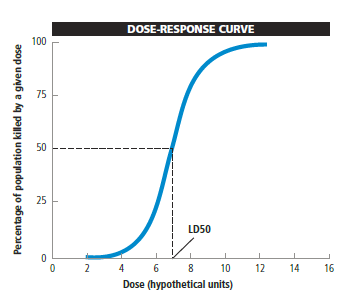 On the accompanying graph, what dose in hypothetical units did it take to kill 25% of the population?
 (Short Answer)
4.8/5 (85)
(85) Why have pesticide producers failed to produce new mosquito-killing insecticides in recent years?
(Multiple Choice)
4.8/5 (72)
(72) The U.S. Environmental Protection Agency currently recommends that regulators assume children face a risk factor ____ times that of adults when exposed to carcinogenic chemicals.
(Multiple Choice)
4.9/5 (93)
(93) A person experiencing dizziness after using a strong household cleaner is showing a(n) ____.
(Multiple Choice)
4.8/5 (92)
(92) In the United States, the leading cause of preventable death is tobacco use.
(True/False)
4.8/5 (83)
(83) Because case reports give detailed information about a single individual, they are often used to estimate the toxicity for a chemical on a more general level.
(True/False)
4.8/5 (80)
(80) If you typically consume large amounts of processed foods, and certain wines, which category of chemical hazard is introduced into your system?
(Multiple Choice)
4.8/5 (70)
(70) Some studies have shown that exposure of human babies to the group of hormonally active agents called ____________________ may correspond with early puberty in girls and male infertility.
(Short Answer)
4.9/5 (80)
(80) Some organisms live on or inside other organisms and feed on them, and can cause serious infectious diseases, including malaria. These are known as ____________________.
(Short Answer)
4.9/5 (79)
(79) A basic principle of toxicology is that any synthetic or natural chemical can be harmful if ingested or inhaled in a large enough quantity.
(True/False)
4.8/5 (78)
(78) Toxicology is a science devoted to the study of all risks to human life.
(True/False)
4.8/5 (83)
(83) Explain the following statement (quotation at the beginning of Chapter 14) made by the German scientist Paracelsus: "The dose makes the poison."
(Essay)
4.8/5 (94)
(94) To help prevent worsening of risks from infectious diseases, it is important to reduce the use of _____.
(Multiple Choice)
4.7/5 (82)
(82) A global-scale outbreak of an infectious disease such as tuberculosis or AIDS is called a(n) ______________________________.
(Short Answer)
4.9/5 (81)
(81) An important breakthrough to help prevent death from dehydration for victims of severe diarrhea has been the development of _________________________.
(Short Answer)
4.8/5 (96)
(96) 
Filters
- Essay(0)
- Multiple Choice(0)
- Short Answer(0)
- True False(0)
- Matching(0)