



 Chat with AI
Exam 6: The Human Population and Urbanization

Exam 1: The Environment and Sustainability91 Questions
Exam 2: Science, Matter, Energy and Systems89 Questions
Exam 3: Ecosystems: What Are They and How Do They Work100 Questions
Exam 4: Biodiversity and Evolution93 Questions
Exam 5: Species Interactions, Ecological Succession and Population Control93 Questions
Exam 6: The Human Population and Urbanization99 Questions
Exam 7: Climate and Biodiversity97 Questions
Exam 8: Sustaining Biodiversity: Saving Species100 Questions
Exam 9: Sustaining Biodiversity: Saving Ecosystems100 Questions
Exam 10: Food Production and the Environment100 Questions
Exam 11: Water Resources and Water Pollution100 Questions
Exam 12: Geology and Nonrenewable Mineral Resources92 Questions
Exam 13: Energy Resources100 Questions
Exam 14: Environmental Hazards and Human Health100 Questions
Exam 15: Air Pollution, Climate Change and Ozone Depletion100 Questions
Exam 16: Solid and Hazardous Waste100 Questions
Exam 17: Environmental Economics, Politics and Worldviews101 Questions
Select questions type


Women who cannot ____ often have more children than those who can.
(Multiple Choice)
4.9/5  (85)
(85) One view of population growth proposes that____________________ advances have allowed humans to avoid the pressure of environmental limits that all populations of other species face.
(Short Answer)
4.7/5 (70)
(70) Briefly discuss the baby boomers and their effect on the United States population profile.
(Essay)
4.8/5 (67)
(67) Match the items listed below with the appropriate choice.
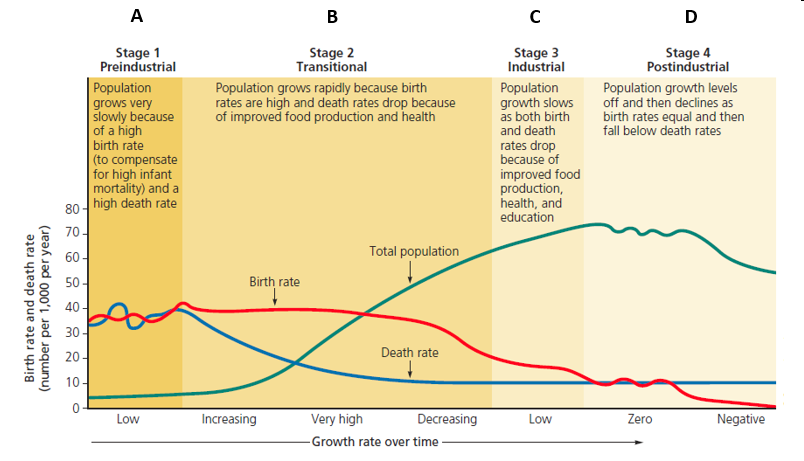
Figure 6.10
Figure 6.10
Premises:
On the generalized model of the demographic transition, choose the stage in which death rates decrease and birth rates are high.
Responses:
1
2
3
Correct Answer: Verified
Premises:
Responses:
(Matching)
5.0/5 (87)
(87) Countries and areas where people have good access to family planning, economic opportunities for women, and schooling for girls generally higher birth rates than those where these things are less available.
(True/False)
4.9/5 (82)
(82) If a country has a declining population without ways to increase the proportion of young, working individuals, then economic problems may result because so many people require government expenditures relative to those paying taxes to support the expenditures.
(True/False)
5.0/5 (82)
(82) Human population growth since 1960 has been evenly distributed around the world.
(True/False)
4.8/5 (75)
(75) One reason birth and fertility rates in more-developed countries tend to be lower is that ____.
(Multiple Choice)
4.9/5 (72)
(72) During the preindustrial stage of the demographic transition, a country has relatively slow population growth despite a high birth rate because the death rate is so high.
(True/False)
4.8/5 (89)
(89) Which of the following implies the greatest built-in momentum for population growth?
(Multiple Choice)
4.8/5 (78)
(78) Match the items listed below with the appropriate choice.
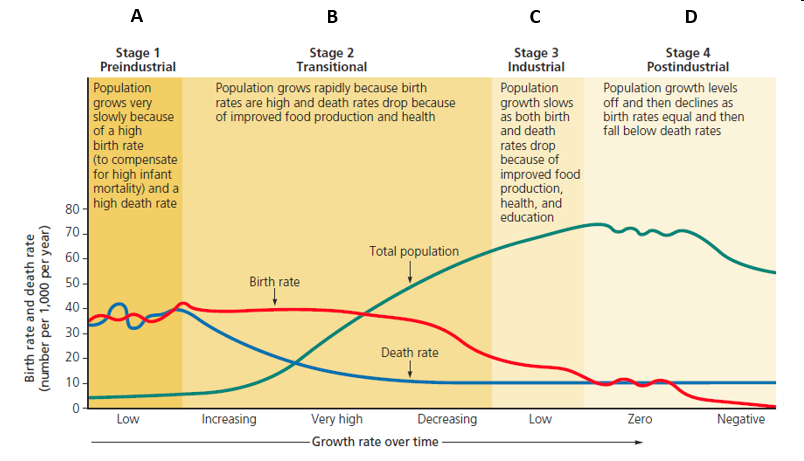
Figure 6.10
Figure 6.10
Premises:
On the generalized model of the demographic transition, choose the stage in which population growth continues but at a slower rate.
Responses:
2
4
1
Correct Answer:Verified
VerifiedPremises:
Responses:
(Matching)
4.8/5 (78)
(78) Human populations grow or decline in particular countries, cities, or other areas through the interplay of three factors: births, ____________________, and migration.
(Short Answer)
4.8/5 (84)
(84) As countries develop economically, birth and death rates generally decline.
(True/False)
4.8/5 (72)
(72) In 1969, planners in which Brazilian city decided to focus on an inexpensive and efficient mass-transit system rather than on the car?
(Multiple Choice)
4.9/5 (76)
(76) An ________ is a city that promotes sustainable growth and development using a variety of approaches, such as eco-friendly transportation, the recycling or reuse of food, and biodiversity protection.____________________.
(Short Answer)
4.9/5 (82)
(82) 
Filters
- Essay(0)
- Multiple Choice(0)
- Short Answer(0)
- True False(0)
- Matching(0)