



 Chat with AI
Exam 6: The Human Population and Urbanization

Exam 1: The Environment and Sustainability91 Questions
Exam 2: Science, Matter, Energy and Systems89 Questions
Exam 3: Ecosystems: What Are They and How Do They Work100 Questions
Exam 4: Biodiversity and Evolution93 Questions
Exam 5: Species Interactions, Ecological Succession and Population Control93 Questions
Exam 6: The Human Population and Urbanization99 Questions
Exam 7: Climate and Biodiversity97 Questions
Exam 8: Sustaining Biodiversity: Saving Species100 Questions
Exam 9: Sustaining Biodiversity: Saving Ecosystems100 Questions
Exam 10: Food Production and the Environment100 Questions
Exam 11: Water Resources and Water Pollution100 Questions
Exam 12: Geology and Nonrenewable Mineral Resources92 Questions
Exam 13: Energy Resources100 Questions
Exam 14: Environmental Hazards and Human Health100 Questions
Exam 15: Air Pollution, Climate Change and Ozone Depletion100 Questions
Exam 16: Solid and Hazardous Waste100 Questions
Exam 17: Environmental Economics, Politics and Worldviews101 Questions
Select questions type


Which of the following takes the fewest resources to manufacture?
(Multiple Choice)
4.9/5  (85)
(85) One important trend seen in urban populations is that ____.
(Multiple Choice)
5.0/5 (72)
(72) The continent with the most rapid population growth is ____.
(Multiple Choice)
4.9/5 (64)
(64) The first phase of urbanization in the United States was that people moved from ____________________ to relatively large, centrally-located cities.
(Short Answer)
5.0/5 (86)
(86) Match the items listed below with the appropriate choice.
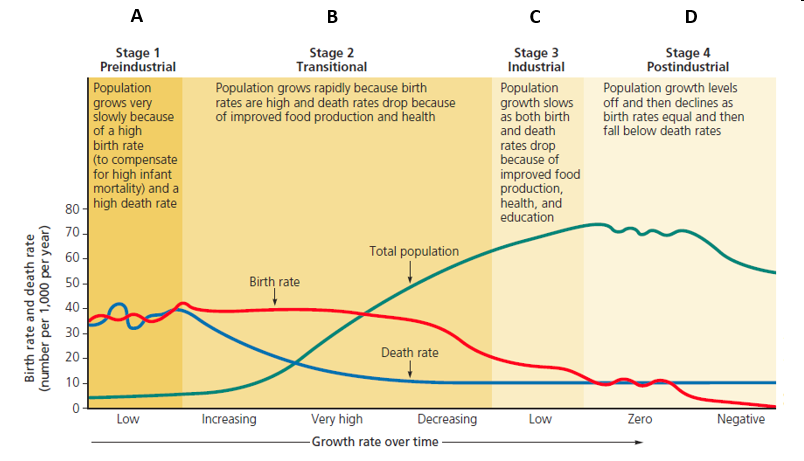
Figure 6.10
Figure 6.10
Premises:
On the generalized model of the demographic transition, choose the stage at which infant mortality is generally high.
Responses:
4
1
2
Correct Answer: Verified
Premises:
Responses:
(Matching)
4.8/5 (87)
(87) Cities can't ever be sustainable because they have such high concentrations of people, automobiles, business enterprises, and industries.
(True/False)
4.7/5 (84)
(84) Residents of dispersed cities that grow outward often rely on motor vehicles for most of their transportation, but residents of compact cities that grow ____________________ get around by walking, biking, or using mass transit.
(Short Answer)
4.8/5 (83)
(83) The most important factor contributing to a high infant mortality rate is usually ____.
(Multiple Choice)
5.0/5 (72)
(72) Match the items listed below with the appropriate choice.
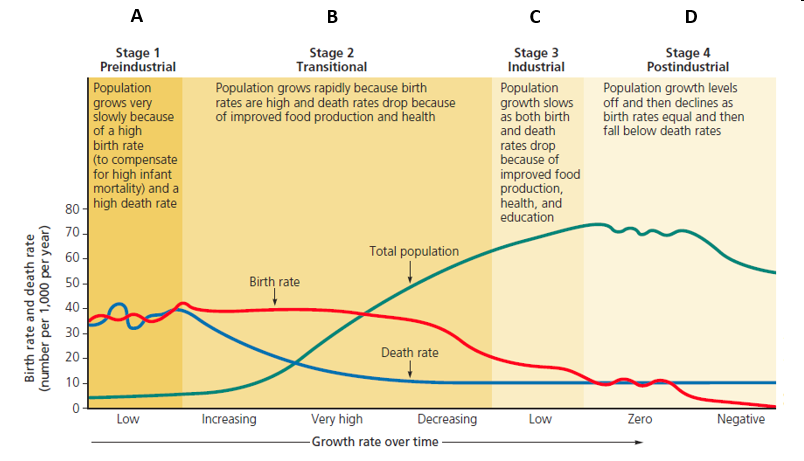
Figure 6.10
Figure 6.10
Premises:
On the generalized model of the demographic transition, choose the stage at which most countries experience zero growth rate.
Responses:
2
4
1
Correct Answer:Verified
VerifiedPremises:
Responses:
(Matching)
4.9/5 (73)
(73) Although motor vehicles are associated with pollution and other environmental concerns, one advantage of them is that ____.
(Multiple Choice)
4.7/5 (84)
(84) ____________________ involves the provision of education and clinical services that can help couples to choose how many children to have and when to have them.
(Short Answer)
4.9/5 (88)
(88) People who have to leave their homes and sometimes their countries because of water or food shortages, soil erosion, or some other form of environmental degradation or depletion are called ____________________.
(Short Answer)
4.7/5 (75)
(75) Scientists can now predict with precision the environmental limits that will control growth of the human population.
(True/False)
4.7/5 (94)
(94) The population of a country will decline if its age structure diagram ____.
(Multiple Choice)
4.9/5 (77)
(77) Areas on the outskirts of cities where people build shacks from corrugated metal, plastic sheets, scrap wood, and other scavenged building materials are called ____.
(Multiple Choice)
4.9/5 (83)
(83) Effective family planning programs have __________________ rates of HIV infection.
(Short Answer)
4.8/5 (88)
(88) ____________________ is a set of policies and tools that allow and encourage more environmentally sustainable urban development with less dependence on cars.
(Short Answer)
4.7/5 (86)
(86) 
Filters
- Essay(0)
- Multiple Choice(0)
- Short Answer(0)
- True False(0)
- Matching(0)