



 Chat with AI
Exam 6: The Human Population and Urbanization

Exam 1: The Environment and Sustainability91 Questions
Exam 2: Science, Matter, Energy and Systems89 Questions
Exam 3: Ecosystems: What Are They and How Do They Work100 Questions
Exam 4: Biodiversity and Evolution93 Questions
Exam 5: Species Interactions, Ecological Succession and Population Control93 Questions
Exam 6: The Human Population and Urbanization99 Questions
Exam 7: Climate and Biodiversity97 Questions
Exam 8: Sustaining Biodiversity: Saving Species100 Questions
Exam 9: Sustaining Biodiversity: Saving Ecosystems100 Questions
Exam 10: Food Production and the Environment100 Questions
Exam 11: Water Resources and Water Pollution100 Questions
Exam 12: Geology and Nonrenewable Mineral Resources92 Questions
Exam 13: Energy Resources100 Questions
Exam 14: Environmental Hazards and Human Health100 Questions
Exam 15: Air Pollution, Climate Change and Ozone Depletion100 Questions
Exam 16: Solid and Hazardous Waste100 Questions
Exam 17: Environmental Economics, Politics and Worldviews101 Questions
Select questions type


How has the human population avoided dramatic declines so far, despite its dramatic growth?
(Essay)
4.8/5  (73)
(73) Populations grow only through increases in the birth rate and reductions in the death rate.
(True/False)
4.8/5 (68)
(68) Between 1850 and 2016, the global urban revolution resulted in urban population increasing from ____.
(Multiple Choice)
4.8/5 (83)
(83) If current trends continue, China's population of 1.37 billion is projected to ____.
(Multiple Choice)
4.8/5 (73)
(73) _________________ , or overuse of resources, occurs when the resource use per individual is very high.
(Short Answer)
4.8/5 (85)
(85) Full-cost pricing reduces automobile use by increasing taxes on property in suburbs.
(True/False)
4.9/5 (90)
(90) Some people argue that human populations can grow indefinitely, although many disagree. Why do some people think this and why do others disagree?
(Essay)
4.9/5 (69)
(69) The period of high birth rates in the United States between 1946 and 1964 is known as the ____________________.
(Short Answer)
4.9/5 (72)
(72) The largest generation currently living in the United States is ____.
(Multiple Choice)
4.8/5 (87)
(87) Some governments have addressed the problems associated with slums and squatter settlements by granting legal titles to the land because ____.
(Multiple Choice)
4.9/5 (86)
(86) The United States admits fewer immigrants than most other industrialized nations.
(True/False)
4.7/5 (76)
(76) Give two reasons why larger families are still common in India, despite access to modern birth control methods.
(Essay)
4.9/5 (80)
(80) The growth of low-density development on the edges of cities and towns is called ____________________.
(Short Answer)
4.9/5 (80)
(80) Women who live in rural areas have a lower total fertility rate than those in urban areas.
(True/False)
4.8/5 (74)
(74) Urban areas are attracting more and more residents, partly because of the hope that employment is more readily available there than in rural areas.
(True/False)
4.7/5 (80)
(80) Match the items listed below with the appropriate choice.
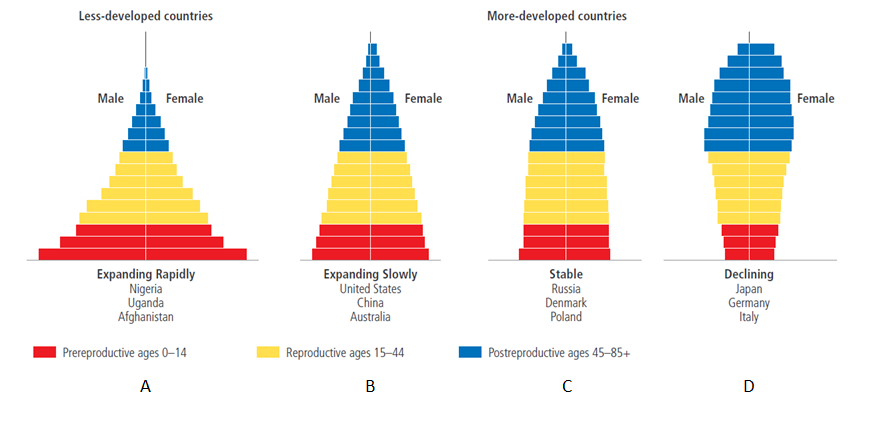
Figure 6.7
Figure 6.7
Correct Answer: Verified
Premises:
Responses:
(Matching)
4.7/5 (69)
(69) The demographic transition model helps to explain why ____.
(Multiple Choice)
4.7/5 (86)
(86) Explain this statement: The world's population growth has slowed, but the world's population is still growing. Include a comment about where the slowing has occurred.
(Essay)
5.0/5 (75)
(75) 
Filters
- Essay(0)
- Multiple Choice(0)
- Short Answer(0)
- True False(0)
- Matching(0)