



 Chat with AI
Exam 2: Scarcity, Trade-Offs, and Production Possibilities

Exam 1: The Role and Method of Economics288 Questions
Exam 2: Scarcity, Trade-Offs, and Production Possibilities166 Questions
Exam 3: Supply and Demand122 Questions
Exam 4: Bringing Supply and Demand Together150 Questions
Exam 5: Elasticity116 Questions
Exam 6: Market Efficiency and Market Failure151 Questions
Exam 7: Production and Costs159 Questions
Exam 8: Perfect Competition155 Questions
Exam 9: Monopoly155 Questions
Exam 10: Monopolistic Competition and Oligopoly99 Questions
Exam 11: Labour Markets and the Distribution of Income188 Questions
Exam 12: The Environment49 Questions
Select questions type


What is assumed when an economy's production possibilities curve for a year is drawn?
(Multiple Choice)
4.8/5  (82)
(82) Which of the following is NOT a question that scarcity forces all societies to answer?
(Multiple Choice)
4.8/5 (85)
(85) Ming-Na must write a political science term paper and prepare for an economics exam. The production possibilities curve between political science and economics preparation is a straight line. As time spent studying economics increases, what is the effect on the opportunity cost of studying for economics?
(Multiple Choice)
4.8/5 (79)
(79) Which of the following will shift a production possibilities curve outward?
(Multiple Choice)
5.0/5 (79)
(79) An economy that has many unemployed workers and idle factories is not operating efficiently.
(True/False)
4.8/5 (91)
(91) FIGURE 2-3
 -Refer to Figure 2-3. Comparatively, at which point is the opportunity cost of one more unit of a consumption good greater?
 (Multiple Choice)
4.8/5 (63)
(63) Which of the following distinguishes a "straight-line" production possibilities curve from one that is "bowed out"?
(Multiple Choice)
4.9/5 (77)
(77) What does a linear (straight line) production possibilities curve illustrate?
(Multiple Choice)
4.9/5 (73)
(73) Which of the following is NOT a resource exchanged in the factor markets?
(Multiple Choice)
4.9/5 (70)
(70) A decrease in the unemployment rate will shift an economy's production possibilities curve outward.
(True/False)
4.8/5 (91)
(91) FIGURE 2-8
 -Refer to Figure 2-8. In order to move from Point D to Point C, what will the economy have to give up?
 (Multiple Choice)
4.8/5 (96)
(96) FIGURE 2-9
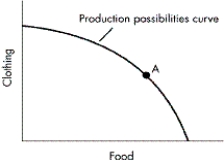 -Refer to Figure 2-9. If Points A and B indicate consumption and investment for two different economies, other things held constant, which of the following statements about the growth of the economies is most accurate?
 (Multiple Choice)
4.8/5 (73)
(73) Along a straight-line production possibilities curve, which of the following best describes the opportunity costs of producing the good on the X-axis?
(Multiple Choice)
4.9/5 (83)
(83) FIGURE 2-8
-Refer to Figure 2-8. In order for the economy to move from Point B to Point E at a given point in time, what would it have to do?
-Refer to Figure 2-8. In order for the economy to move from Point B to Point E at a given point in time, what would it have to do? (Multiple Choice)
4.9/5 (83)
(83) How can we measure the opportunity cost of producing a good? Using a bowed outward production possibilities curve between ice cream and hammers, identify graphically the opportunity cost of obtaining an additional hammer.
(Essay)
4.8/5 (93)
(93) When more resources in an economy are devoted to the production of capital goods, what happens to the production possibilities curve?
(Multiple Choice)
4.9/5 (82)
(82) In the simple circular flow model of the economy, total expenditures on goods and services equal total household income.
(True/False)
4.9/5 (78)
(78) An increase in an economy's capital stock increases its future productive capacity.
(True/False)
5.0/5 (72)
(72) FIGURE 2-1
 -Refer to Figure 2-1. What does the arrow from the product markets to the firms represent?
 (Multiple Choice)
4.8/5 (80)
(80) 
Filters
- Essay(0)
- Multiple Choice(0)
- Short Answer(0)
- True False(0)
- Matching(0)