



 Chat with AI
Exam 2: Scarcity, Trade-Offs, and Production Possibilities

Exam 1: The Role and Method of Economics288 Questions
Exam 2: Scarcity, Trade-Offs, and Production Possibilities166 Questions
Exam 3: Supply and Demand122 Questions
Exam 4: Bringing Supply and Demand Together150 Questions
Exam 5: Elasticity116 Questions
Exam 6: Market Efficiency and Market Failure151 Questions
Exam 7: Production and Costs159 Questions
Exam 8: Perfect Competition155 Questions
Exam 9: Monopoly155 Questions
Exam 10: Monopolistic Competition and Oligopoly99 Questions
Exam 11: Labour Markets and the Distribution of Income188 Questions
Exam 12: The Environment49 Questions
Select questions type


FIGURE 2-1
 -Refer to Figure 2-1. Which of the followings statements about payments for goods and services is the most accurate?
 (Multiple Choice)
4.8/5  (90)
(90) FIGURE 2-3
 -Refer to Figure 2-3. At which point is it currently not possible to produce?
 (Multiple Choice)
4.9/5 (72)
(72) The opportunity cost of a particular good tends to increase with its rate of output because some resources cannot be easily adapted from the production of one good or service to another.
(True/False)
4.8/5 (84)
(84) FIGURE 2-6
 -Refer to Figure 2-6. The diagram represents a trade-off in an economy between prison cells and classrooms. Which position represents the choice to allocate the greatest amount of resources to producing classrooms?
 (Multiple Choice)
4.8/5 (81)
(81) Which one of the following will NOT cause the production possibilities curve to shift outward?
(Multiple Choice)
4.7/5 (77)
(77) Which of the following will shift the production possibilities curve outward?
(Multiple Choice)
4.9/5 (89)
(89) FIGURE 2-14
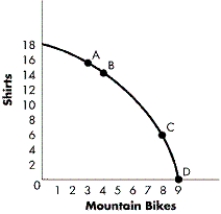 -Refer to the figure. Why is the opportunity cost of producing a mountain bike different when moving from Point A to Point B than when moving from Point C to Point D along the production possibilities curve?
 (Essay)
5.0/5 (80)
(80) How does the fact that resources are not equally substitutable across uses affect the production possibilities curve?
(Multiple Choice)
4.8/5 (69)
(69) There are four factors of production: land, labour, capital, and entrepreneurship.
(True/False)
4.8/5 (68)
(68) Natural gas prices in Halifax, Nova Scotia, decrease because new wells are brought into production. At the same time, local oil prices rise because of increased shipping costs. As a result, what might you expect to find in the Halifax industrial sector?
(Multiple Choice)
4.7/5 (79)
(79) What is the main reason economists are concerned about the problem of idle or unemployed resources?
(Multiple Choice)
4.8/5 (89)
(89) The production possibilities curve for an economy that experiences a constant opportunity cost of production is linear (a straight line).
(True/False)
5.0/5 (78)
(78) Which of the following statements about the production possibilities curve is the most accurate?
(Multiple Choice)
4.8/5 (87)
(87) A devastating earthquake destroys 10 percent of the population in Vancouver. What is the result?
(Multiple Choice)
4.9/5 (85)
(85) How is a technological advance that increases the productivity of all inputs best illustrated?
(Multiple Choice)
4.8/5 (96)
(96) Individuals who live outside of urban areas continue to build their houses and businesses further and further out, spreading into farming communities and uninhabited areas. What are the trade-offs involved in allowing this type of community expansion?
(Essay)
4.8/5 (69)
(69) In a market economy, government officials make most production decisions in a centralized manner.
(True/False)
4.8/5 (72)
(72) Which one of the following will cause the production possibilities curve to shift outward?
(Multiple Choice)
4.7/5 (93)
(93) 
Filters
- Essay(0)
- Multiple Choice(0)
- Short Answer(0)
- True False(0)
- Matching(0)