



 Chat with AI
Exam 9: Monopoly

Exam 1: The Role and Method of Economics288 Questions
Exam 2: Scarcity, Trade-Offs, and Production Possibilities166 Questions
Exam 3: Supply and Demand122 Questions
Exam 4: Bringing Supply and Demand Together150 Questions
Exam 5: Elasticity116 Questions
Exam 6: Market Efficiency and Market Failure151 Questions
Exam 7: Production and Costs159 Questions
Exam 8: Perfect Competition155 Questions
Exam 9: Monopoly155 Questions
Exam 10: Monopolistic Competition and Oligopoly99 Questions
Exam 11: Labour Markets and the Distribution of Income188 Questions
Exam 12: The Environment49 Questions
Select questions type


What does successful price discrimination have a negative effect on?

Free
(Multiple Choice)
4.8/5  (75)
(75) Correct Answer: Verified
A
Where does a profit-maximizing monopolist operate?
Free
(Multiple Choice)
4.9/5 (72)
(72) Correct Answer:Verified
VerifiedA
When would a monopolist shut down in the short run?
Free
(Multiple Choice)
4.8/5 (73)
(73) Correct Answer:Verified
VerifiedB
FIGURE 9-4
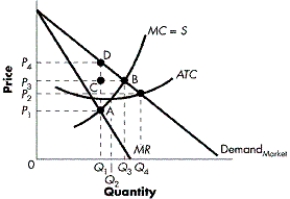 -Refer to Figure 9-4. What price would a monopolist charge when maximizing profits?
 (Multiple Choice)
4.8/5 (67)
(67) If marginal revenue on the tenth unit of output equals $4 for a non-discriminating, profit-maximizing monopolist, then what is the price?
(Multiple Choice)
4.9/5 (84)
(84) The demand curve faced by a monopolist is the same as the marginal revenue curve.
(True/False)
4.9/5 (73)
(73) A natural gas monopoly currently sells 100 gigajoules of natural gas at $11.00 per gigajoule. To sell one more gigajoule, the natural gas company must lower the price of natural gas to $10.90. Which of the following best describes the marginal revenue of the 101st gigajoule of natural gas?
(Multiple Choice)
4.9/5 (64)
(64) Which of the following is a major difference between a monopolist and firms in perfectly competitive markets?
(Multiple Choice)
4.9/5 (74)
(74) What does average cost regulation of a natural monopoly NOT involve?
(Multiple Choice)
4.9/5 (79)
(79) A natural monopolist will voluntarily choose to produce at the point of allocative efficiency.
(True/False)
5.0/5 (77)
(77) Under what circumstances will a price-discriminating monopolist tend to charge a lower price to students?
(Multiple Choice)
4.8/5 (85)
(85) The following diagram contains information on cost and revenue curves facing a regulated monopoly.
FIGURE 9-3
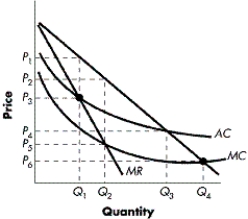 -Refer to Figure 9-3. If the government is able to regulate the monopolist using average-cost pricing, what price and output combinations are expected to result?
 (Multiple Choice)
5.0/5 (85)
(85) Which of the following firms does NOT practice price discrimination?
(Multiple Choice)
4.8/5 (82)
(82) Monopoly firms, which are provided a subsidy equal to their losses and subject to marginal cost-pricing regulation, have little incentive to minimize costs.
(True/False)
4.9/5 (74)
(74) Figure 9-1
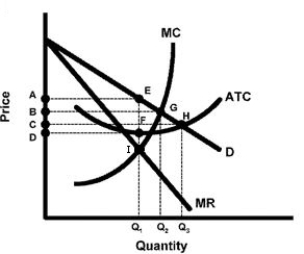 -Refer to Figure 9-1. What area indicates the welfare loss due to monopoly?
 (Multiple Choice)
4.8/5 (90)
(90) The following diagram contains information on cost and revenue curves facing a regulated monopoly.
FIGURE 9-3
-Refer to Figure 9-3. Which of the following price and output combinations would the monopoly prefer?
-Refer to Figure 9-3. Which of the following price and output combinations would the monopoly prefer? (Multiple Choice)
4.9/5 (69)
(69) What is the result when a monopolist is able to price-discriminate?
(Multiple Choice)
4.8/5 (83)
(83) When setting prices, on what basis may the monopolist choose to charge alternative customers different prices?
(Multiple Choice)
4.8/5 (84)
(84) TABLE 9-2
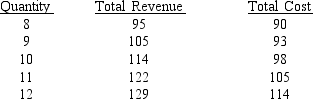 -Refer to Table 9-2. What is the profit-maximizing level of output?
 (Multiple Choice)
4.9/5 (82)
(82) 
Filters
- Essay(0)
- Multiple Choice(0)
- Short Answer(0)
- True False(0)
- Matching(0)