



 Chat with AI
Exam 12: The Environment

Exam 1: The Role and Method of Economics288 Questions
Exam 2: Scarcity, Trade-Offs, and Production Possibilities166 Questions
Exam 3: Supply and Demand122 Questions
Exam 4: Bringing Supply and Demand Together150 Questions
Exam 5: Elasticity116 Questions
Exam 6: Market Efficiency and Market Failure151 Questions
Exam 7: Production and Costs159 Questions
Exam 8: Perfect Competition155 Questions
Exam 9: Monopoly155 Questions
Exam 10: Monopolistic Competition and Oligopoly99 Questions
Exam 11: Labour Markets and the Distribution of Income188 Questions
Exam 12: The Environment49 Questions
Select questions type


Which of the following is more likely to result in better pollution reduction technologies?

Free
(Multiple Choice)
4.9/5  (87)
(87) Correct Answer: Verified
B
Which of the following is NOT one of the three objectives of a pollution control policy?
Free
(Multiple Choice)
4.9/5 (77)
(77) Correct Answer:Verified
VerifiedB
FIGURE 12-3
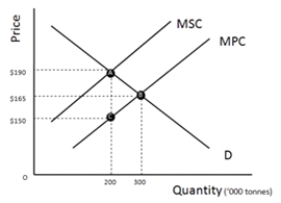 -Refer to Figure 12-3, which represents the market for pulp, the production of which creates dioxin emissions. Suppose the market is currently producing at the profit maximizing point and the government wishes to impose a tax to correct the overallocation of resources caused by the externality. What per unit tax would accomplish this goal?
Free
(Multiple Choice)
5.0/5 (79)
(79) Correct Answer:Verified
VerifiedC
FIGURE 12-2
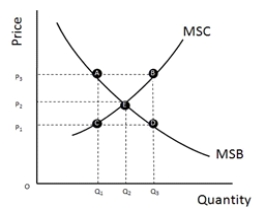 -Refer to Figure 12-2, which represents the costs and benefits of pollution control. What is the optimal amount of pollution control?
 (Multiple Choice)
4.8/5 (62)
(62) Which of the following is NOT an externality associated with the production of steel?
(Multiple Choice)
4.7/5 (74)
(74) FIGURE 12-1
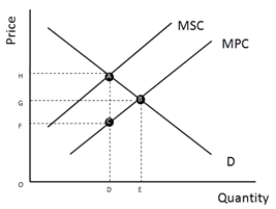 -Refer to Figure 12-1, which represents a hypothetical market for steel. What represents the socially optimal price and output combination?
 (Multiple Choice)
4.8/5 (74)
(74) In a cap and trade system, who has the most incentive to develop pollution abatement technologies?
(Multiple Choice)
4.8/5 (79)
(79) Suppose that your neighbour's dog barks every morning and wakes you up. The marginal benefit of the sleep that you lost is $100. Your neighbour's marginal benefit from owning the dog is $120. Suggest how a private transaction might make you both better off. What if the marginal benefit of your sleep was $120 and your neighbour's marginal benefit from owning the dog was $100.
(Essay)
4.7/5 (76)
(76) FIGURE 12-2
-Refer to Figure 12-2, which represents the costs and benefits of pollution control. What might overly stringent pollution-control legislation result in the marginal social benefit being equal to?
-Refer to Figure 12-2, which represents the costs and benefits of pollution control. What might overly stringent pollution-control legislation result in the marginal social benefit being equal to? (Multiple Choice)
4.8/5 (82)
(82) Why are negative externalities difficult to internalize in practice?
(Multiple Choice)
5.0/5 (76)
(76) An externality exists when an individual other than the demander receives part of the benefits.
(True/False)
4.8/5 (66)
(66) Your neighbour's dog barks and disturbs your sleep. According to the Coase theorem, in which of the following scenarios can you and your neighbour NOT come to a resolution?
(Multiple Choice)
4.8/5 (72)
(72) FIGURE 12-1
-Refer to Figure 12-1, which represents a hypothetical market for steel. To internalize the externality, what is the total amount that the firms have to pay society equal to?
-Refer to Figure 12-1, which represents a hypothetical market for steel. To internalize the externality, what is the total amount that the firms have to pay society equal to? (Multiple Choice)
4.8/5 (85)
(85) Since it is nearly impossible to measure negative externalities, it is better to ignore them and allow the market solution to continue.
(True/False)
4.9/5 (86)
(86) FIGURE 12-3
-Refer to Figure 12-3, which represents the market for pulp, the production of which creates dioxin emissions. What is the externality per tonne of pulp?
-Refer to Figure 12-3, which represents the market for pulp, the production of which creates dioxin emissions. What is the externality per tonne of pulp? (Multiple Choice)
4.7/5 (80)
(80) What is the most likely outcome when trying to eliminate pollution?
(Multiple Choice)
4.8/5 (78)
(78) FIGURE 12-2
-Refer to Figure 12-2, which represents the costs and benefits of pollution control. In the absence of pollution control legislation, at what point will firms spend on pollution-control measures?
-Refer to Figure 12-2, which represents the costs and benefits of pollution control. In the absence of pollution control legislation, at what point will firms spend on pollution-control measures? (Multiple Choice)
4.8/5 (80)
(80) Which of the following is an externality associated with owning a dog?
(Multiple Choice)
4.8/5 (85)
(85) FIGURE 12-1
-Refer to Figure 12-1, which represents a hypothetical market for steel. At the socially optimal output level, what are internal costs equal to?
-Refer to Figure 12-1, which represents a hypothetical market for steel. At the socially optimal output level, what are internal costs equal to? (Multiple Choice)
4.7/5 (83)
(83) 
Filters
- Essay(0)
- Multiple Choice(0)
- Short Answer(0)
- True False(0)
- Matching(0)