



 Chat with AI
Exam 13: Monopolistic Competition

Exam 1: Limits, Alternatives, and Choices107 Questions
Exam 2: The Market System and the Circular Flow287 Questions
Exam 3: Demand, Supply, and Market Equilibrium151 Questions
Exam 4: Market Failures Caused by Externalities Asymmetric Information229 Questions
Exam 5: Public Goods, Public Choice, and Government Failure268 Questions
Exam 6: Elasticity399 Questions
Exam 7: Utility Maximization358 Questions
Exam 8: Behavioral Economics311 Questions
Exam 9: Businesses and the Costs of Production445 Questions
Exam 10: Pure Competition in the Short Run342 Questions
Exam 11: Pure Competition in the Long Run250 Questions
Exam 12: Pure Monopoly407 Questions
Exam 13: Monopolistic Competition279 Questions
Exam 14: Oligopoly and Strategic Behavior362 Questions
Exam 15: Technology, RD, and Efficiency309 Questions
Exam 16: The Demand for Resources359 Questions
Exam 17: Wage Determination168 Questions
Exam 18: Rent, Interest, and Profit305 Questions
Exam 19: Natural Resource and Energy Economics337 Questions
Exam 20: Public Finance: Expenditures and Taxes336 Questions
Exam 21: Antitrust Policy and Regulation264 Questions
Exam 22: Agriculture: Economics and Policy265 Questions
Exam 23: Income Inequality, Poverty, and Discrimination324 Questions
Exam 24: Health Care280 Questions
Exam 25: Immigration259 Questions
Exam 26: International Trade347 Questions
Exam 27: The Balance of Payments, Exchange Rates, and Trade Deficits318 Questions
Exam 28: The Economics of Developing Countries277 Questions
Select questions type


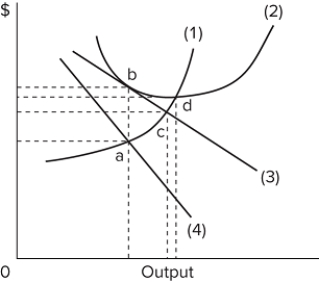 Refer to the above graph of the representative firm in monopolistic competition. Point b indicates
 (Multiple Choice)
5.0/5  (70)
(70) A monopolistically competitive firm's marginal revenue curve
(Multiple Choice)
4.9/5 (71)
(71) The goal of product differentiation and advertising in monopolistic competition is to make
(Multiple Choice)
4.9/5 (85)
(85) Answer the question based on the demand and cost schedules for a monopolistically competitive firm given in the table below. 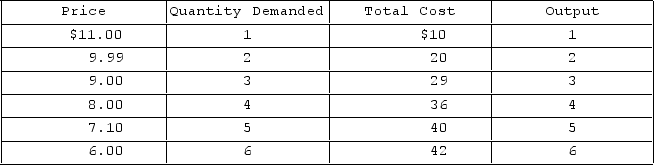 Suppose that entry into this industry changes this firm's demand schedule from columns (1)and (3)to columns (2)and (3). We can conclude that this industry is
 (Multiple Choice)
4.9/5 (79)
(79) Answer the question on the basis of the following demand and cost data for a specific firm. 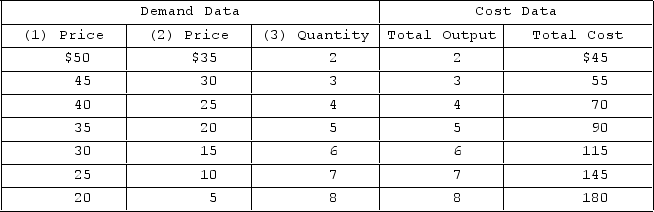 If columns 1 and 3 are this firm's demand schedule, the profit-maximizing level of output will be
 (Multiple Choice)
4.8/5 (72)
(72) Which of the following statements concerning a monopolistically competitive industry is correct?
(Multiple Choice)
4.9/5 (70)
(70) A significant benefit of monopolistic competition compared with pure competition is
(Multiple Choice)
4.7/5 (83)
(83) The graph depicts a monopolistically competitive firm. 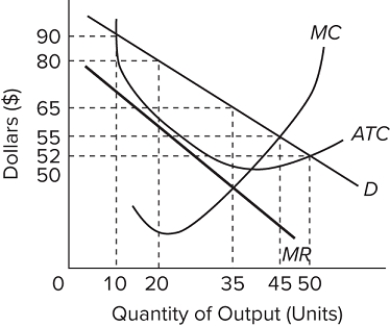 At the profit-maximizing level of short-run output, this monopolistically competitive firm will be making a profit of
 (Multiple Choice)
4.7/5 (77)
(77) When a monopolistically competitive firm is in long-run equilibrium,
(Multiple Choice)
4.9/5 (83)
(83) In monopolistic competition, if a firm advertises and effectively raises consumer awareness of its product, it tends to
(Multiple Choice)
4.9/5 (69)
(69) Discuss the phrase "variety is the spice of life" in reference to monopolistic competition.
(Essay)
4.9/5 (81)
(81) Monopolistically competitive firms are inefficient because they produce at a point on the rising segment of their average cost curves.
(True/False)
4.8/5 (88)
(88) 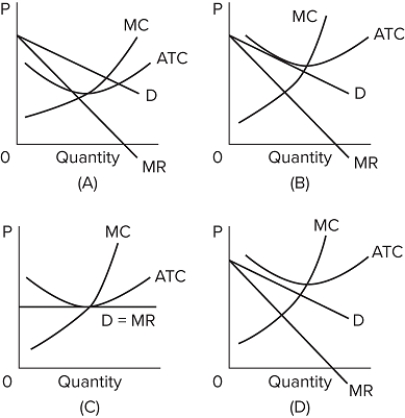 Refer to the above graphs. A short-run equilibrium that would result in losses for a monopolistically competitive firm would be represented by graph
 (Multiple Choice)
4.8/5 (89)
(89) 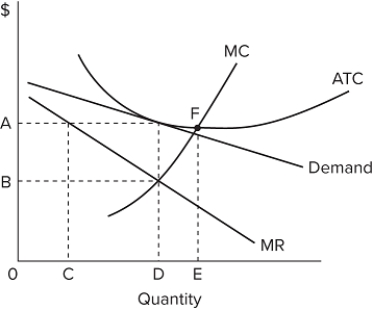 Refer to the diagram for a monopolistically competitive firm. Long-run equilibrium price will be
 (Multiple Choice)
4.9/5 (69)
(69) Answer the question on the basis of the following demand and cost data for a specific firm.  If columns 1 and 3 are this firm's demand schedule, the profit-maximizing level of output will be
 (Multiple Choice)
4.9/5 (78)
(78) The main point of the 1987 Wendy's commercial depicting a Soviet fashion show was to
(Multiple Choice)
4.9/5 (80)
(80) 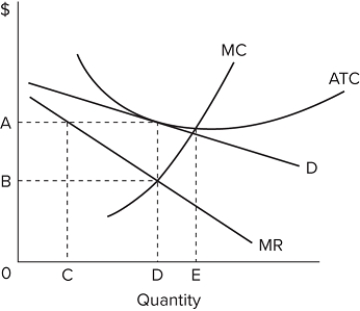 Refer to the diagram for a monopolistically competitive producer. If this firm were to realize productive efficiency, it would
 (Multiple Choice)
4.9/5 (68)
(68) The price elasticity of a monopolistically competitive firm's demand curve varies
(Multiple Choice)
4.9/5 (66)
(66) 
Filters
- Essay(0)
- Multiple Choice(0)
- Short Answer(0)
- True False(0)
- Matching(0)