



 Chat with AI
Exam 13: Monopolistic Competition

Exam 1: Limits, Alternatives, and Choices107 Questions
Exam 2: The Market System and the Circular Flow287 Questions
Exam 3: Demand, Supply, and Market Equilibrium151 Questions
Exam 4: Market Failures Caused by Externalities Asymmetric Information229 Questions
Exam 5: Public Goods, Public Choice, and Government Failure268 Questions
Exam 6: Elasticity399 Questions
Exam 7: Utility Maximization358 Questions
Exam 8: Behavioral Economics311 Questions
Exam 9: Businesses and the Costs of Production445 Questions
Exam 10: Pure Competition in the Short Run342 Questions
Exam 11: Pure Competition in the Long Run250 Questions
Exam 12: Pure Monopoly407 Questions
Exam 13: Monopolistic Competition279 Questions
Exam 14: Oligopoly and Strategic Behavior362 Questions
Exam 15: Technology, RD, and Efficiency309 Questions
Exam 16: The Demand for Resources359 Questions
Exam 17: Wage Determination168 Questions
Exam 18: Rent, Interest, and Profit305 Questions
Exam 19: Natural Resource and Energy Economics337 Questions
Exam 20: Public Finance: Expenditures and Taxes336 Questions
Exam 21: Antitrust Policy and Regulation264 Questions
Exam 22: Agriculture: Economics and Policy265 Questions
Exam 23: Income Inequality, Poverty, and Discrimination324 Questions
Exam 24: Health Care280 Questions
Exam 25: Immigration259 Questions
Exam 26: International Trade347 Questions
Exam 27: The Balance of Payments, Exchange Rates, and Trade Deficits318 Questions
Exam 28: The Economics of Developing Countries277 Questions
Select questions type


Which industry would be best characterized as monopolistically competitive?
(Multiple Choice)
4.9/5  (87)
(87) The four-firm concentration ratio cannot have a value above 1.0, or 100 percent.
(True/False)
4.8/5 (80)
(80) A monopolistically competitive firm is operating at a short-run level of output where price is $30, average total cost is $27, marginal cost is $20, and marginal revenue is $25. In the short run this firm should
(Multiple Choice)
4.8/5 (91)
(91) Suppose the Herfindahl indexes for industries A, B, and C are 1,200, 5,000, and 7,500 respectively. These data imply that
(Multiple Choice)
4.8/5 (60)
(60) Firms in an industry will not earn long-run economic profits if
(Multiple Choice)
4.9/5 (74)
(74) The market situation of a monopolistic competitor is made more complex than our simple revenue-and-costs graphs would suggest, because the firm in reality juggles three decisions:
(Multiple Choice)
4.8/5 (84)
(84) Monopolistic competition resembles pure competition because
(Multiple Choice)
4.9/5 (83)
(83) Answer the question based on the demand and cost schedules for a monopolistically competitive firm given in the table below. 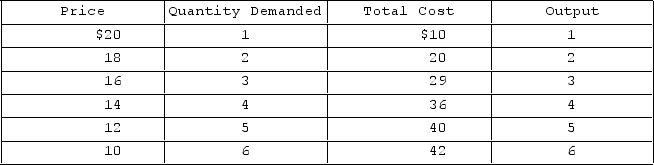 What price will this monopolistically competitive firm charge to maximize profits?
 (Multiple Choice)
4.9/5 (98)
(98) Answer the question on the basis of the following demand and cost data for a specific firm.  Suppose that entry into the industry changes this firm's demand schedule from columns (1)and (3)to columns (2)and (3). Economic profit will
 (Multiple Choice)
4.9/5 (70)
(70) Answer the question on the basis of the following demand and cost data for a specific firm.  If columns (1)and (3)of the demand data shown are this firm's demand schedule, economic profit will be
 (Multiple Choice)
4.9/5 (79)
(79) 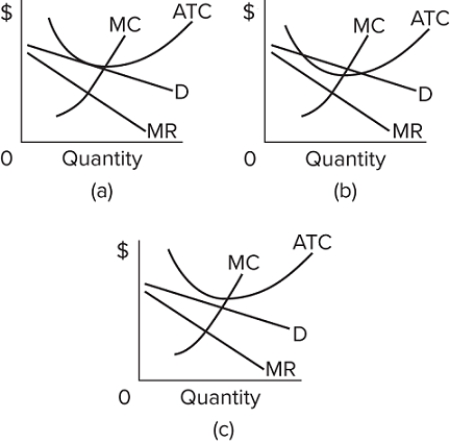 Refer to the diagrams, which pertain to monopolistically competitive firms. Long-run equilibrium is shown by
 (Multiple Choice)
4.9/5 (77)
(77) In the long run, the economic profits for a monopolistically competitive firm will be
(Multiple Choice)
4.8/5 (69)
(69) If you sum the squares of the market shares of each firm in an industry (as measured by percent of industry sales), you are calculating the
(Multiple Choice)
4.8/5 (72)
(72) Which of the following statements is not true for a monopolistically competitive industry?
(Multiple Choice)
4.8/5 (78)
(78) 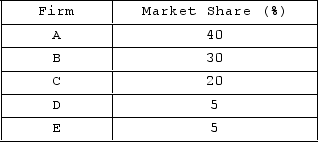 Refer to the data. The four-firm concentration ratio for this industry is
 (Multiple Choice)
4.9/5 (78)
(78) 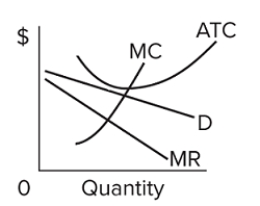 In short-run equilibrium, the monopolistically competitive firm shown will set its price
 (Multiple Choice)
4.8/5 (84)
(84) We would expect the four-firm concentration ratio of the restaurant industry in a large metropolitan area to be about 0.80, or 80 percent, and higher.
(True/False)
4.8/5 (70)
(70) 
Filters
- Essay(0)
- Multiple Choice(0)
- Short Answer(0)
- True False(0)
- Matching(0)