



 Chat with AI
Exam 13: Monopolistic Competition

Exam 1: Limits, Alternatives, and Choices107 Questions
Exam 2: The Market System and the Circular Flow287 Questions
Exam 3: Demand, Supply, and Market Equilibrium151 Questions
Exam 4: Market Failures Caused by Externalities Asymmetric Information229 Questions
Exam 5: Public Goods, Public Choice, and Government Failure268 Questions
Exam 6: Elasticity399 Questions
Exam 7: Utility Maximization358 Questions
Exam 8: Behavioral Economics311 Questions
Exam 9: Businesses and the Costs of Production445 Questions
Exam 10: Pure Competition in the Short Run342 Questions
Exam 11: Pure Competition in the Long Run250 Questions
Exam 12: Pure Monopoly407 Questions
Exam 13: Monopolistic Competition279 Questions
Exam 14: Oligopoly and Strategic Behavior362 Questions
Exam 15: Technology, RD, and Efficiency309 Questions
Exam 16: The Demand for Resources359 Questions
Exam 17: Wage Determination168 Questions
Exam 18: Rent, Interest, and Profit305 Questions
Exam 19: Natural Resource and Energy Economics337 Questions
Exam 20: Public Finance: Expenditures and Taxes336 Questions
Exam 21: Antitrust Policy and Regulation264 Questions
Exam 22: Agriculture: Economics and Policy265 Questions
Exam 23: Income Inequality, Poverty, and Discrimination324 Questions
Exam 24: Health Care280 Questions
Exam 25: Immigration259 Questions
Exam 26: International Trade347 Questions
Exam 27: The Balance of Payments, Exchange Rates, and Trade Deficits318 Questions
Exam 28: The Economics of Developing Countries277 Questions
Select questions type


Answer the question based on the demand and cost schedules for a monopolistically competitive firm given in the table below.  What will be the economic profit (or loss)for this monopolistically competitive firm at the profit-maximizing level of output?
 (Multiple Choice)
4.9/5  (85)
(85) If the four-firm concentration ratio in an oligopolistic industry is 100 percent and each firm has an equal percentage of sales, the Herfindahl index is
(Multiple Choice)
4.9/5 (85)
(85) 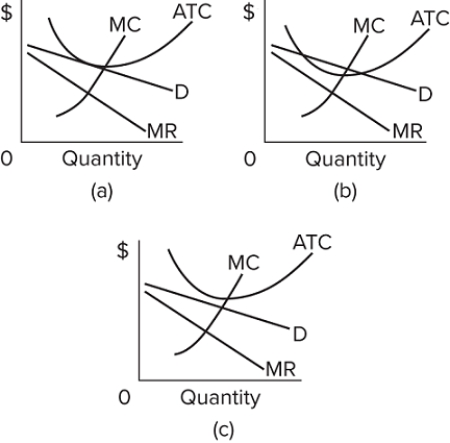 Refer to the diagrams, which pertain to monopolistically competitive firms. A short-run equilibrium entailing economic profits is shown by
 (Multiple Choice)
4.9/5 (80)
(80) Which is true of pure competition but not of monopolistic competition?
(Multiple Choice)
4.9/5 (81)
(81) Monopolistically competitive firms are similar to monopolies in that they have
(Multiple Choice)
4.8/5 (65)
(65) Why do monopolistically competitive firms spend funds for product differentiation and advertising when this practice only adds to the firm's costs?
(Essay)
4.8/5 (60)
(60) The following are the respective numbers for the four-firm concentration ratio and Herfindahl index in an industry. Which set of numbers is most suggestive that the industry is monopolistically competitive?
(Multiple Choice)
4.8/5 (68)
(68) 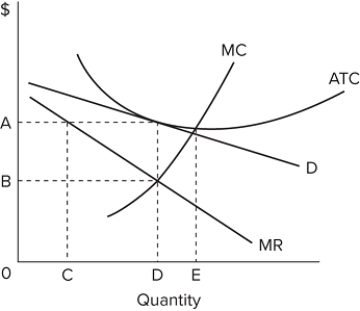 Refer to the diagram for a monopolistically competitive producer. This firm is experiencing
 (Multiple Choice)
4.9/5 (89)
(89) Answer the question on the basis of the following demand and cost data for a specific firm.  With the demand schedule shown by columns (2)and (3), in long-run equilibrium
 (Multiple Choice)
4.9/5 (68)
(68) A monopolistically competitive industry is like a purely competitive industry in that
(Multiple Choice)
4.9/5 (78)
(78) Answer the question on the basis of the following demand and cost data for a specific firm.  If columns 1 and 3 are this firm's demand schedule, maximum economic profit will be
 (Multiple Choice)
4.8/5 (77)
(77) Monopolistically competitive sellers realize economic profits in the long run because entry barriers are significant.
(True/False)
4.9/5 (94)
(94) The economic profits earned by monopolistically competitive sellers are zero in the long run.
(True/False)
4.7/5 (77)
(77) Monopolistic competition is characterized by excess capacity because
(Multiple Choice)
4.9/5 (82)
(82) Economic analysis of a monopolistically competitive industry is more complicated than that of pure competition because
(Multiple Choice)
4.8/5 (80)
(80) 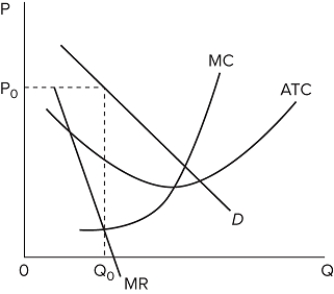 Refer to the above graph for a representative firm in monopolistic competition in a constant-cost industry. This firm is
 (Multiple Choice)
4.9/5 (92)
(92) Monopolistic competitive firms are productively inefficient because production occurs where
(Multiple Choice)
4.9/5 (67)
(67) The monopolistically competitive seller maximizes profits by equating price and marginal cost.
(True/False)
4.9/5 (73)
(73) If the number of firms in a monopolistically competitive industry increases and the degree of product differentiation diminishes,
(Multiple Choice)
4.9/5 (88)
(88) 
Filters
- Essay(0)
- Multiple Choice(0)
- Short Answer(0)
- True False(0)
- Matching(0)