



 Chat with AI
Exam 13: Monopolistic Competition

Exam 1: Limits, Alternatives, and Choices107 Questions
Exam 2: The Market System and the Circular Flow287 Questions
Exam 3: Demand, Supply, and Market Equilibrium151 Questions
Exam 4: Market Failures Caused by Externalities Asymmetric Information229 Questions
Exam 5: Public Goods, Public Choice, and Government Failure268 Questions
Exam 6: Elasticity399 Questions
Exam 7: Utility Maximization358 Questions
Exam 8: Behavioral Economics311 Questions
Exam 9: Businesses and the Costs of Production445 Questions
Exam 10: Pure Competition in the Short Run342 Questions
Exam 11: Pure Competition in the Long Run250 Questions
Exam 12: Pure Monopoly407 Questions
Exam 13: Monopolistic Competition279 Questions
Exam 14: Oligopoly and Strategic Behavior362 Questions
Exam 15: Technology, RD, and Efficiency309 Questions
Exam 16: The Demand for Resources359 Questions
Exam 17: Wage Determination168 Questions
Exam 18: Rent, Interest, and Profit305 Questions
Exam 19: Natural Resource and Energy Economics337 Questions
Exam 20: Public Finance: Expenditures and Taxes336 Questions
Exam 21: Antitrust Policy and Regulation264 Questions
Exam 22: Agriculture: Economics and Policy265 Questions
Exam 23: Income Inequality, Poverty, and Discrimination324 Questions
Exam 24: Health Care280 Questions
Exam 25: Immigration259 Questions
Exam 26: International Trade347 Questions
Exam 27: The Balance of Payments, Exchange Rates, and Trade Deficits318 Questions
Exam 28: The Economics of Developing Countries277 Questions
Select questions type


A monopolistically competitive industry combines elements of both competition and monopoly. The competition element results from
(Multiple Choice)
4.9/5  (86)
(86) An important similarity between a monopolistically competitive firm and a pure monopolist is that both
(Multiple Choice)
4.7/5 (81)
(81) Answer the question on the basis of the following demand and cost data for a specific firm. 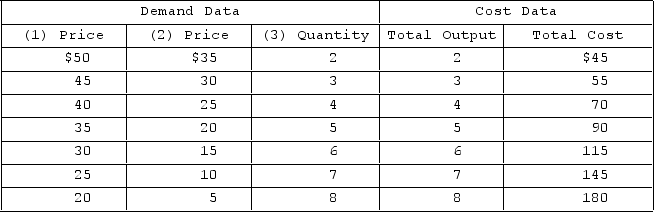 Suppose that entry of firms into the industry changes this firm's demand schedule from columns 1 and 3 to columns 2 and 3. Maximum economic profit will
 (Multiple Choice)
4.9/5 (84)
(84) The demand curve faced by a monopolistically competitive firm is more elastic than the monopolist's demand curve.
(True/False)
4.8/5 (67)
(67) The demand curve of a monopolistically competitive producer is less elastic than that of a purely competitive producer.
(True/False)
4.8/5 (74)
(74) In the long run, the price charged by a monopolistically competitive firm seeking to maximize profit will
(Multiple Choice)
4.9/5 (83)
(83) 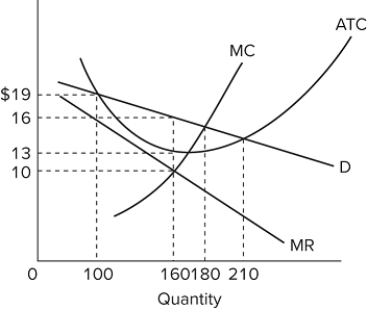 Refer to the diagram for a monopolistically competitive firm in short-run equilibrium. This firm will realize an economic
 (Multiple Choice)
4.9/5 (85)
(85) Explain why monopolistically competitive firms have excess capacity.
(Essay)
4.8/5 (77)
(77) Industries X and Y both have four-firm concentration ratios of 32 percent, but the Herfindahl index for X is 256, while that for Y is 264. These data suggest
(Multiple Choice)
4.9/5 (82)
(82) In the long-run equilibrium of a monopolistically competitive industry,
(Multiple Choice)
4.8/5 (73)
(73) 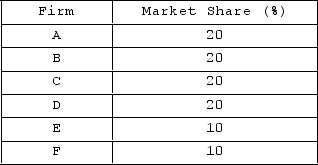 Refer to the data. The Herfindahl index for the industry is
 (Multiple Choice)
4.9/5 (70)
(70) Which of the following is a measure of the degree of industry concentration?
(Multiple Choice)
4.9/5 (84)
(84) Monopolistic competition provides the benefit of product variety but at the cost of productive inefficiency.
(True/False)
4.7/5 (75)
(75) If the representative firm in a monopolistically competitive industry has an optimal output where P < ATC, the industry will expand in the long run.
(True/False)
4.9/5 (94)
(94) At long-run equilibrium in monopolistic competition, there is
(Multiple Choice)
5.0/5 (81)
(81) Answer the question on the basis of the following short run demand and cost data for a specific firm. 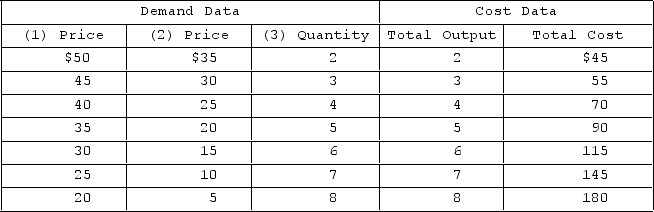 In the long run, the number of firms in this monopolistic competitive industry will most likely
 (Multiple Choice)
4.7/5 (86)
(86) 
Filters
- Essay(0)
- Multiple Choice(0)
- Short Answer(0)
- True False(0)
- Matching(0)