



 Chat with AI
Exam 13: Monopolistic Competition

Exam 1: Limits, Alternatives, and Choices107 Questions
Exam 2: The Market System and the Circular Flow287 Questions
Exam 3: Demand, Supply, and Market Equilibrium151 Questions
Exam 4: Market Failures Caused by Externalities Asymmetric Information229 Questions
Exam 5: Public Goods, Public Choice, and Government Failure268 Questions
Exam 6: Elasticity399 Questions
Exam 7: Utility Maximization358 Questions
Exam 8: Behavioral Economics311 Questions
Exam 9: Businesses and the Costs of Production445 Questions
Exam 10: Pure Competition in the Short Run342 Questions
Exam 11: Pure Competition in the Long Run250 Questions
Exam 12: Pure Monopoly407 Questions
Exam 13: Monopolistic Competition279 Questions
Exam 14: Oligopoly and Strategic Behavior362 Questions
Exam 15: Technology, RD, and Efficiency309 Questions
Exam 16: The Demand for Resources359 Questions
Exam 17: Wage Determination168 Questions
Exam 18: Rent, Interest, and Profit305 Questions
Exam 19: Natural Resource and Energy Economics337 Questions
Exam 20: Public Finance: Expenditures and Taxes336 Questions
Exam 21: Antitrust Policy and Regulation264 Questions
Exam 22: Agriculture: Economics and Policy265 Questions
Exam 23: Income Inequality, Poverty, and Discrimination324 Questions
Exam 24: Health Care280 Questions
Exam 25: Immigration259 Questions
Exam 26: International Trade347 Questions
Exam 27: The Balance of Payments, Exchange Rates, and Trade Deficits318 Questions
Exam 28: The Economics of Developing Countries277 Questions
Select questions type


The graph depicts a monopolistically competitive firm. 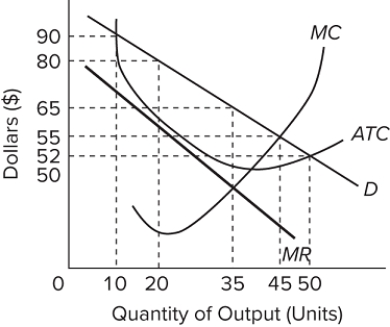 This monopolistically competitive firm is earning economic profits in the short run and
 (Multiple Choice)
4.8/5  (77)
(77) Which statement concerning monopolistic competition is false?
(Multiple Choice)
4.8/5 (83)
(83) Assume that the short-run cost and demand data given in the tables below confront a monopolistic competitor selling a given product and engaged in a given amount of product promotion. 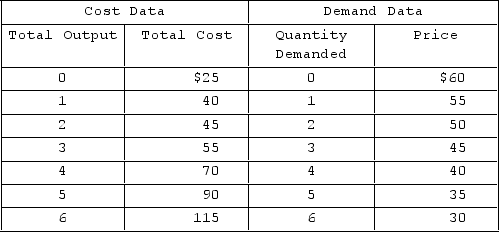 What will the maximum total profits be?
 (Multiple Choice)
4.7/5 (82)
(82) 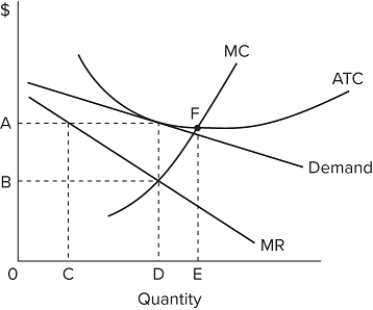 Refer to the diagram for a monopolistically competitive firm. Long-run equilibrium output will be
 (Multiple Choice)
5.0/5 (76)
(76) In the long run, a representative firm in a monopolistically competitive industry will end up
(Multiple Choice)
4.7/5 (90)
(90) 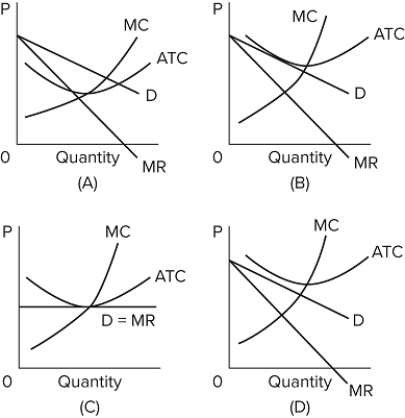 Refer to the above graphs. The long-run equilibrium for a monopolistically competitive firm is represented by graph
 (Multiple Choice)
4.9/5 (74)
(74) The demand curve of a monopolistically competitive producer is
(Multiple Choice)
4.7/5 (83)
(83) That one thing that monopolistic competition provides, which is not assured in the other market structures, is product variety.
(True/False)
4.7/5 (69)
(69)  Refer to the data. The four-firm concentration ratio for this industry is
 (Multiple Choice)
4.9/5 (80)
(80) Suppose that total sales in an industry in a particular year are $800 million and sales by the top four sellers are $50 million, $40 million, $30 million, and $30 million, respectively. We can conclude that
(Multiple Choice)
4.9/5 (84)
(84) Assume that the short-run cost and demand data given in the tables below confront a monopolistic competitor selling a given product and engaged in a given amount of product promotion. 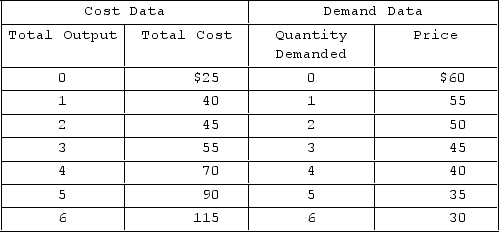 What output and price levels will maximize the firm's profit in the short run?
 (Multiple Choice)
4.8/5 (86)
(86) In which industry is monopolistic competition most likely to be found?
(Multiple Choice)
4.9/5 (75)
(75) Monopolistically competitive and purely competitive industries are similar in that
(Multiple Choice)
4.8/5 (71)
(71) Which of the following characteristics provide a monopolistically competitive firm some monopoly power?
(Multiple Choice)
4.8/5 (74)
(74) As new firms enter a monopolistically competitive market, the demand curves facing existing firms will tend to shift left.
(True/False)
4.7/5 (67)
(67) What are four-firm concentration ratios? How do economists use them to define monopolistically competitive industries?
(Essay)
4.8/5 (79)
(79) 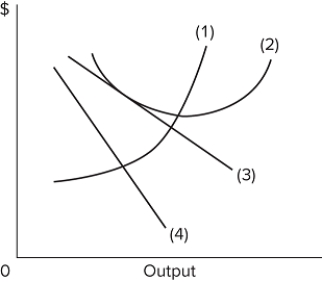 Refer to the above graph of a representative firm in monopolistic competition. If curve (2)represents ATC and line (3)represents demand, then we can conclude that the industry
 (Multiple Choice)
4.8/5 (81)
(81) Which of the following forces does not play a major part in the adjustments of a monopolistically competitive industry toward its long-run equilibrium?
(Multiple Choice)
5.0/5 (90)
(90) 
Filters
- Essay(0)
- Multiple Choice(0)
- Short Answer(0)
- True False(0)
- Matching(0)