



 Chat with AI
Exam 15: Technology, RD, and Efficiency

Exam 1: Limits, Alternatives, and Choices107 Questions
Exam 2: The Market System and the Circular Flow287 Questions
Exam 3: Demand, Supply, and Market Equilibrium151 Questions
Exam 4: Market Failures Caused by Externalities Asymmetric Information229 Questions
Exam 5: Public Goods, Public Choice, and Government Failure268 Questions
Exam 6: Elasticity399 Questions
Exam 7: Utility Maximization358 Questions
Exam 8: Behavioral Economics311 Questions
Exam 9: Businesses and the Costs of Production445 Questions
Exam 10: Pure Competition in the Short Run342 Questions
Exam 11: Pure Competition in the Long Run250 Questions
Exam 12: Pure Monopoly407 Questions
Exam 13: Monopolistic Competition279 Questions
Exam 14: Oligopoly and Strategic Behavior362 Questions
Exam 15: Technology, RD, and Efficiency309 Questions
Exam 16: The Demand for Resources359 Questions
Exam 17: Wage Determination168 Questions
Exam 18: Rent, Interest, and Profit305 Questions
Exam 19: Natural Resource and Energy Economics337 Questions
Exam 20: Public Finance: Expenditures and Taxes336 Questions
Exam 21: Antitrust Policy and Regulation264 Questions
Exam 22: Agriculture: Economics and Policy265 Questions
Exam 23: Income Inequality, Poverty, and Discrimination324 Questions
Exam 24: Health Care280 Questions
Exam 25: Immigration259 Questions
Exam 26: International Trade347 Questions
Exam 27: The Balance of Payments, Exchange Rates, and Trade Deficits318 Questions
Exam 28: The Economics of Developing Countries277 Questions
Select questions type


The first working prototype of a microcomputer chip would be an example of an
(Multiple Choice)
4.7/5  (77)
(77) 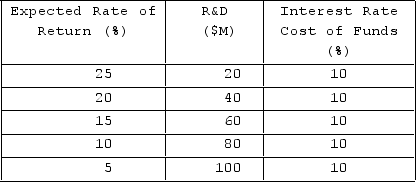 If we plotted the given data on a graph with R&D expenditures on the horizontal axis, the
 (Multiple Choice)
4.8/5 (82)
(82) Pure monopoly is the best market structure for encouraging R&D and innovation.
(True/False)
4.8/5 (83)
(83) Suppose a firm anticipates that an R&D expenditure of $200 million will result in a new production process that will reduce costs and thus create a one-time added profit of $220 million a year later. The firm's expected rate of return is
(Multiple Choice)
4.8/5 (79)
(79) Assume a firm faces these costs: total cost of capital = $4,000; price paid for labor = $20 per labor unit; and price paid for raw materials = $8 per raw-material unit. Originally the firm produced 2,000 units of output by combining its fixed capital with 200 units of labor and 500 units of raw materials. Now the firm changes its production process so that it can produce 3,000 units of output by combining its fixed capital with 100 units of labor and 500 units of raw materials. What valid conclusion can be drawn about the effect and reasons for the change?
(Multiple Choice)
4.8/5 (83)
(83) A firm's optimal amount of R&D occurs where the marginal benefit of this activity exceeds marginal cost by the greatest amount.
(True/False)
4.9/5 (75)
(75) Assume a firm faces these costs: total cost of capital = $4,000; price paid for labor = $20 per labor unit; and price paid for raw materials = $8 per raw-material unit. The firm improves its production process so that it can produce 3,000 units of output by combining its fixed capital with 100 units of labor and 500 units of raw materials. What are the total cost and average cost of producing the 3,000 units of output?
(Multiple Choice)
4.8/5 (65)
(65) The worldwide duration of patents that begins at the time of application is
(Multiple Choice)
5.0/5 (69)
(69) 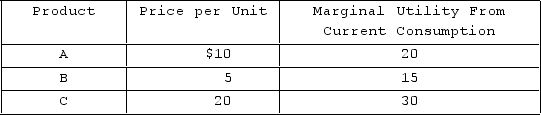 The table shows the marginal utilities derived from current consumption levels of three new products, A, B, and C, that are being sold in the market at the prices listed. The consumer can immediately gain the most extra total utility by switching spending from
 (Multiple Choice)
4.9/5 (91)
(91) A firm decides to make a $20 million expenditure on research and development that will create a new product. This product is expected to generate a one-time increase in the firm's revenues by a total of $40 million a year later. The firm also estimates that the production cost of the new product will be $18 million, also realized one year after the initial R&D expenditure. What is the expected rate of return on this research and development expenditure?
(Multiple Choice)
4.7/5 (67)
(67) 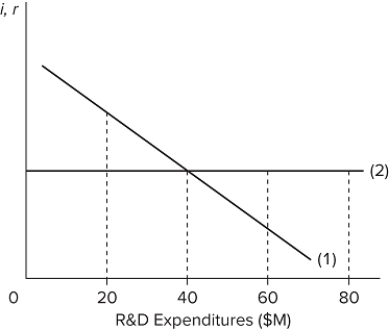 In the diagram, the optimal amount of R&D is
What activity traditionally receives the largest share of total business spending on R&D in the U.S.?
(Multiple Choice)
4.8/5 (76)
(76) Most product innovations consist of minor changes to existing products and are incremental improvements.
(True/False)
4.8/5 (61)
(61)  Refer to the data for a consumer whose income = $8. Suppose the price of new product Z is $2 rather than $1. This consumer would purchase
 (Multiple Choice)
4.8/5 (69)
(69) 
Filters
- Essay(0)
- Multiple Choice(0)
- Short Answer(0)
- True False(0)
- Matching(0)