



 Chat with AI
Exam 15: Technology, RD, and Efficiency

Exam 1: Limits, Alternatives, and Choices107 Questions
Exam 2: The Market System and the Circular Flow287 Questions
Exam 3: Demand, Supply, and Market Equilibrium151 Questions
Exam 4: Market Failures Caused by Externalities Asymmetric Information229 Questions
Exam 5: Public Goods, Public Choice, and Government Failure268 Questions
Exam 6: Elasticity399 Questions
Exam 7: Utility Maximization358 Questions
Exam 8: Behavioral Economics311 Questions
Exam 9: Businesses and the Costs of Production445 Questions
Exam 10: Pure Competition in the Short Run342 Questions
Exam 11: Pure Competition in the Long Run250 Questions
Exam 12: Pure Monopoly407 Questions
Exam 13: Monopolistic Competition279 Questions
Exam 14: Oligopoly and Strategic Behavior362 Questions
Exam 15: Technology, RD, and Efficiency309 Questions
Exam 16: The Demand for Resources359 Questions
Exam 17: Wage Determination168 Questions
Exam 18: Rent, Interest, and Profit305 Questions
Exam 19: Natural Resource and Energy Economics337 Questions
Exam 20: Public Finance: Expenditures and Taxes336 Questions
Exam 21: Antitrust Policy and Regulation264 Questions
Exam 22: Agriculture: Economics and Policy265 Questions
Exam 23: Income Inequality, Poverty, and Discrimination324 Questions
Exam 24: Health Care280 Questions
Exam 25: Immigration259 Questions
Exam 26: International Trade347 Questions
Exam 27: The Balance of Payments, Exchange Rates, and Trade Deficits318 Questions
Exam 28: The Economics of Developing Countries277 Questions
Select questions type


Which of the following supports the contention that pure competitors have a weak incentive to engage in R&D?
(Multiple Choice)
4.9/5  (79)
(79) The marginal cost to a firm of R&D expenditures is the market interest rate the firm must pay to obtain the needed financing.
(True/False)
4.9/5 (96)
(96) When economists view technological change as internal to the economy, they mean that it
(Multiple Choice)
4.8/5 (77)
(77) An amount of R&D spending that is less than the optimal amount indicates that the
(Multiple Choice)
4.9/5 (69)
(69) One of the outcomes for society from product innovation is
(Multiple Choice)
4.8/5 (72)
(72) Process innovation leads to technological advance because it
(Multiple Choice)
5.0/5 (82)
(82) Which of the following supports the contention that pure competitors have a strong incentive to engage in R&D?
(Multiple Choice)
5.0/5 (75)
(75) As it relates to R&D, a firm's expected-rate-of-return-curve, r,
(Multiple Choice)
4.8/5 (84)
(84) In the music industry, cassette tapes were replaced by compact discs, which in turn were replaced by the iPod and MP3 technology. This process would be an example of
(Multiple Choice)
4.9/5 (89)
(89) R&D spending decisions by firms are complicated because they involve having to compare present expenditures against future expected gains.
(True/False)
4.9/5 (74)
(74) The expected-rate-of-return curve for R&D expenditures of a firm slopes downward because of
(Multiple Choice)
4.8/5 (79)
(79) The major impact of product innovation tends to be on the firms' revenues, while that of process innovation tends to be on costs.
(True/False)
4.9/5 (81)
(81) Which of the following are aptly considered entrepreneurs?
(Multiple Choice)
4.9/5 (84)
(84) The first discovery (as distinct from first commercial application)of a product or process is called
(Multiple Choice)
4.9/5 (71)
(71) A consumer had been consuming product X for some time. This period, she buys fewer X in order to try some units of a new product Y. She finds that her marginal utility of X is 20 (at a price of $10 per unit), while the marginal utility of Y is 36 (at a price of $12). The utility-maximizing rule suggests that this consumer should
(Multiple Choice)
4.9/5 (81)
(81) 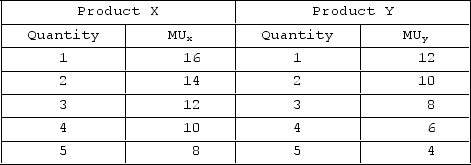 The table shows the marginal utility schedules for old product X and new product Y for a hypothetical consumer. The price of X is $2, and the price of good Y is $1. The budget of the consumer is $10. What is the increase in total utility from the original situation when purchasing just X, compared to now when the consumer purchases the utility-maximizing combination of both X and Y?
 (Multiple Choice)
4.9/5 (88)
(88) 
Filters
- Essay(0)
- Multiple Choice(0)
- Short Answer(0)
- True False(0)
- Matching(0)