



 Chat with AI
Exam 15: Technology, RD, and Efficiency

Exam 1: Limits, Alternatives, and Choices107 Questions
Exam 2: The Market System and the Circular Flow287 Questions
Exam 3: Demand, Supply, and Market Equilibrium151 Questions
Exam 4: Market Failures Caused by Externalities Asymmetric Information229 Questions
Exam 5: Public Goods, Public Choice, and Government Failure268 Questions
Exam 6: Elasticity399 Questions
Exam 7: Utility Maximization358 Questions
Exam 8: Behavioral Economics311 Questions
Exam 9: Businesses and the Costs of Production445 Questions
Exam 10: Pure Competition in the Short Run342 Questions
Exam 11: Pure Competition in the Long Run250 Questions
Exam 12: Pure Monopoly407 Questions
Exam 13: Monopolistic Competition279 Questions
Exam 14: Oligopoly and Strategic Behavior362 Questions
Exam 15: Technology, RD, and Efficiency309 Questions
Exam 16: The Demand for Resources359 Questions
Exam 17: Wage Determination168 Questions
Exam 18: Rent, Interest, and Profit305 Questions
Exam 19: Natural Resource and Energy Economics337 Questions
Exam 20: Public Finance: Expenditures and Taxes336 Questions
Exam 21: Antitrust Policy and Regulation264 Questions
Exam 22: Agriculture: Economics and Policy265 Questions
Exam 23: Income Inequality, Poverty, and Discrimination324 Questions
Exam 24: Health Care280 Questions
Exam 25: Immigration259 Questions
Exam 26: International Trade347 Questions
Exam 27: The Balance of Payments, Exchange Rates, and Trade Deficits318 Questions
Exam 28: The Economics of Developing Countries277 Questions
Select questions type


The optimal amount of R&D spending for the firm occurs where its expected return is equal to the interest-rate cost-of-funds to finance it.
(True/False)
4.8/5  (88)
(88) 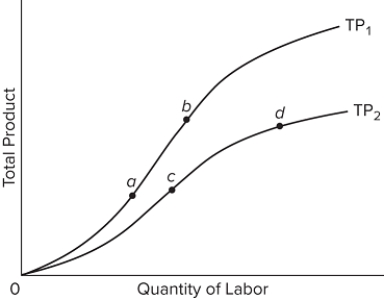 Refer to the diagram, which relates to Firm X. Suppose X implements an innovative new production method that shifts its total product curve from TP ₂ to TP ₁. Other things equal,
 (Multiple Choice)
5.0/5 (73)
(73) If a particular R&D expenditure is expected to be worthwhile, the firm should undertake it because the project will definitely increase the firm's future profits.
(True/False)
4.9/5 (88)
(88) Gigantic Corporation follows a strategy of waiting for rivals to innovate, then quickly imitating any successful innovations. This behavior is known as
(Multiple Choice)
4.7/5 (64)
(64) The role of entrepreneurs includes all of the following, except
(Multiple Choice)
4.8/5 (65)
(65) According to the inverted-U theory, R&D expenditures as a percentage of sales tend to be relatively low in
(Multiple Choice)
4.8/5 (78)
(78) Suppose firm X implements a new method for extracting copper from copper-bearing ore. This is an example of
(Multiple Choice)
4.9/5 (78)
(78) Suppose a firm anticipates that a particular R&D expenditure of $100 million will result in a new product and thus create a one-time added profit of $108 million a year later. The firm will
(Multiple Choice)
4.8/5 (74)
(74)  The table shows the rate of return and R&D spending for a hypothetical firm. Assume the interest-rate cost of funds rises from 9 percent to 21 percent. What will happen to the optimal amount of R&D spending?
 (Multiple Choice)
4.8/5 (82)
(82) A "fast-second strategy" refers to a situation where small competitors of a dominant firm will wait for the dominant firm to innovate, and then quickly imitate the dominant firm's innovations.
(True/False)
4.7/5 (70)
(70) Which of the following correctly orders, highest to lowest, the relative magnitudes of U.S. spending by businesses on components of R&D?
(Multiple Choice)
4.9/5 (85)
(85) The "inverted-U theory" of R&D shows the relationship between
(Multiple Choice)
4.9/5 (77)
(77) New scientific knowledge mainly comes from university and government laboratories, not private firms, because
(Multiple Choice)
4.8/5 (87)
(87) If a firm develops better methods of producing a product, then this process innovation can be expected to result in a(n)
(Multiple Choice)
4.9/5 (80)
(80) In 2016, about ____ percent of U.S. business R&D spending was for development (innovation and imitation).
(Multiple Choice)
4.8/5 (68)
(68) The theory that R&D expenditures as a percentage of firms' sales first rise, reach a peak, and then fall with increases in industry concentration is called the inverted-U theory of R&D.
(True/False)
4.9/5 (79)
(79) Which market structure offers little incentive to engage in R&D?
(Multiple Choice)
4.9/5 (69)
(69) 
Filters
- Essay(0)
- Multiple Choice(0)
- Short Answer(0)
- True False(0)
- Matching(0)