



 Chat with AI
Exam 15: Technology, RD, and Efficiency

Exam 1: Limits, Alternatives, and Choices107 Questions
Exam 2: The Market System and the Circular Flow287 Questions
Exam 3: Demand, Supply, and Market Equilibrium151 Questions
Exam 4: Market Failures Caused by Externalities Asymmetric Information229 Questions
Exam 5: Public Goods, Public Choice, and Government Failure268 Questions
Exam 6: Elasticity399 Questions
Exam 7: Utility Maximization358 Questions
Exam 8: Behavioral Economics311 Questions
Exam 9: Businesses and the Costs of Production445 Questions
Exam 10: Pure Competition in the Short Run342 Questions
Exam 11: Pure Competition in the Long Run250 Questions
Exam 12: Pure Monopoly407 Questions
Exam 13: Monopolistic Competition279 Questions
Exam 14: Oligopoly and Strategic Behavior362 Questions
Exam 15: Technology, RD, and Efficiency309 Questions
Exam 16: The Demand for Resources359 Questions
Exam 17: Wage Determination168 Questions
Exam 18: Rent, Interest, and Profit305 Questions
Exam 19: Natural Resource and Energy Economics337 Questions
Exam 20: Public Finance: Expenditures and Taxes336 Questions
Exam 21: Antitrust Policy and Regulation264 Questions
Exam 22: Agriculture: Economics and Policy265 Questions
Exam 23: Income Inequality, Poverty, and Discrimination324 Questions
Exam 24: Health Care280 Questions
Exam 25: Immigration259 Questions
Exam 26: International Trade347 Questions
Exam 27: The Balance of Payments, Exchange Rates, and Trade Deficits318 Questions
Exam 28: The Economics of Developing Countries277 Questions
Select questions type


Which pair of market structures provides firms with the greatest ability to finance R&D out of retained earnings?
(Multiple Choice)
4.9/5  (73)
(73) Entrepreneurs often form new small firms called "spin-off firms."
(True/False)
5.0/5 (83)
(83) 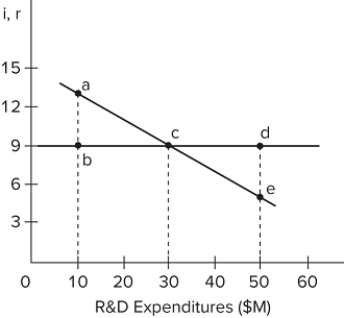 In the graph, the optimal amount of R&D spending and the interest-rate cost-of-funds at that optimal level would be, respectively,
 (Multiple Choice)
4.8/5 (94)
(94) An industry with which of the following four-firm concentration ratios would tend to have the greatest amount of R&D expenditures as a percentage of sales?
(Multiple Choice)
4.9/5 (80)
(80) 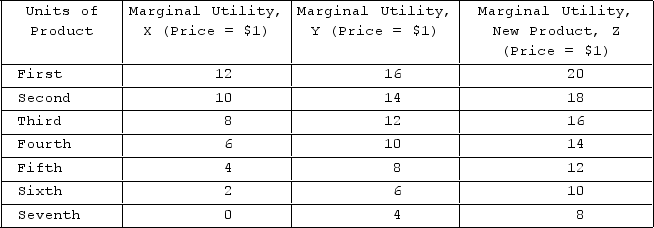 Refer to the data for a consumer whose income = $12. In equilibrium, the introduction of new product Z has increased this consumer's total utility by
 (Multiple Choice)
4.9/5 (93)
(93) Legal protections against competitors producing and selling a product identical to the one you invented are called _________; legal protections against competitors using your product's name are called __________.
(Multiple Choice)
4.7/5 (75)
(75) Suppose that a firm successfully introduces a highly profitable new product. If this new product is priced higher than existing substitute products, then the
(Multiple Choice)
4.8/5 (88)
(88) In exchange for a share of ZYX's profits if it succeeds, Firm ABC provides development funds to newly formed ZYX, which is developing an innovative product. ABC funds are called ____________, while ZYX is known as a ____________.
(Multiple Choice)
4.7/5 (81)
(81)  Refer to the data for a consumer whose income = $6. In equilibrium, the introduction of new product Z has increased this consumer's total utility by
 (Multiple Choice)
4.9/5 (75)
(75) 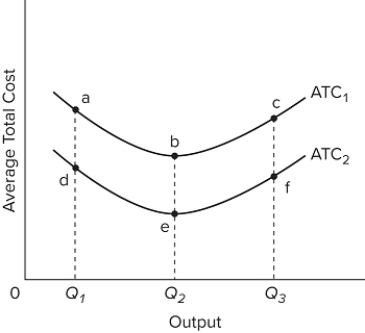 Refer to the diagram. Process innovation will tend to
Do economists believe that patents should be eliminated on some types of products? Explain.
(Essay)
4.8/5 (73)
(73)  Refer to the data. At $40 million of R&D expenditures, the
 (Multiple Choice)
4.8/5 (90)
(90) The conjecture that R&D expenditures as a percentage of firms' sales first rise, reach a peak, and then fall as industry concentration rises is known as the
(Multiple Choice)
4.8/5 (82)
(82) Process innovation causes an upward shift in a firm's total product curve and
(Multiple Choice)
4.8/5 (78)
(78) The process by which new firms and new products replace existing dominant firms and products is called
(Multiple Choice)
4.7/5 (87)
(87) Which of the following does not aptly describe innovation?
(Multiple Choice)
4.8/5 (64)
(64) 
Filters
- Essay(0)
- Multiple Choice(0)
- Short Answer(0)
- True False(0)
- Matching(0)