



 Chat with AI
Exam 15: Technology, RD, and Efficiency

Exam 1: Limits, Alternatives, and Choices107 Questions
Exam 2: The Market System and the Circular Flow287 Questions
Exam 3: Demand, Supply, and Market Equilibrium151 Questions
Exam 4: Market Failures Caused by Externalities Asymmetric Information229 Questions
Exam 5: Public Goods, Public Choice, and Government Failure268 Questions
Exam 6: Elasticity399 Questions
Exam 7: Utility Maximization358 Questions
Exam 8: Behavioral Economics311 Questions
Exam 9: Businesses and the Costs of Production445 Questions
Exam 10: Pure Competition in the Short Run342 Questions
Exam 11: Pure Competition in the Long Run250 Questions
Exam 12: Pure Monopoly407 Questions
Exam 13: Monopolistic Competition279 Questions
Exam 14: Oligopoly and Strategic Behavior362 Questions
Exam 15: Technology, RD, and Efficiency309 Questions
Exam 16: The Demand for Resources359 Questions
Exam 17: Wage Determination168 Questions
Exam 18: Rent, Interest, and Profit305 Questions
Exam 19: Natural Resource and Energy Economics337 Questions
Exam 20: Public Finance: Expenditures and Taxes336 Questions
Exam 21: Antitrust Policy and Regulation264 Questions
Exam 22: Agriculture: Economics and Policy265 Questions
Exam 23: Income Inequality, Poverty, and Discrimination324 Questions
Exam 24: Health Care280 Questions
Exam 25: Immigration259 Questions
Exam 26: International Trade347 Questions
Exam 27: The Balance of Payments, Exchange Rates, and Trade Deficits318 Questions
Exam 28: The Economics of Developing Countries277 Questions
Select questions type


 Refer to the data. At $20 million of R&D expenditures, the
 (Multiple Choice)
4.8/5  (76)
(76) 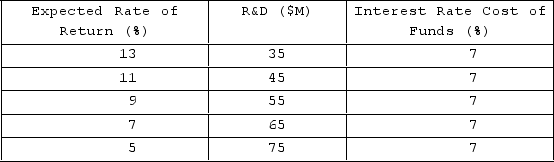 The table shows the expected rate of return, R&D spending, and interest-rate cost-of-funds for a hypothetical firm. In a graph for determining the optimal R&D expenditure, the interest-cost of funds curve would be a(n)
 (Multiple Choice)
4.9/5 (77)
(77) Henry Ford's development of an assembly method for building cars and trucks would be an example of
(Multiple Choice)
4.7/5 (84)
(84) Consumers will buy a new product instead of an old one that they are used to buying, if the MU of the new product is larger than the MU of the old product.
(True/False)
4.9/5 (83)
(83) Suppose a firm anticipates that an R&D expenditure of $100 million will result in a new production process that will reduce costs and thus create a one-time added profit of $112 million a year later. The firm's expected rate of return is
(Multiple Choice)
4.9/5 (74)
(74) The central idea illustrated by the vignette on "catgut" used as violin strings is
(Multiple Choice)
4.7/5 (78)
(78) 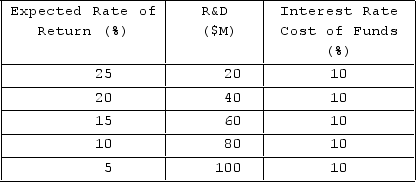 Refer to the data. The firm's optimal amount of R&D spending is
 (Multiple Choice)
4.8/5 (71)
(71) 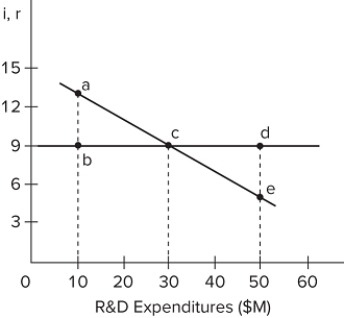 In the graph, the interest-rate cost-of-funds curve would be the line connecting points
 (Multiple Choice)
4.8/5 (76)
(76) Suppose that Marlen Fisher has legal protection against anyone producing and selling a fishing lure identical to his unique-action "MarFish" lure, whatever the competitor might name the lure. This legal protection is most likely to be a
(Multiple Choice)
4.8/5 (65)
(65) Suppose that Book-Cost Busters (BCB), without authorization, reproduced a best-selling novel and placed it for downloading on the BCB pay-for-use website. This action would violate the publisher's
(Multiple Choice)
5.0/5 (86)
(86) Describe R&D expenditures in the United States. What percentage of spending goes for invention, innovation, and diffusion?
(Essay)
4.9/5 (79)
(79) In deciding on an optimal amount and type of research and development, firms should adhere to the rule: Expand R&D until
(Multiple Choice)
4.9/5 (73)
(73) U.S. firms collectively devote the largest portion of their total R&D spending to
(Multiple Choice)
4.9/5 (66)
(66) The optimal market structure for technological advance seems to be an industry in which
(Multiple Choice)
4.8/5 (88)
(88) The corporate decision on type and level of R&D activity is difficult because
(Multiple Choice)
4.8/5 (92)
(92) 
Filters
- Essay(0)
- Multiple Choice(0)
- Short Answer(0)
- True False(0)
- Matching(0)