



 Chat with AI
Exam 19: Natural Resource and Energy Economics

Exam 1: Limits, Alternatives, and Choices107 Questions
Exam 2: The Market System and the Circular Flow287 Questions
Exam 3: Demand, Supply, and Market Equilibrium151 Questions
Exam 4: Market Failures Caused by Externalities Asymmetric Information229 Questions
Exam 5: Public Goods, Public Choice, and Government Failure268 Questions
Exam 6: Elasticity399 Questions
Exam 7: Utility Maximization358 Questions
Exam 8: Behavioral Economics311 Questions
Exam 9: Businesses and the Costs of Production445 Questions
Exam 10: Pure Competition in the Short Run342 Questions
Exam 11: Pure Competition in the Long Run250 Questions
Exam 12: Pure Monopoly407 Questions
Exam 13: Monopolistic Competition279 Questions
Exam 14: Oligopoly and Strategic Behavior362 Questions
Exam 15: Technology, RD, and Efficiency309 Questions
Exam 16: The Demand for Resources359 Questions
Exam 17: Wage Determination168 Questions
Exam 18: Rent, Interest, and Profit305 Questions
Exam 19: Natural Resource and Energy Economics337 Questions
Exam 20: Public Finance: Expenditures and Taxes336 Questions
Exam 21: Antitrust Policy and Regulation264 Questions
Exam 22: Agriculture: Economics and Policy265 Questions
Exam 23: Income Inequality, Poverty, and Discrimination324 Questions
Exam 24: Health Care280 Questions
Exam 25: Immigration259 Questions
Exam 26: International Trade347 Questions
Exam 27: The Balance of Payments, Exchange Rates, and Trade Deficits318 Questions
Exam 28: The Economics of Developing Countries277 Questions
Select questions type


One of the worst systems for encouraging conservation of fisheries is the combination of total allowable catch (TAC)with individual transferable quota (ITQ).
(True/False)
4.8/5  (60)
(60) Which of the following factors fosters the survival of alternative-energy companies?
(Multiple Choice)
4.8/5 (88)
(88) In which step of the demographic transition would we expect population to grow the fastest?
(Multiple Choice)
4.7/5 (77)
(77) As technologies improve, the costs of producing alternatives will likely fall, reducing the cost of replacing oil.
(True/False)
4.8/5 (95)
(95) In the absence of enforceable property rights, there is little incentive to preserve resources for future use.
(True/False)
4.8/5 (64)
(64) Paul Ehrlich's book The Population Bomb made which of the following predictions?
(Multiple Choice)
4.9/5 (80)
(80) Property rights over fish in the open ocean exist once the fish are caught.
(True/False)
4.9/5 (96)
(96) What are some of the benefits of forests? What percent of the land area in the U.S. is covered in forests?
(Essay)
4.8/5 (74)
(74) The total cost of extracting and selling a resource in a given year is the sum of the extraction cost and user cost.
(True/False)
5.0/5 (84)
(84) 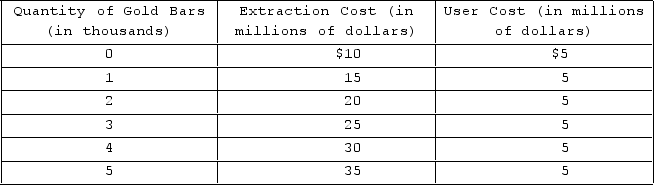 The table shows the quantity of gold bars in thousands, the extraction cost for each thousand bars (in millions of dollars), and the user cost of each thousand bars (in millions of dollars)facing the OZ Mining Company this year (all costs are marginal). If the current price of a bar of gold is $25,000, how many bars (in thousands)should OZ extract and sell this year in order to maximize profits?
 (Multiple Choice)
4.8/5 (65)
(65) The user cost of a resource is the market price paid by the buyer of the resource.
(True/False)
4.9/5 (84)
(84) What are conflict diamonds, and what do they illustrate about resource use?
(Essay)
4.8/5 (68)
(68) Melanie and Oli are competing Pacific halibut fishers. Both have been allocated ITQs that limit their catch to 1,000 tons of Pacific halibut each. Melanie's cost per ton is $20; Oli's cost per ton is $25. If the market price of Pacific halibut is $35 per ton, what is the minimum amount per ton that Melanie would have to offer Oli to convince him to sell Melanie his ITQs?
(Multiple Choice)
4.9/5 (84)
(84) If the price of oil falls, the economic viability of alternative energy sources also tends to fall.
(True/False)
4.8/5 (69)
(69) 
Filters
- Essay(0)
- Multiple Choice(0)
- Short Answer(0)
- True False(0)
- Matching(0)