



 Chat with AI
Exam 19: Natural Resource and Energy Economics

Exam 1: Limits, Alternatives, and Choices107 Questions
Exam 2: The Market System and the Circular Flow287 Questions
Exam 3: Demand, Supply, and Market Equilibrium151 Questions
Exam 4: Market Failures Caused by Externalities Asymmetric Information229 Questions
Exam 5: Public Goods, Public Choice, and Government Failure268 Questions
Exam 6: Elasticity399 Questions
Exam 7: Utility Maximization358 Questions
Exam 8: Behavioral Economics311 Questions
Exam 9: Businesses and the Costs of Production445 Questions
Exam 10: Pure Competition in the Short Run342 Questions
Exam 11: Pure Competition in the Long Run250 Questions
Exam 12: Pure Monopoly407 Questions
Exam 13: Monopolistic Competition279 Questions
Exam 14: Oligopoly and Strategic Behavior362 Questions
Exam 15: Technology, RD, and Efficiency309 Questions
Exam 16: The Demand for Resources359 Questions
Exam 17: Wage Determination168 Questions
Exam 18: Rent, Interest, and Profit305 Questions
Exam 19: Natural Resource and Energy Economics337 Questions
Exam 20: Public Finance: Expenditures and Taxes336 Questions
Exam 21: Antitrust Policy and Regulation264 Questions
Exam 22: Agriculture: Economics and Policy265 Questions
Exam 23: Income Inequality, Poverty, and Discrimination324 Questions
Exam 24: Health Care280 Questions
Exam 25: Immigration259 Questions
Exam 26: International Trade347 Questions
Exam 27: The Balance of Payments, Exchange Rates, and Trade Deficits318 Questions
Exam 28: The Economics of Developing Countries277 Questions
Select questions type


Which of the following is a major reason to believe that we are not likely to run out of natural resources?
(Multiple Choice)
4.8/5  (84)
(84) According to U.S. Geological Survey data from 1950 to 2015, total water use in the United States has
(Multiple Choice)
4.7/5 (73)
(73) 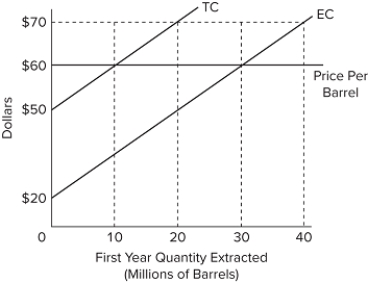 The graph shows the extraction costs for TX Oil Company in the first year in a situation where it will extract oil from a reserve over two years. If total costs increase and the price of oil stays at $60, then the firm will
 (Multiple Choice)
4.8/5 (74)
(74) Because wind turbines supply no energy on windless days, and solar power is only generated when the sun is up and out, one inherent problem with both wind and solar power is the
(Multiple Choice)
4.7/5 (85)
(85) Garrett Hardin's tragedy of the commons best applies to which of the following issues?
(Multiple Choice)
4.8/5 (61)
(61) ITQs generate the most efficient use of resources when everyone keeps and fills their own quotas.
(True/False)
4.9/5 (66)
(66) Unless people can benefit from conservation, there is a temptation to
(Multiple Choice)
4.9/5 (87)
(87) Melanie and Oli are competing Pacific halibut fishers. Both have been allocated ITQs that limit their catch to 1,000 tons of Pacific halibut each. Melanie's cost per ton is $20; Oli's cost per ton is $28. If the market price of Pacific halibut is $40 per ton, what is the maximum amount Melanie would be willing to pay per ton for Oli's ITQs?
(Multiple Choice)
4.8/5 (66)
(66) A farmer discovers a natural gas reserve on his property. He can extract the natural gas for a profit of $40 per unit now, $55 per unit in one year, $57 per unit in two years, and $60 in three years. The current market rate of interest is 6 percent. When should the farmer extract the natural gas to obtain the most profit per unit in present value terms?
(Multiple Choice)
4.9/5 (90)
(90) 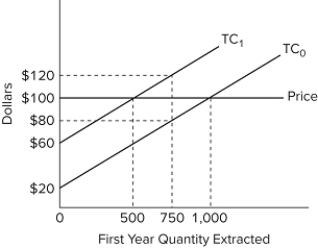 Refer to the diagram, assuming that the firm represented is operating on curve TC ₀ . A change from TC ₀ to TC ₁ could be caused by
 (Multiple Choice)
4.8/5 (83)
(83) Kara and Kyle are competing sockeye salmon fishers. Both have been allocated ITQs that limit their catch to 2,000 tons of sockeye salmon each. Kara's cost per ton is $6; Kyle's cost per ton is $10. If the market price of sockeye salmon is $14 per ton, what is the maximum amount Kara would be willing to pay per ton for Kyle's ITQs?
(Multiple Choice)
4.9/5 (78)
(78) One major reason why the survival of elephants is threatened is that
(Multiple Choice)
4.9/5 (68)
(68) If a country has a total fertility rate of 4.0, then, all else equal, we would expect
(Multiple Choice)
4.9/5 (85)
(85) Kara and Kyle are competing sockeye salmon fishers. Both have been allocated ITQs that limit their catch to 2,000 tons of sockeye salmon each. Kara's cost per ton is $8; Kyle's cost per ton is $12. If the market price of sockeye salmon is $15 per ton, what is the minimum amount per ton that Kara would have to offer Kyle to convince him to sell Kara his ITQs?
(Multiple Choice)
4.9/5 (67)
(67) In 2018, the countries with the highest scores on the Environmental Performance Index were
(Multiple Choice)
4.7/5 (84)
(84) The optimal extraction level in the present for a nonrenewable resource is
(Multiple Choice)
4.9/5 (77)
(77) Other things equal, ethanol made from corn becomes economically viable (same or lower cost than using oil)when oil prices reach _____ or more per barrel.
(Multiple Choice)
4.9/5 (77)
(77) Total allowable catch policies and individual transferable quotas both
(Multiple Choice)
4.8/5 (81)
(81) 
Filters
- Essay(0)
- Multiple Choice(0)
- Short Answer(0)
- True False(0)
- Matching(0)