



 Chat with AI
Exam 19: Natural Resource and Energy Economics

Exam 1: Limits, Alternatives, and Choices107 Questions
Exam 2: The Market System and the Circular Flow287 Questions
Exam 3: Demand, Supply, and Market Equilibrium151 Questions
Exam 4: Market Failures Caused by Externalities Asymmetric Information229 Questions
Exam 5: Public Goods, Public Choice, and Government Failure268 Questions
Exam 6: Elasticity399 Questions
Exam 7: Utility Maximization358 Questions
Exam 8: Behavioral Economics311 Questions
Exam 9: Businesses and the Costs of Production445 Questions
Exam 10: Pure Competition in the Short Run342 Questions
Exam 11: Pure Competition in the Long Run250 Questions
Exam 12: Pure Monopoly407 Questions
Exam 13: Monopolistic Competition279 Questions
Exam 14: Oligopoly and Strategic Behavior362 Questions
Exam 15: Technology, RD, and Efficiency309 Questions
Exam 16: The Demand for Resources359 Questions
Exam 17: Wage Determination168 Questions
Exam 18: Rent, Interest, and Profit305 Questions
Exam 19: Natural Resource and Energy Economics337 Questions
Exam 20: Public Finance: Expenditures and Taxes336 Questions
Exam 21: Antitrust Policy and Regulation264 Questions
Exam 22: Agriculture: Economics and Policy265 Questions
Exam 23: Income Inequality, Poverty, and Discrimination324 Questions
Exam 24: Health Care280 Questions
Exam 25: Immigration259 Questions
Exam 26: International Trade347 Questions
Exam 27: The Balance of Payments, Exchange Rates, and Trade Deficits318 Questions
Exam 28: The Economics of Developing Countries277 Questions
Select questions type


The Economist's Commodity Price Index reveals that the supply of productive resources has increased faster than the demand for decades.
(True/False)
4.8/5  (75)
(75) Why is the overall world population still increasing? What are the expectations for population growth in the future?
(Essay)
4.8/5 (73)
(73) Malthus argued that any increase in living standards would cause a decrease in population growth.
(True/False)
4.8/5 (69)
(69) Which of the following policies has succeeded in reducing fishery catch sizes without creating an "arms race" among fishers?
(Multiple Choice)
5.0/5 (76)
(76) An oil producer discovers an oil supply in Texas that can be pumped for a profit of $50 per barrel now, $60 per barrel in three years, $80 per barrel in five years, or $90 a barrel in seven years. The current market rate of interest is 3 percent. When should the oil producer extract the oil to obtain the most profit per barrel in present value terms?
(Multiple Choice)
4.9/5 (72)
(72) An increase in the present value of the profit that can be obtained by delaying resource extraction will lead profit-maximizing firms to
(Multiple Choice)
4.8/5 (70)
(70) 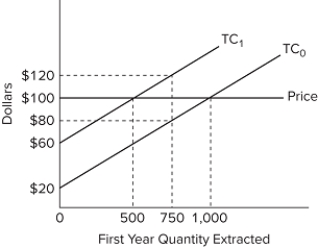 Refer to the diagram, assuming that the firm represented is operating on curve TC ₀ . What is the user cost of extracting a unit of this resource?
 (Multiple Choice)
4.8/5 (83)
(83) In the extraction of a nonrenewable resource such as coal, the mining firm faces "user costs," which refers to the cost of digging out the coal, running the mine, and transporting the coal.
(True/False)
4.7/5 (69)
(69) Alex and Belle are both loggers wanting to harvest timber from the same forest. Alex prefers to harvest and replant at a sustainable rate; Belle wants to harvest as many trees as possible to maximize short-run profit and then move on. They face the same production costs. If property rights are poorly enforced or nonexistent,
(Multiple Choice)
4.9/5 (86)
(86) Which of the following is the best example of a market failure that would lead a firm to extract resources at a rate that is faster than the rate that would maximize its long-term stream of profits?
(Multiple Choice)
4.8/5 (74)
(74) Melanie and Oli are competing Pacific halibut fishers. Both have been allocated ITQs that limit their catch to 1,000 tons of Pacific halibut each. Melanie's cost per ton is $20; Oli's cost per ton is $25. If the market price of Pacific halibut is $35 per ton, and Melanie and Oli both catch their quota, their combined profit will be
(Multiple Choice)
4.8/5 (82)
(82) Demographers expect world population to peak and then decline in the twenty-first century.
(True/False)
4.9/5 (69)
(69) 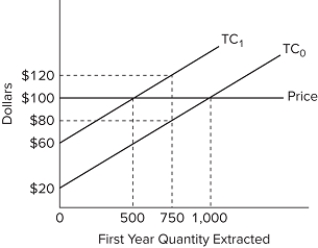 Refer to the diagram, assuming that the firm represented is operating on curve 1. If the current price of the resource rises by $20, the optimal quantity extracted in the first year will
 (Multiple Choice)
4.7/5 (67)
(67) Commercially run forestry companies that have secure property rights over their trees
(Multiple Choice)
4.8/5 (75)
(75) A profit-maximizing company should extract a nonrenewable resource in the present up to the quantity where the
(Multiple Choice)
4.8/5 (90)
(90) An oil company is considering drilling in the Gulf at a current cost of $300,000 with an expected profit of $500,000 in three years. The current market rateof interest is 10 percent. Should the company make the investment?
(Multiple Choice)
4.8/5 (89)
(89) 
Filters
- Essay(0)
- Multiple Choice(0)
- Short Answer(0)
- True False(0)
- Matching(0)