



 Chat with AI
Exam 19: Natural Resource and Energy Economics

Exam 1: Limits, Alternatives, and Choices107 Questions
Exam 2: The Market System and the Circular Flow287 Questions
Exam 3: Demand, Supply, and Market Equilibrium151 Questions
Exam 4: Market Failures Caused by Externalities Asymmetric Information229 Questions
Exam 5: Public Goods, Public Choice, and Government Failure268 Questions
Exam 6: Elasticity399 Questions
Exam 7: Utility Maximization358 Questions
Exam 8: Behavioral Economics311 Questions
Exam 9: Businesses and the Costs of Production445 Questions
Exam 10: Pure Competition in the Short Run342 Questions
Exam 11: Pure Competition in the Long Run250 Questions
Exam 12: Pure Monopoly407 Questions
Exam 13: Monopolistic Competition279 Questions
Exam 14: Oligopoly and Strategic Behavior362 Questions
Exam 15: Technology, RD, and Efficiency309 Questions
Exam 16: The Demand for Resources359 Questions
Exam 17: Wage Determination168 Questions
Exam 18: Rent, Interest, and Profit305 Questions
Exam 19: Natural Resource and Energy Economics337 Questions
Exam 20: Public Finance: Expenditures and Taxes336 Questions
Exam 21: Antitrust Policy and Regulation264 Questions
Exam 22: Agriculture: Economics and Policy265 Questions
Exam 23: Income Inequality, Poverty, and Discrimination324 Questions
Exam 24: Health Care280 Questions
Exam 25: Immigration259 Questions
Exam 26: International Trade347 Questions
Exam 27: The Balance of Payments, Exchange Rates, and Trade Deficits318 Questions
Exam 28: The Economics of Developing Countries277 Questions
Select questions type


Since 1950, the energy efficiency of the U.S. economy in terms of producing goods and services has
(Multiple Choice)
4.9/5  (81)
(81) 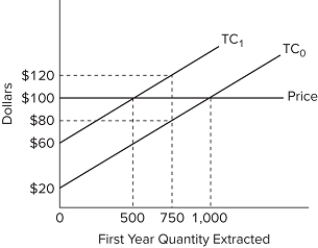 Refer to the diagram. An increase in extraction costs could be shown by
 (Multiple Choice)
4.9/5 (86)
(86) Which of the following statements is true about falling birthrates?
(Multiple Choice)
4.8/5 (69)
(69) Wind and solar energy has many benefits over coal and gas. Are there any downsides? If so, discuss.
(Essay)
4.8/5 (86)
(86) An oil company has the opportunity to extract oil from a reserve in three years with a per barrel profit of $100 per barrel. The current market rate of interest is 8 percent. The present value of this future extraction is about
(Multiple Choice)
4.8/5 (85)
(85) Fisheries have been overexploited relative to forests primarily because people care more about trees than fish.
(True/False)
4.8/5 (86)
(86) Which of the following is considered a renewable natural resource?
(Multiple Choice)
4.8/5 (76)
(76) The total allowable catch (TAC)system differs from the individual transferable quota (ITQ)system in that
(Multiple Choice)
4.8/5 (71)
(71) In the case of extraction of a nonrenewable resource, when user costs increase, it implies that expected future profits
(Multiple Choice)
4.8/5 (89)
(89) Define total fertility rate and replacement rate. Use them to describe the population prospects for many developed countries.
(Essay)
5.0/5 (78)
(78) In the case of conflict diamonds, the strict enforcement of property rights has led to too fast of a rate of extraction.
(True/False)
4.8/5 (77)
(77) Which of the following is not considered by demographers to be part of the three-step demographic transition?
(Multiple Choice)
5.0/5 (77)
(77) Thomas Malthus argued that increases in living standards tend to reduce birthrates.
(True/False)
4.8/5 (75)
(75) Future shortages in natural resource markets are not expected to occur widely due to
(Multiple Choice)
4.8/5 (73)
(73) Why do some nations have growing or sustainable forests and other nations experience deforestation?
(Essay)
4.9/5 (88)
(88) 
Filters
- Essay(0)
- Multiple Choice(0)
- Short Answer(0)
- True False(0)
- Matching(0)