



 Chat with AI
Exam 19: Natural Resource and Energy Economics

Exam 1: Limits, Alternatives, and Choices107 Questions
Exam 2: The Market System and the Circular Flow287 Questions
Exam 3: Demand, Supply, and Market Equilibrium151 Questions
Exam 4: Market Failures Caused by Externalities Asymmetric Information229 Questions
Exam 5: Public Goods, Public Choice, and Government Failure268 Questions
Exam 6: Elasticity399 Questions
Exam 7: Utility Maximization358 Questions
Exam 8: Behavioral Economics311 Questions
Exam 9: Businesses and the Costs of Production445 Questions
Exam 10: Pure Competition in the Short Run342 Questions
Exam 11: Pure Competition in the Long Run250 Questions
Exam 12: Pure Monopoly407 Questions
Exam 13: Monopolistic Competition279 Questions
Exam 14: Oligopoly and Strategic Behavior362 Questions
Exam 15: Technology, RD, and Efficiency309 Questions
Exam 16: The Demand for Resources359 Questions
Exam 17: Wage Determination168 Questions
Exam 18: Rent, Interest, and Profit305 Questions
Exam 19: Natural Resource and Energy Economics337 Questions
Exam 20: Public Finance: Expenditures and Taxes336 Questions
Exam 21: Antitrust Policy and Regulation264 Questions
Exam 22: Agriculture: Economics and Policy265 Questions
Exam 23: Income Inequality, Poverty, and Discrimination324 Questions
Exam 24: Health Care280 Questions
Exam 25: Immigration259 Questions
Exam 26: International Trade347 Questions
Exam 27: The Balance of Payments, Exchange Rates, and Trade Deficits318 Questions
Exam 28: The Economics of Developing Countries277 Questions
Select questions type


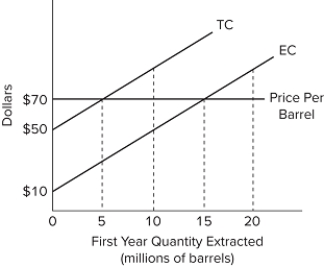 Refer to the diagram, representing Slippery Slope Oil Company. How many million barrels should Slippery Slope extract and sell this year?
 (Multiple Choice)
4.8/5  (73)
(73) What is most likely to happen when no logger owns the property rights to a forest that is open to logging?
(Multiple Choice)
4.9/5 (105)
(105) Demographers predict that the worldwide total fertility rate will decline to one birth per woman per lifetime. If this happens, then
(Multiple Choice)
4.9/5 (88)
(88) Based on the fertility-rate calculations for major industrialized countries, their populations are expected to decline significantly in the coming years because the
(Multiple Choice)
4.7/5 (76)
(76) Under a TAC system, fishing of a particular fishery is halted after
(Multiple Choice)
4.8/5 (73)
(73) Alex and Belle are both loggers wanting to harvest timber from the same forest. Alex prefers to harvest and replant at a sustainable rate; Belle wants to harvest as many trees as possible to maximize short-run profit and then move on. They face the same production costs. The forest is more likely to be harvested and replanted at a sustainable rate if
(Multiple Choice)
4.9/5 (98)
(98) If resource extraction companies can benefit from both present and future extraction, they will limit current extraction to only those units which are more profitable to extract in the present rather than in the future.
(True/False)
4.9/5 (74)
(74) Modernizing economies that have declining birthrates may still experience population growth because of rapidly declining death rates.
(True/False)
4.8/5 (75)
(75) An electricity company is considering damming a small river to generate electricity at a cost of $250,000 and a profit of $300,000 in 5 years. The current market rate of interest is 3 percent. Should the company make the investment?
(Multiple Choice)
4.9/5 (62)
(62) The economic benefits of forests include provision of wildlife habitats, erosion prevention, and oxygen production.
(True/False)
4.7/5 (81)
(81) If predictions that the world will run out of oil or petroleum in the next century become true, then
(Multiple Choice)
4.9/5 (80)
(80) The cost of not being able to extract and sell a nonrenewable resource in the future (because it is being extracted in the present)is known by natural resource economists as the
(Multiple Choice)
4.7/5 (96)
(96) In 2017, according to U.S. Energy Information Administration data, which of the following sources of energy contributed the largest share to U.S. electricity generation?
(Multiple Choice)
4.8/5 (78)
(78) Low birthrates in industrialized countries are a major concern for governments, reducing the number of potential soldiers and taxpayers to support social programs.
(True/False)
4.9/5 (78)
(78) Which of the following policies has succeeded in reducing fishery catch sizes?
(Multiple Choice)
4.9/5 (69)
(69) User cost is defined as the present value of the profit the company would earn if it delayed extraction until next year.
(True/False)
4.9/5 (70)
(70) 
Filters
- Essay(0)
- Multiple Choice(0)
- Short Answer(0)
- True False(0)
- Matching(0)