



 Chat with AI
Exam 25: Immigration

Exam 1: Limits, Alternatives, and Choices107 Questions
Exam 2: The Market System and the Circular Flow287 Questions
Exam 3: Demand, Supply, and Market Equilibrium151 Questions
Exam 4: Market Failures Caused by Externalities Asymmetric Information229 Questions
Exam 5: Public Goods, Public Choice, and Government Failure268 Questions
Exam 6: Elasticity399 Questions
Exam 7: Utility Maximization358 Questions
Exam 8: Behavioral Economics311 Questions
Exam 9: Businesses and the Costs of Production445 Questions
Exam 10: Pure Competition in the Short Run342 Questions
Exam 11: Pure Competition in the Long Run250 Questions
Exam 12: Pure Monopoly407 Questions
Exam 13: Monopolistic Competition279 Questions
Exam 14: Oligopoly and Strategic Behavior362 Questions
Exam 15: Technology, RD, and Efficiency309 Questions
Exam 16: The Demand for Resources359 Questions
Exam 17: Wage Determination168 Questions
Exam 18: Rent, Interest, and Profit305 Questions
Exam 19: Natural Resource and Energy Economics337 Questions
Exam 20: Public Finance: Expenditures and Taxes336 Questions
Exam 21: Antitrust Policy and Regulation264 Questions
Exam 22: Agriculture: Economics and Policy265 Questions
Exam 23: Income Inequality, Poverty, and Discrimination324 Questions
Exam 24: Health Care280 Questions
Exam 25: Immigration259 Questions
Exam 26: International Trade347 Questions
Exam 27: The Balance of Payments, Exchange Rates, and Trade Deficits318 Questions
Exam 28: The Economics of Developing Countries277 Questions
Select questions type


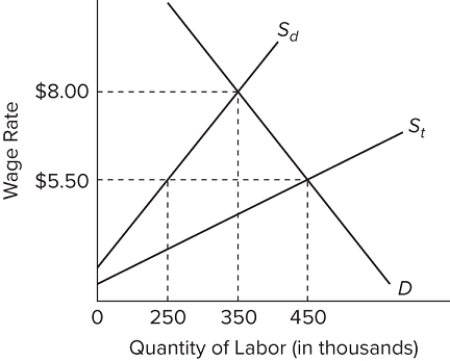 Assumptions: (1)Employers in this market are willing and able to ignore minimum wage laws; (2)Sd represents the supply of domestic-born (and legal immigrant)workers; (3)Sₜ represents the total supply of workers in this labor market (Sd plus illegal immigrants); and (4)unless otherwise stated, illegal immigration is not effectively blocked by the government.How many illegal immigrant workers will be hired at equilibrium?
 (Multiple Choice)
4.9/5  (84)
(84) Studies show that the largest negative impact of illegal immigrants is on
(Multiple Choice)
4.8/5 (65)
(65) Business income will decrease in the nation from which workers emigrate.
(True/False)
4.9/5 (85)
(85) The majority of international migrants move to countries relatively close to their home countries because close proximity reduces the cost of the move relative to anticipated benefits.
(True/False)
4.9/5 (62)
(62) As a result of a major overhaul of the U.S. welfare system in 1996,
(Multiple Choice)
4.7/5 (73)
(73) Removing all illegal immigrants would expand domestic-born employment by an amount equal to the number of illegal immigrants removed.
(True/False)
5.0/5 (71)
(71) 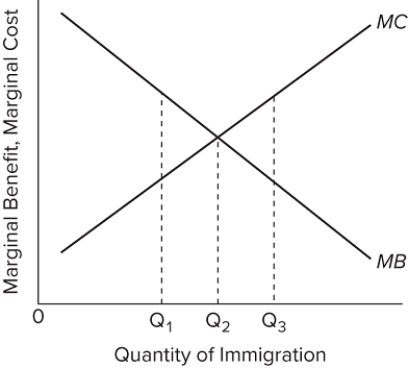 Refer to the figure. An increase in the number of highly motivated and skilled potential immigrants will
 (Multiple Choice)
4.8/5 (70)
(70) 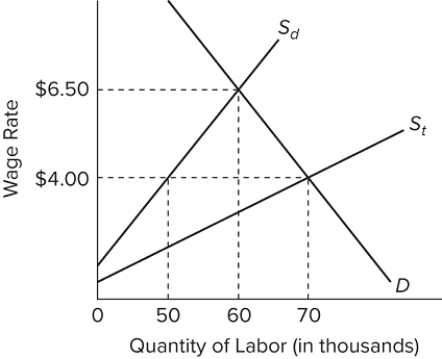 Assumptions: (1)Employers in this market are willing and able to ignore minimum wage laws; (2)Sd represents the supply of domestic-born (and legal immigrant)workers; (3)Sₜ represents the total supply of workers in this labor market (Sd plus illegal immigrants); and (4)unless otherwise stated, illegal immigration is not effectively blocked by the government.If the government effectively prevents illegal immigrants from working in this labor market, the equilibrium wage and level of employment are
 (Multiple Choice)
4.9/5 (81)
(81) The optimal level of immigration occurs where marginal benefit is at its greatest.
(True/False)
4.9/5 (73)
(73) Suppose that Rosa is considering migration to another country. To move, she will have to spend $5,000 on transportation and $4,000 in application and other processing fees. Rosa's stream of future earnings in her home country is $500,000. She expects to earn a stream of future earnings of $800,000 in another country. Based on this information, Rosa's implicit cost of migrating is
(Multiple Choice)
4.9/5 (75)
(75) Which of the following groups has the highest proportion of unskilled illegal immigrants in the U.S.?
(Multiple Choice)
4.9/5 (74)
(74) Suppose the elasticity of labor demand is 0.6. Then a decrease in the wage rate will
(Multiple Choice)
4.8/5 (71)
(71)  Assumptions: (1)The demand for labor in Alphania and Betania are as shown by Dₐ and Dᵦ , respectively; (2)Alphania's native labor force is F and that of Betania is g; (3)wage L in Alphania is equal to wage m in Betania; and (4)full employment exists in both countries. If migration is costless and unimpeded,
 (Multiple Choice)
4.9/5 (95)
(95) 
Filters
- Essay(0)
- Multiple Choice(0)
- Short Answer(0)
- True False(0)
- Matching(0)