



 Chat with AI
Exam 25: Immigration

Exam 1: Limits, Alternatives, and Choices107 Questions
Exam 2: The Market System and the Circular Flow287 Questions
Exam 3: Demand, Supply, and Market Equilibrium151 Questions
Exam 4: Market Failures Caused by Externalities Asymmetric Information229 Questions
Exam 5: Public Goods, Public Choice, and Government Failure268 Questions
Exam 6: Elasticity399 Questions
Exam 7: Utility Maximization358 Questions
Exam 8: Behavioral Economics311 Questions
Exam 9: Businesses and the Costs of Production445 Questions
Exam 10: Pure Competition in the Short Run342 Questions
Exam 11: Pure Competition in the Long Run250 Questions
Exam 12: Pure Monopoly407 Questions
Exam 13: Monopolistic Competition279 Questions
Exam 14: Oligopoly and Strategic Behavior362 Questions
Exam 15: Technology, RD, and Efficiency309 Questions
Exam 16: The Demand for Resources359 Questions
Exam 17: Wage Determination168 Questions
Exam 18: Rent, Interest, and Profit305 Questions
Exam 19: Natural Resource and Energy Economics337 Questions
Exam 20: Public Finance: Expenditures and Taxes336 Questions
Exam 21: Antitrust Policy and Regulation264 Questions
Exam 22: Agriculture: Economics and Policy265 Questions
Exam 23: Income Inequality, Poverty, and Discrimination324 Questions
Exam 24: Health Care280 Questions
Exam 25: Immigration259 Questions
Exam 26: International Trade347 Questions
Exam 27: The Balance of Payments, Exchange Rates, and Trade Deficits318 Questions
Exam 28: The Economics of Developing Countries277 Questions
Select questions type


What has been the effect of immigration on population and labor force growth in the United States in recent years?
(Essay)
5.0/5  (74)
(74) The simple immigration model assumes that the capital stock is constant in each country. If this assumption is relaxed, then the
(Multiple Choice)
4.7/5 (72)
(72) If unemployed workers leave a nation, the standard of living (national income per capita)will rise in that nation.
(True/False)
4.8/5 (83)
(83) According to the World Bank, remittances from its workers abroad accounted for what portion of Mexico's GDP in 2017?
(Multiple Choice)
4.8/5 (78)
(78) Which of the following cases best illustrates economic immigration?
(Multiple Choice)
5.0/5 (89)
(89) Juan wants to migrate from Mexico to the United States but knows he cannot do so legally at this time. If he decides to attempt to enter the United States illegally, which of the following costs will he most likely not face?
(Multiple Choice)
4.9/5 (77)
(77) Illegal immigrants overall contribute more in taxes than they receive in services from state and local governments.
(True/False)
4.9/5 (72)
(72) Suppose that Rosa is considering migration to another country. To move, she will have to spend $5,000 on transportation and $4,000 in application and other processing fees. Rosa's stream of future earnings in her home country is $500,000. She expects to earn a stream of future earnings of $800,000 in another country. Based on this information, Rosa will decide to migrate as long as the implicit costs of leaving her friends and family and adjusting to a new culture are
(Multiple Choice)
4.8/5 (94)
(94) In 2017, refugees constituted a bigger portion of total legal immigration into the U.S. than employment-based immigrants.
(True/False)
4.8/5 (71)
(71)  Symbols: Q = number of workers demanded; W = wage rate; and VTP = value of the cumulative total product (output)of the particular number of workers. Assumptions: (1)The current wage in Zinnia is $20, and the current wage in Marigold is $12; (2)full employment exists in both countries. If migration is costless and unimpeded, the wage in both countries will equalize at
 (Multiple Choice)
4.9/5 (75)
(75) Many of the recent concerns about immigration in the U.S. have focused on green-card holders.
(True/False)
4.9/5 (79)
(79) 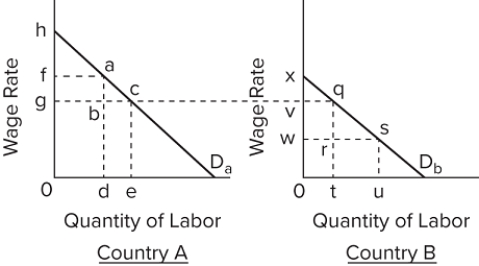 In the accompanying graphs, the pre-migration labor force in country A is 0d and in country B it is 0u. Domestic output in country A will, after the immigration,
 (Multiple Choice)
4.8/5 (79)
(79) What is meant by "beaten path?" How does it influence immigration decisions?
(Essay)
4.8/5 (83)
(83) 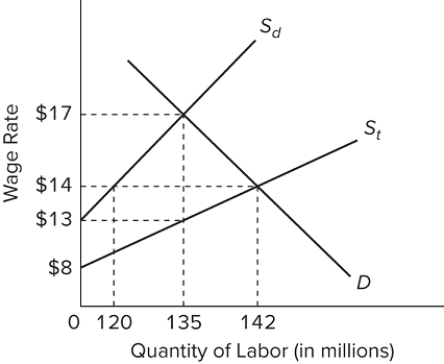 Refer to the graph of the market for low-skilled labor. Sdis the supply of domestic resident workers, and Sₜ is the total supply of labor, including undocumented workers. What are the equilibrium wage rate and equilibrium employment if there is illegal immigration?
 (Multiple Choice)
4.9/5 (75)
(75) 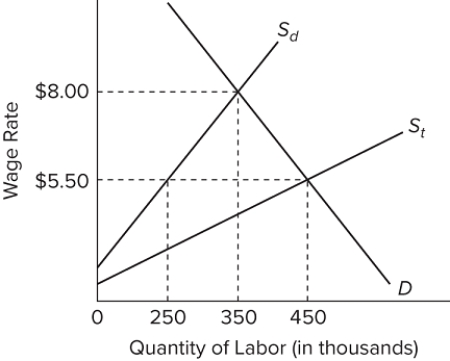 Assumptions: (1)Employers in this market are willing and able to ignore minimum wage laws; (2)Sd represents the supply of domestic-born (and legal immigrant)workers; (3)Sₜ represents the total supply of workers in this labor market (Sd plus illegal immigrants); and (4)unless otherwise stated, illegal immigration is not effectively blocked by the government.Assume initially that government does not effectively block illegal immigration. If the government then finds a way to prevent all illegal immigrants from working in this labor market,
 (Multiple Choice)
4.8/5 (81)
(81) 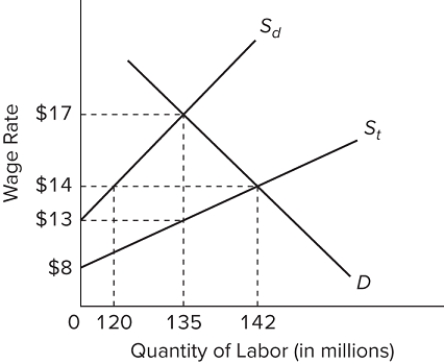 Refer to the graph of the market for low-skilled labor. Sdis the supply of domestic resident workers, and Sₜ is the total supply of labor, including undocumented workers. Suppose the government cuts off the flow of illegal immigrants to this market. By how much will the employment of legal residents be increased?
 (Multiple Choice)
4.8/5 (84)
(84) Inflows of immigrant workers tend to reduce the wages of domestic-born workers. Under which of the following circumstances is this least likely to occur?
(Multiple Choice)
4.7/5 (86)
(86) Between 1996 and 2006, cash welfare payments to immigrants
(Multiple Choice)
4.8/5 (68)
(68) 
Filters
- Essay(0)
- Multiple Choice(0)
- Short Answer(0)
- True False(0)
- Matching(0)