



 Chat with AI
Exam 25: Immigration

Exam 1: Limits, Alternatives, and Choices107 Questions
Exam 2: The Market System and the Circular Flow287 Questions
Exam 3: Demand, Supply, and Market Equilibrium151 Questions
Exam 4: Market Failures Caused by Externalities Asymmetric Information229 Questions
Exam 5: Public Goods, Public Choice, and Government Failure268 Questions
Exam 6: Elasticity399 Questions
Exam 7: Utility Maximization358 Questions
Exam 8: Behavioral Economics311 Questions
Exam 9: Businesses and the Costs of Production445 Questions
Exam 10: Pure Competition in the Short Run342 Questions
Exam 11: Pure Competition in the Long Run250 Questions
Exam 12: Pure Monopoly407 Questions
Exam 13: Monopolistic Competition279 Questions
Exam 14: Oligopoly and Strategic Behavior362 Questions
Exam 15: Technology, RD, and Efficiency309 Questions
Exam 16: The Demand for Resources359 Questions
Exam 17: Wage Determination168 Questions
Exam 18: Rent, Interest, and Profit305 Questions
Exam 19: Natural Resource and Energy Economics337 Questions
Exam 20: Public Finance: Expenditures and Taxes336 Questions
Exam 21: Antitrust Policy and Regulation264 Questions
Exam 22: Agriculture: Economics and Policy265 Questions
Exam 23: Income Inequality, Poverty, and Discrimination324 Questions
Exam 24: Health Care280 Questions
Exam 25: Immigration259 Questions
Exam 26: International Trade347 Questions
Exam 27: The Balance of Payments, Exchange Rates, and Trade Deficits318 Questions
Exam 28: The Economics of Developing Countries277 Questions
Select questions type


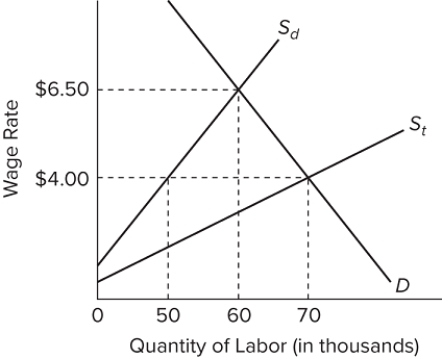 Assumptions: (1)Employers in this market are willing and able to ignore minimum wage laws; (2)Sd represents the supply of domestic-born (and legal immigrant)workers; (3)Sₜ represents the total supply of workers in this labor market (Sd plus illegal immigrants); and (4)unless otherwise stated, illegal immigration is not effectively blocked by the government.Assume initially that government does not effectively block illegal immigration. If the government then finds a way to prevent all illegal immigrants from working in this labor market,
 (Multiple Choice)
4.8/5  (82)
(82) The simple immigration model assumes that the capital stock is constant in each country. If this assumption is relaxed, then the
(Multiple Choice)
4.9/5 (77)
(77) Which of the following is least likely to be considered economic immigration?
(Multiple Choice)
4.9/5 (91)
(91) 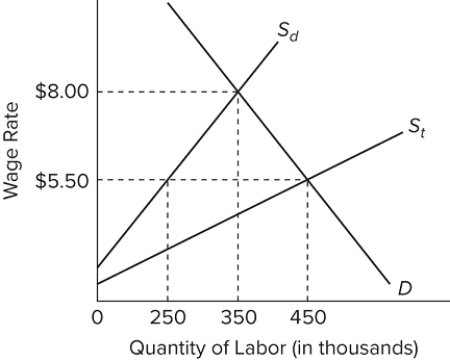 Assumptions: (1)Employers in this market are willing and able to ignore minimum wage laws; (2)Sd represents the supply of domestic-born (and legal immigrant)workers; (3)Sₜ represents the total supply of workers in this labor market (Sd plus illegal immigrants); and (4)unless otherwise stated, illegal immigration is not effectively blocked by the government.If the government effectively prevents illegal immigrants from working in this labor market, the equilibrium wage and level of employment are, respectively,
 (Multiple Choice)
4.9/5 (91)
(91) Illegal immigration can result in higher wages for domestic-born workers who are complementary inputs.
(True/False)
4.7/5 (71)
(71) 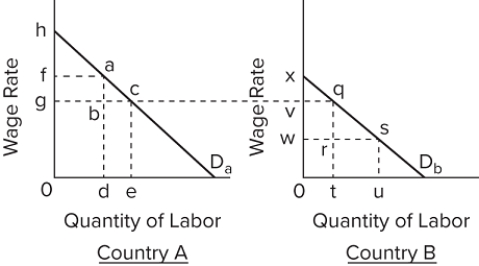 In the accompanying graphs, the pre-migration labor force in country A is 0d and in country B it is 0u. Domestic output in country B will, after the emigration of labor,
 (Multiple Choice)
4.8/5 (75)
(75) If immigration increases the productivity of domestic workers, then it
(Multiple Choice)
4.8/5 (72)
(72) Other things equal, the optimal quantity of immigrants will be greater, the
(Multiple Choice)
4.9/5 (76)
(76)  Assumptions: (1)The demand for labor in Alphania and Betania are as shown by Dₐ and Dᵦ , respectively; (2)Alphania's native labor force is F and that of Betania is g; (3)wage L in Alphania is equal to wage m in Betania; and (4)full employment exists in both countries. If migration is costless and unimpeded, the absolute wage bill will necessarily
 (Multiple Choice)
4.8/5 (78)
(78) Economic theory suggests that immigration should be allowed into a country until the marginal benefit of the last immigrant is zero.
(True/False)
4.9/5 (71)
(71) In 2017, China overtook Mexico to become the number one country of origin of U.S. legal immigrants.
(True/False)
4.9/5 (76)
(76) Illegal immigrants make up about what percentage of all construction workers?
(Multiple Choice)
4.8/5 (78)
(78) 
Filters
- Essay(0)
- Multiple Choice(0)
- Short Answer(0)
- True False(0)
- Matching(0)