



 Chat with AI
Exam 25: Immigration

Exam 1: Limits, Alternatives, and Choices107 Questions
Exam 2: The Market System and the Circular Flow287 Questions
Exam 3: Demand, Supply, and Market Equilibrium151 Questions
Exam 4: Market Failures Caused by Externalities Asymmetric Information229 Questions
Exam 5: Public Goods, Public Choice, and Government Failure268 Questions
Exam 6: Elasticity399 Questions
Exam 7: Utility Maximization358 Questions
Exam 8: Behavioral Economics311 Questions
Exam 9: Businesses and the Costs of Production445 Questions
Exam 10: Pure Competition in the Short Run342 Questions
Exam 11: Pure Competition in the Long Run250 Questions
Exam 12: Pure Monopoly407 Questions
Exam 13: Monopolistic Competition279 Questions
Exam 14: Oligopoly and Strategic Behavior362 Questions
Exam 15: Technology, RD, and Efficiency309 Questions
Exam 16: The Demand for Resources359 Questions
Exam 17: Wage Determination168 Questions
Exam 18: Rent, Interest, and Profit305 Questions
Exam 19: Natural Resource and Energy Economics337 Questions
Exam 20: Public Finance: Expenditures and Taxes336 Questions
Exam 21: Antitrust Policy and Regulation264 Questions
Exam 22: Agriculture: Economics and Policy265 Questions
Exam 23: Income Inequality, Poverty, and Discrimination324 Questions
Exam 24: Health Care280 Questions
Exam 25: Immigration259 Questions
Exam 26: International Trade347 Questions
Exam 27: The Balance of Payments, Exchange Rates, and Trade Deficits318 Questions
Exam 28: The Economics of Developing Countries277 Questions
Select questions type


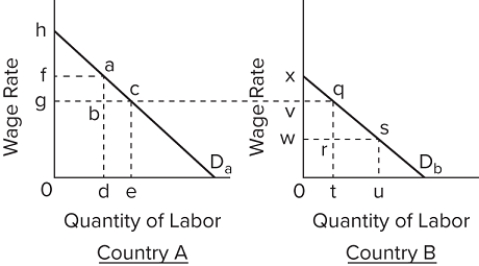 In the accompanying graphs, the pre-migration labor force in country A is 0d and in country B it is 0u. If business income is total output minus total labor cost, then business income in country A after the immigration occurs is equal to area
 (Multiple Choice)
4.9/5  (71)
(71) Which of the following best describes the impact of immigration on complementary resources?
(Multiple Choice)
4.9/5 (81)
(81) In 2017, which of the following countries contributed the largest number of legal immigrants into the U.S.?
(Multiple Choice)
4.7/5 (85)
(85) State three major reasons why people immigrate to the United States.
(Essay)
4.8/5 (83)
(83) Immigrants made up approximately what percentage of the U.S. labor force in 2017?
(Multiple Choice)
4.9/5 (89)
(89) The outflow of highly educated workers from low-income countries to high-income countries is called
(Multiple Choice)
4.9/5 (76)
(76)  Symbols: Q = number of workers demanded; W = wage rate; and VTP = value of the cumulative total product (output)of the particular number of workers. Assumptions: (1)The current wage in Zinnia is $20, and the current wage in Marigold is $12; (2)full employment exists in both countries.At the current wage rate, the combined number of workers in the two nations is
 (Multiple Choice)
4.8/5 (65)
(65)  Symbols: Q = number of workers demanded; W = wage rate; and VTP = value of the cumulative total product (output)of the particular number of workers. Assumptions: (1)The current wage in Zinnia is $18, and the current wage in Marigold is $14; (2)full employment exists in both countries. If migration is costless and unimpeded,
 (Multiple Choice)
4.8/5 (86)
(86) Which of the following statements is most accurate about welfare utilization by immigrant and nonimmigrant households (households with minor children)in 2014?
(Multiple Choice)
4.7/5 (76)
(76) 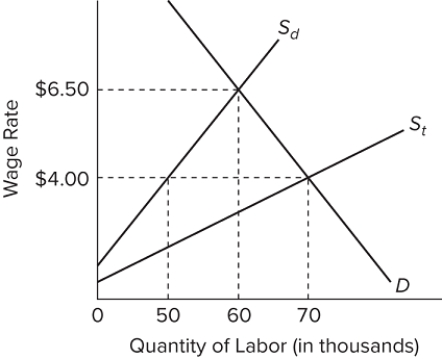 Assumptions: (1)Employers in this market are willing and able to ignore minimum wage laws; (2)Sd represents the supply of domestic-born (and legal immigrant)workers; (3)Sₜ represents the total supply of workers in this labor market (Sd plus illegal immigrants); and (4)unless otherwise stated, illegal immigration is not effectively blocked by the government.How many illegal immigrant workers will be hired at equilibrium?
 (Multiple Choice)
5.0/5 (86)
(86) 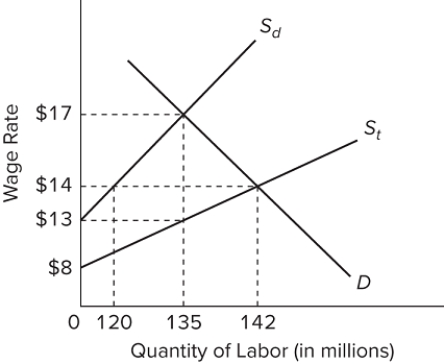 Refer to the graph of the market for low-skilled labor. Sdis the supply of domestic resident workers, and Sₜ is the total supply of labor, including undocumented workers. If there are illegal immigrants in the market, how many illegal immigrants will be employed?
 (Multiple Choice)
4.9/5 (78)
(78) In 2017, immigrants made up a larger portion of the labor force in the U.S. than in Australia.
(True/False)
4.8/5 (81)
(81) From 2000 to 2009, the net annual inflow of illegal immigrants averaged about
(Multiple Choice)
4.8/5 (75)
(75) In the destination country, who tends to lose from labor immigration?
(Multiple Choice)
4.9/5 (81)
(81)  Symbols: Q = number of workers demanded; W = wage rate; and VTP = value of the cumulative total product (output)of the particular number of workers. Assumptions: (1)The current wage in Zinnia is $20, and the current wage in Marigold is $12; (2)full employment exists in both countries.At the current wage rate, the combined number of workers in the two nations is
 (Multiple Choice)
5.0/5 (71)
(71) Any migration that affects the economies of the countries involved is referred to as "economic immigration."
(True/False)
4.8/5 (75)
(75) The main driver of economic immigration is the opportunity to improve earnings and living standards.
(True/False)
4.7/5 (74)
(74) 
Filters
- Essay(0)
- Multiple Choice(0)
- Short Answer(0)
- True False(0)
- Matching(0)