



 Chat with AI
Exam 25: Immigration

Exam 1: Limits, Alternatives, and Choices107 Questions
Exam 2: The Market System and the Circular Flow287 Questions
Exam 3: Demand, Supply, and Market Equilibrium151 Questions
Exam 4: Market Failures Caused by Externalities Asymmetric Information229 Questions
Exam 5: Public Goods, Public Choice, and Government Failure268 Questions
Exam 6: Elasticity399 Questions
Exam 7: Utility Maximization358 Questions
Exam 8: Behavioral Economics311 Questions
Exam 9: Businesses and the Costs of Production445 Questions
Exam 10: Pure Competition in the Short Run342 Questions
Exam 11: Pure Competition in the Long Run250 Questions
Exam 12: Pure Monopoly407 Questions
Exam 13: Monopolistic Competition279 Questions
Exam 14: Oligopoly and Strategic Behavior362 Questions
Exam 15: Technology, RD, and Efficiency309 Questions
Exam 16: The Demand for Resources359 Questions
Exam 17: Wage Determination168 Questions
Exam 18: Rent, Interest, and Profit305 Questions
Exam 19: Natural Resource and Energy Economics337 Questions
Exam 20: Public Finance: Expenditures and Taxes336 Questions
Exam 21: Antitrust Policy and Regulation264 Questions
Exam 22: Agriculture: Economics and Policy265 Questions
Exam 23: Income Inequality, Poverty, and Discrimination324 Questions
Exam 24: Health Care280 Questions
Exam 25: Immigration259 Questions
Exam 26: International Trade347 Questions
Exam 27: The Balance of Payments, Exchange Rates, and Trade Deficits318 Questions
Exam 28: The Economics of Developing Countries277 Questions
Select questions type


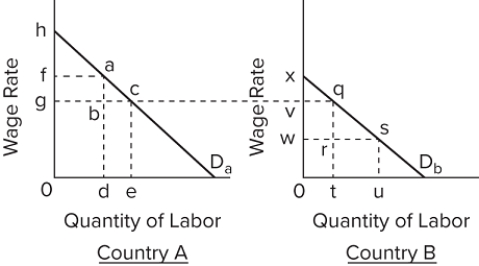 In the accompanying graphs, the pre-migration labor force in country A is 0 d and in country B it is 0 u. The migration of labor from low-income country B to high-income country A will
 (Multiple Choice)
4.8/5  (75)
(75) When an immigrant sends a remittance from his host country to his family in his home country, the benefits of immigration to the
(Multiple Choice)
4.8/5 (78)
(78) Other things equal, immigration has what effects on the destination nation?
(Multiple Choice)
4.7/5 (90)
(90) 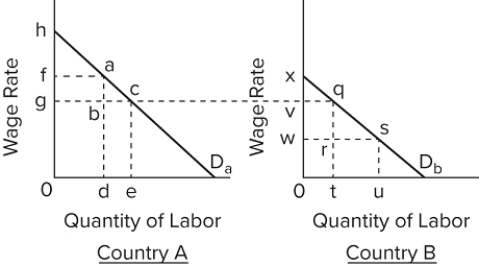 In the accompanying graphs, the pre-migration labor force in country A is 0d and in country B it is 0u. What part of domestic output in country A is the total wage bill, or total wage income, before and after the immigration?
 (Multiple Choice)
4.8/5 (75)
(75) How can the migration distance affect the cost-benefit evaluation of moving to another nation?
(Essay)
4.8/5 (71)
(71) Which of the following individuals is most likely to migrate to Switzerland, assuming that all face equally good prospects of securing a good job after arrival?
(Multiple Choice)
5.0/5 (79)
(79) Suppose that Rosa is considering migration to another country. To move, she will have to spend $4,000 on transportation and $6,000 in application and other processing fees. Rosa's stream of future earnings in her home country is $400,000. She expects to earn a stream of future earnings of $750,000 in another country. Based on this information, Rosa will decide to migrate as long as the implicit costs of leaving her friends and family and adjusting to a new culture are
(Multiple Choice)
5.0/5 (76)
(76) Welfare reform in 1996 reversed the trend of growing welfare payments to immigrants.
(True/False)
4.8/5 (67)
(67) The voluntary relocation of employable migrants from low-paying nations to high-paying nations reduces
(Multiple Choice)
4.7/5 (71)
(71) The average fiscal burden on state and local government for each low-skilled immigrant household may be as high as
(Multiple Choice)
4.9/5 (82)
(82) Under what circumstances will immigration be most likely to equalize wage rates across countries?
(Multiple Choice)
4.8/5 (90)
(90) There was a spike in U.S. legal immigration from 1989 to 1991 due to
(Multiple Choice)
4.7/5 (77)
(77) With labor migration, the amount of change in the destination country's wage rates depends on the
(Multiple Choice)
4.8/5 (84)
(84) Summarize the main research conclusions found by prominent economists on the economic effects of immigration.
(Essay)
4.7/5 (77)
(77) 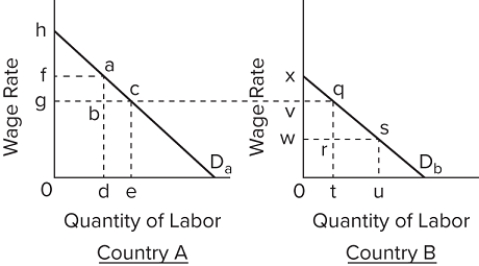 In the accompanying graphs, the pre-migration labor force in country A is 0d and in country B it is 0u. If business income is total output minus total labor cost, then business income in country B after emigration occurs
 (Multiple Choice)
4.9/5 (81)
(81) 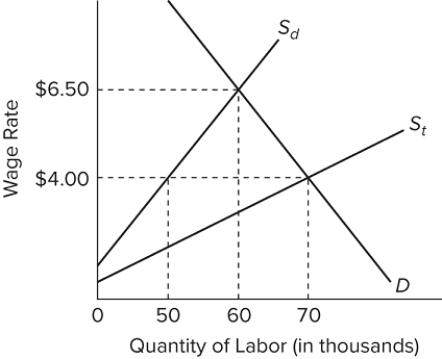 Assumptions: (1)Employers in this market are willing and able to ignore minimum wage laws; (2)Sd represents the supply of domestic-born (and legal immigrant)workers; (3)Sₜ represents the total supply of workers in this labor market (Sd plus illegal immigrants); and (4)unless otherwise stated, illegal immigration is not effectively blocked by the government.The equilibrium wage and level of employment are, respectively,
 (Multiple Choice)
4.9/5 (91)
(91) Which of the following statements is true about migration behavior?
(Multiple Choice)
4.9/5 (76)
(76)  Symbols: Q = number of workers demanded; W = wage rate; and VTP = value of the cumulative total product (output)of the particular number of workers. Assumptions: (1)The current wage in Zinnia is $20, and the current wage in Marigold is $12; (2)full employment exists in both countries. If migration is costless and unimpeded,
 (Multiple Choice)
4.9/5 (75)
(75) If the elasticity of demand for labor in the United States is unitary, immigration into the United States can be expected to
(Multiple Choice)
4.8/5 (69)
(69) 
Filters
- Essay(0)
- Multiple Choice(0)
- Short Answer(0)
- True False(0)
- Matching(0)