



 Chat with AI
Exam 3: Demand, Supply, and Market Equilibrium

Exam 2: The Market System and the Circular Flow274 Questions
Exam 3: Demand, Supply, and Market Equilibrium357 Questions
Exam 4: Market Failures Caused by Externalities Asymmetric Information222 Questions
Exam 5: Public Goods, Public Choice, and Government Failure242 Questions
Exam 6: An Introduction to Macroeconomics243 Questions
Exam 7: Measuring Domestic Output and National Income238 Questions
Exam 8: Economic Growth274 Questions
Exam 9: Business Cycles, Unemployment, and Inflation298 Questions
Exam 10: Basic Macroeconomic Relationships233 Questions
Exam 11: The Aggregate Expenditures Model126 Questions
Exam 12: Aggregate Demand and Aggregate Supply320 Questions
Exam 13: Fiscal Policy, Deficits, and Debt401 Questions
Exam 14: Money, Banking, and Financial Institutions265 Questions
Exam 15: Money Creation285 Questions
Exam 16: Interest Rates and Monetary Policy405 Questions
Exam 17: Financial Economics356 Questions
Exam 18: Extending the Analysis of Aggregate Supply268 Questions
Exam 19: Current Issues in Macro Theory and Policy279 Questions
Exam 20: International Trade339 Questions
Exam 21: The Balance of Payments, Exchange Rates, and Trade Deficits315 Questions
Exam 22: The Economics of Developing Countries269 Questions
Select questions type


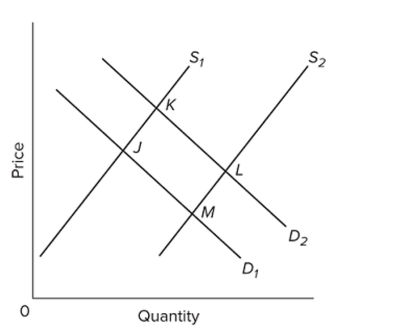 Refer to the diagram, in which S1 and D1 represent the original supply and demand curves and S2 and D2 the new curves. In this market
 (Multiple Choice)
4.8/5  (74)
(74) Which of the following will cause a decrease in market equilibrium price and an increase in equilibrium quantity?
(Multiple Choice)
5.0/5 (85)
(85) If the price of Pepsi decreases, other factors constant, then we'd expect to see a consequent shift of the demand curve for
(Multiple Choice)
4.9/5 (74)
(74) (1) (2) (3) (4) (5) Price 50 40 \ 10 70 80 60 50 9 60 70 80 60 8 50 60 90 70 7 40 50 100 80 6 30 40 Refer to the table. In relation to column (3), a change from column (2) to column (1) would indicate a(n)
(Multiple Choice)
4.8/5 (82)
(82) The idea of the Law of Demand, as applied to electric cars, assumes which of the following to be constant?
(Multiple Choice)
4.9/5 (86)
(86) Camille's Creations and Julia's Jewels both sell beads in a competitive market. If at the market price of $5 both are running out of beads to sell (they can't keep up with the quantity demanded at that
Price), then we would expect both Camille's and Julia's to
(Multiple Choice)
4.8/5 (93)
(93) (Advanced analysis) The demand for commodity X is represented by the equation P = 100 - 2Q and supply by the equation P = 10 + 4Q. The equilibrium quantity is
(Multiple Choice)
4.8/5 (78)
(78) (Last Word) In examining the relationship between student loans and college tuition, researchers found that
(Multiple Choice)
4.9/5 (76)
(76) If products C and D are close substitutes, an increase in the price of C will
(Multiple Choice)
4.8/5 (62)
(62) Which of the following would cause a leftward shift in the supply curve for car washes?
(Multiple Choice)
4.9/5 (86)
(86) An increase in the excise tax on cigarettes raises the price of cigarettes by shifting the
(Multiple Choice)
4.8/5 (87)
(87) Assume in a competitive market that price is initially above the equilibrium level. We can predict that price will
(Multiple Choice)
4.9/5 (70)
(70) In the following question you are asked to determine, other things equal, the effects of a given change in a determinant of demand or supply for product X upon (1) the demand (D) for, or supply (S)
Of, X; (2) the equilibrium price (P) of X; and (3) the equilibrium quantity (Q) of X.
An improvement in the technology used to produce X will
(Multiple Choice)
4.8/5 (75)
(75) If there was initially a shortage in the market for a product, then
(Multiple Choice)
4.9/5 (76)
(76) (Advanced analysis) The demand for commodity X is represented by the equation P = 10 - 0.2Q and supply by the equation P = 2 + 0.2Q. The equilibrium quantity is
(Multiple Choice)
4.8/5 (77)
(77) 
Filters
- Essay(0)
- Multiple Choice(0)
- Short Answer(0)
- True False(0)
- Matching(0)