



 Chat with AI
Exam 3: Demand, Supply, and Market Equilibrium

Exam 2: The Market System and the Circular Flow274 Questions
Exam 3: Demand, Supply, and Market Equilibrium357 Questions
Exam 4: Market Failures Caused by Externalities Asymmetric Information222 Questions
Exam 5: Public Goods, Public Choice, and Government Failure242 Questions
Exam 6: An Introduction to Macroeconomics243 Questions
Exam 7: Measuring Domestic Output and National Income238 Questions
Exam 8: Economic Growth274 Questions
Exam 9: Business Cycles, Unemployment, and Inflation298 Questions
Exam 10: Basic Macroeconomic Relationships233 Questions
Exam 11: The Aggregate Expenditures Model126 Questions
Exam 12: Aggregate Demand and Aggregate Supply320 Questions
Exam 13: Fiscal Policy, Deficits, and Debt401 Questions
Exam 14: Money, Banking, and Financial Institutions265 Questions
Exam 15: Money Creation285 Questions
Exam 16: Interest Rates and Monetary Policy405 Questions
Exam 17: Financial Economics356 Questions
Exam 18: Extending the Analysis of Aggregate Supply268 Questions
Exam 19: Current Issues in Macro Theory and Policy279 Questions
Exam 20: International Trade339 Questions
Exam 21: The Balance of Payments, Exchange Rates, and Trade Deficits315 Questions
Exam 22: The Economics of Developing Countries269 Questions
Select questions type


(Advanced analysis) The demand for commodity X is represented by the equation P = 100 - 2Q and supply by the equation P = 10 + 4Q. If demand changes from P = 100 - 2Q to P = 130 - Q, the new
Equilibrium quantity is
(Multiple Choice)
4.9/5  (74)
(74) The table below shows the weekly demand for hamburgers in a market where there are just three buyers.
Price Buyer 1Qd 1 Buyer 2 Qd 2 Buyer 3 Qd 3 \ 6 7 4 6 5 9 7 8 4 15 10 12 3 21 15 16 At a price of $6, the weekly market quantity demanded for hamburger is
(Multiple Choice)
4.8/5 (82)
(82) An increase in the demand for online streaming music indicates that more is
(Multiple Choice)
4.9/5 (78)
(78) Quantity Demanded Price Quantity Supplied 52 \ 50 73 62 45 62 72 40 51 82 35 42 92 30 33 In this market, economists would call a government-set maximum price of $40 a
(Multiple Choice)
4.8/5 (90)
(90) If an effective ceiling price is placed on hamburgers, then
(Multiple Choice)
4.9/5 (67)
(67) 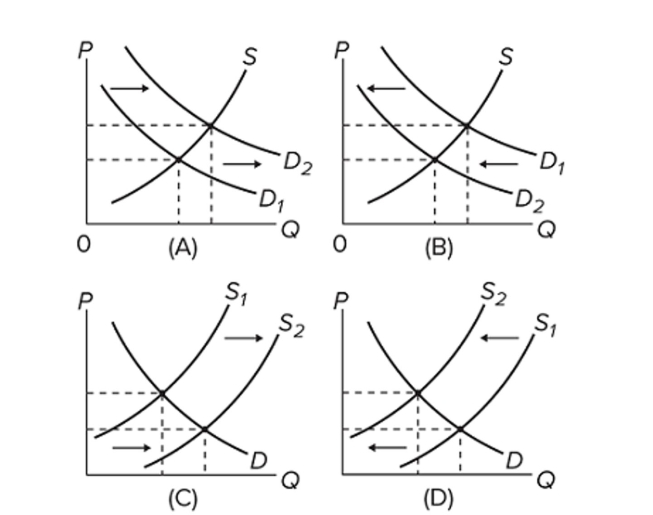 Which of the diagrams illustrates the effect of a governmental subsidy on the market for AIDS research?
 (Multiple Choice)
4.9/5 (81)
(81) 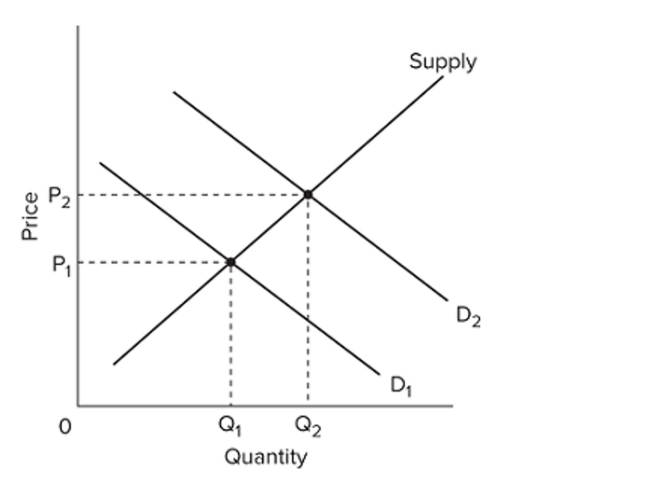 Refer to the above graph showing the market for a product. Which of the following would best explain why the shift in demand from D1 to D2 would cause price to rise from P1 to P2?
 (Multiple Choice)
4.8/5 (76)
(76) Price Per Unit Quantity Demanded Per Year Quantity Supplied Per Year \ 5 2,000 0 10 1,800 300 15 1,600 600 20 1,400 900 25 1,200 1,200 30 1,000 1,500 Refer to the above table. A surplus of 500 units will occur when the price is
(Multiple Choice)
4.9/5 (86)
(86) Suppose that at prices of $1, $2, $3, $4, and $5 for product Z, the corresponding quantities supplied are 3, 4, 5, 6, and 7 units, respectively. Which of the following would increase the quantities supplied
Of Z to, say, 6, 8, 10, 12, and 14 units at these prices?
(Multiple Choice)
4.7/5 (87)
(87) Sometimes, we observe cases where the price of a product rose and the quantity bought by buyers also increased. Such cases occur due to a violation of the
(Multiple Choice)
4.9/5 (72)
(72) Data from the registrar's office at Gigantic State University indicate that over the past 20 years tuition and enrollment have both increased. From this information we can conclude that
(Multiple Choice)
5.0/5 (75)
(75) In which of the following statements are the terms "demand" and "quantity demanded" used correctly?
(Multiple Choice)
5.0/5 (82)
(82) 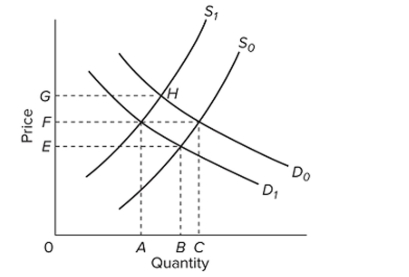 Refer to the diagram, which shows demand and supply conditions in the competitive market for product X. A shift in the demand curve from D0 to D1 might be caused by a(n)
 (Multiple Choice)
4.8/5 (80)
(80) In the following question you are asked to determine, other things equal, the effects of a given change in a determinant of demand or supply for product X upon (1) the demand (D) for, or supply (S)
Of, X; (2) the equilibrium price (P) of X; and (3) the equilibrium quantity (Q) of X.
An increase in the price of a product that is a close substitute for X will
(Multiple Choice)
4.8/5 (78)
(78) With a downsloping demand curve and an upsloping supply curve for a product, a decrease in resource prices will
(Multiple Choice)
4.8/5 (83)
(83) 
Filters
- Essay(0)
- Multiple Choice(0)
- Short Answer(0)
- True False(0)
- Matching(0)