



 Chat with AI
Exam 3: Demand, Supply, and Market Equilibrium

Exam 2: The Market System and the Circular Flow274 Questions
Exam 3: Demand, Supply, and Market Equilibrium357 Questions
Exam 4: Market Failures Caused by Externalities Asymmetric Information222 Questions
Exam 5: Public Goods, Public Choice, and Government Failure242 Questions
Exam 6: An Introduction to Macroeconomics243 Questions
Exam 7: Measuring Domestic Output and National Income238 Questions
Exam 8: Economic Growth274 Questions
Exam 9: Business Cycles, Unemployment, and Inflation298 Questions
Exam 10: Basic Macroeconomic Relationships233 Questions
Exam 11: The Aggregate Expenditures Model126 Questions
Exam 12: Aggregate Demand and Aggregate Supply320 Questions
Exam 13: Fiscal Policy, Deficits, and Debt401 Questions
Exam 14: Money, Banking, and Financial Institutions265 Questions
Exam 15: Money Creation285 Questions
Exam 16: Interest Rates and Monetary Policy405 Questions
Exam 17: Financial Economics356 Questions
Exam 18: Extending the Analysis of Aggregate Supply268 Questions
Exam 19: Current Issues in Macro Theory and Policy279 Questions
Exam 20: International Trade339 Questions
Exam 21: The Balance of Payments, Exchange Rates, and Trade Deficits315 Questions
Exam 22: The Economics of Developing Countries269 Questions
Select questions type


(Advanced analysis) The equation for the supply curve in the diagram shown is approximately 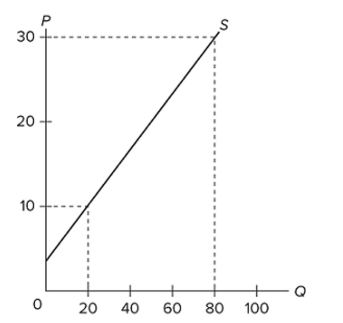
(Multiple Choice)
4.8/5  (68)
(68) If a price ceiling is set below the equilibrium price in a market,
(Multiple Choice)
4.8/5 (76)
(76) 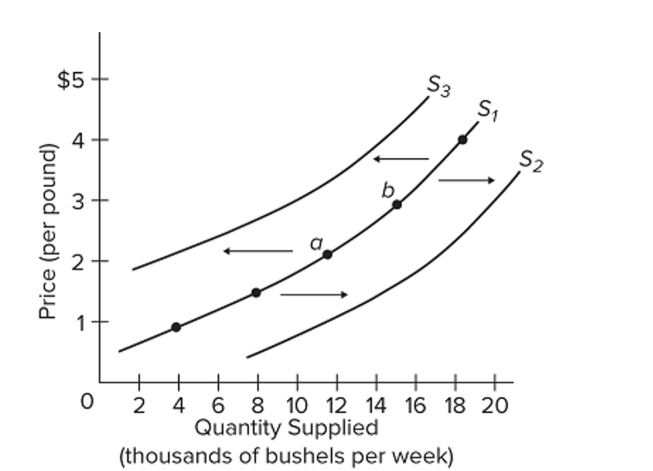 Refer to the figure above, which shows three supply curves for corn. Which of the following would cause the supply of corn to shift from S1 to S2?
 (Multiple Choice)
4.8/5 (76)
(76) The figure below shows three demand curves for coffee. 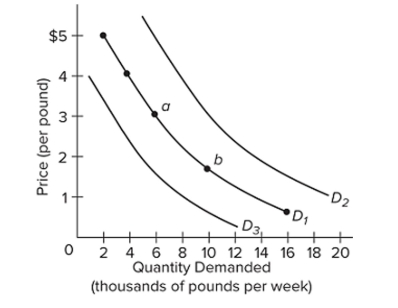 An increase in the price of coffee, other factors constant, would cause a
 (Multiple Choice)
4.8/5 (78)
(78) (Advanced analysis) The demand for commodity X is represented by the equation P = 10 - 0.2Q and supply by the equation P = 2 + 0.2Q. The equilibrium price for X is
(Multiple Choice)
4.8/5 (82)
(82) (Consider This) Suppose that salsa manufacturers sell 2 million bottles at $3.50 in one year and 3 million bottles at $3 in the next year. Based on this information, we can conclude that the
(Multiple Choice)
4.7/5 (75)
(75) 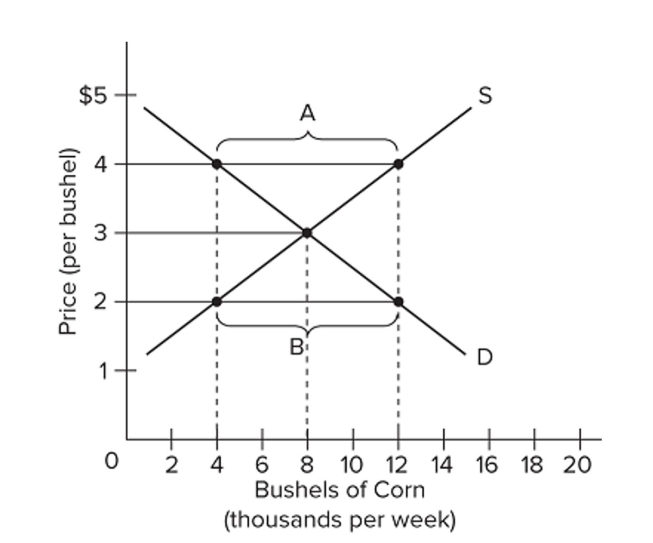 Refer to the above diagram of the market for corn. If the price in this market is at $4 per bushel, then there will be a
 (Multiple Choice)
4.9/5 (77)
(77) A news story states that "DVDs lose their appeal as consumers switch to online streaming for movies." In a competitive market for DVDs, this situation would lead to a(n)
(Multiple Choice)
4.8/5 (77)
(77) Price Per Unit Quantity Demanded Per Year Quantity Supplied Per Year \ 5 2,000 0 10 1,800 300 15 1,600 600 20 1,400 900 25 1,200 1,200 30 1,000 1,500 Refer to the above table. At a price of $15 per unit, which of the following would exist?
(Multiple Choice)
4.9/5 (87)
(87) In the following question you are asked to determine, other things equal, the effects of a given change in a determinant of demand or supply for product X upon (1) the demand (D) for, or supply (S)
Of, X; (2) the equilibrium price (P) of X; and (3) the equilibrium quantity (Q) of X.
Consumer expectations that the price of X will rise sharply in the future will
(Multiple Choice)
4.8/5 (76)
(76) Which would best explain a decrease in both the price and the quantity of a product over a period of time?
(Multiple Choice)
4.9/5 (72)
(72) If farmers withhold some of their current corn harvest from the market because they anticipate a higher price of corn in the near future, then this would cause a(n)
(Multiple Choice)
5.0/5 (88)
(88) Two months ago, the Maryville Shirt company sold 2,000 shirts at $30 per shirt. Last month the company raised its price to $35 per shirt and sold 3,000 shirts. Evidently the company experienced
A(n)
(Multiple Choice)
4.9/5 (91)
(91) 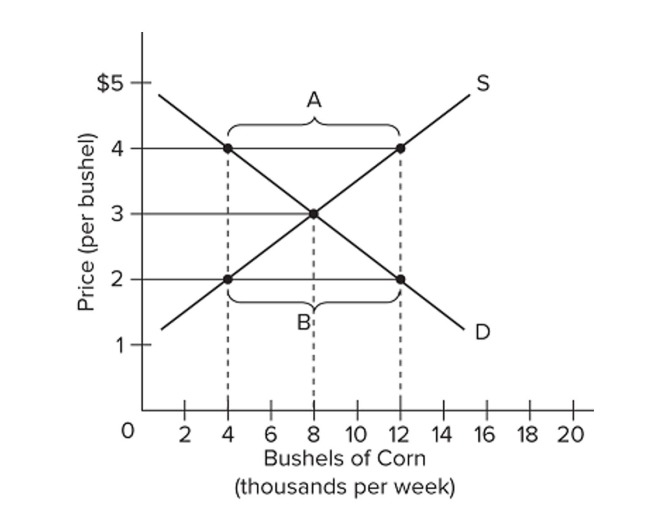 Refer to the above diagram illustrating the market for corn. If the price in this market is fixed at $2 per bushel, then
 (Multiple Choice)
4.9/5 (77)
(77) Suppose that goods A and B are close substitutes. If the price of good A falls, then we would expect an
(Multiple Choice)
4.8/5 (78)
(78) When the price of a product increases, a consumer is able to buy less of it with a given money income. This describes the
(Multiple Choice)
5.0/5 (78)
(78) If a legal ceiling price is set above the equilibrium price,
(Multiple Choice)
4.9/5 (69)
(69) 
Filters
- Essay(0)
- Multiple Choice(0)
- Short Answer(0)
- True False(0)
- Matching(0)