



 Chat with AI
Exam 3: Demand, Supply, and Market Equilibrium

Exam 2: The Market System and the Circular Flow274 Questions
Exam 3: Demand, Supply, and Market Equilibrium357 Questions
Exam 4: Market Failures Caused by Externalities Asymmetric Information222 Questions
Exam 5: Public Goods, Public Choice, and Government Failure242 Questions
Exam 6: An Introduction to Macroeconomics243 Questions
Exam 7: Measuring Domestic Output and National Income238 Questions
Exam 8: Economic Growth274 Questions
Exam 9: Business Cycles, Unemployment, and Inflation298 Questions
Exam 10: Basic Macroeconomic Relationships233 Questions
Exam 11: The Aggregate Expenditures Model126 Questions
Exam 12: Aggregate Demand and Aggregate Supply320 Questions
Exam 13: Fiscal Policy, Deficits, and Debt401 Questions
Exam 14: Money, Banking, and Financial Institutions265 Questions
Exam 15: Money Creation285 Questions
Exam 16: Interest Rates and Monetary Policy405 Questions
Exam 17: Financial Economics356 Questions
Exam 18: Extending the Analysis of Aggregate Supply268 Questions
Exam 19: Current Issues in Macro Theory and Policy279 Questions
Exam 20: International Trade339 Questions
Exam 21: The Balance of Payments, Exchange Rates, and Trade Deficits315 Questions
Exam 22: The Economics of Developing Countries269 Questions
Select questions type


Which of the following statements is true about price ceilings?
(Multiple Choice)
4.9/5  (84)
(84) A newspaper reports that the average price of new homes in a certain city had decreased, and the number of new homes sold had also decreased. This situation is probably caused by
(Multiple Choice)
4.9/5 (78)
(78) A market that is achieving allocative efficiency also is assumed to be achieving productive
efficiency.
(True/False)
4.9/5 (80)
(80) The table below shows the weekly demand for hamburgers in a market where there are just three buyers.
Price Buyer 1Qd 1 Buyer 2 Qd 2 Buyer 3 Qd 3 \ 6 7 4 6 5 9 7 8 4 15 10 12 3 21 15 16 If the price of hamburger falls from $5 to $3, then the weekly market quantity demanded will
(Multiple Choice)
4.8/5 (67)
(67) Which of the following will not cause a change in the demand for product A?
(Multiple Choice)
4.8/5 (73)
(73) If product Y is an inferior good, a decrease in consumer incomes will
(Multiple Choice)
4.8/5 (83)
(83) 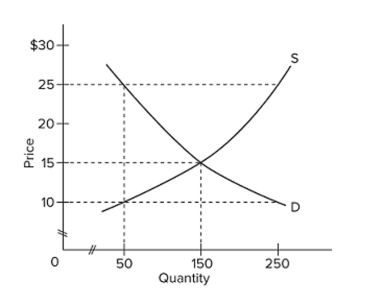 In a competitive market illustrated by the diagram above, for a price floor to be effective and alter the market situation, it must be set
 (Multiple Choice)
4.8/5 (85)
(85) (Advanced analysis) The demand for commodity X is represented by the equation P = 100 - 2Q and supply by the equation P = 10 + 4Q. The equilibrium price is
(Multiple Choice)
4.9/5 (99)
(99) 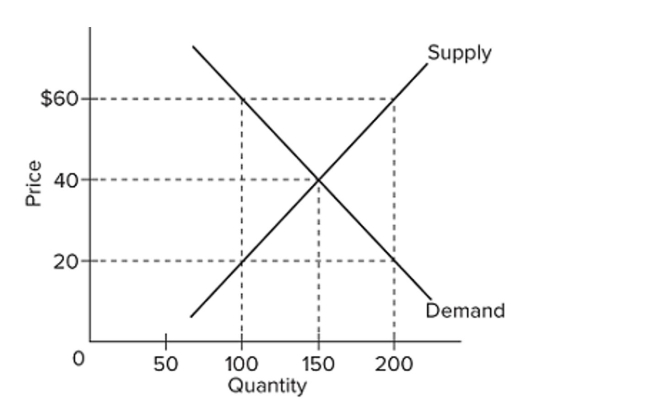 Refer to the diagram. A price of $20 in this market will result in a
 (Multiple Choice)
4.8/5 (89)
(89) (Advanced analysis) The demand for commodity X is represented by the equation P = 10 - 0.2Q and supply by the equation P = 2 + 0.2Q. If demand changes from P = 10 - 0.2Q to P = 7 - 0.3Q, the new
Equilibrium quantity is
(Multiple Choice)
4.9/5 (79)
(79) 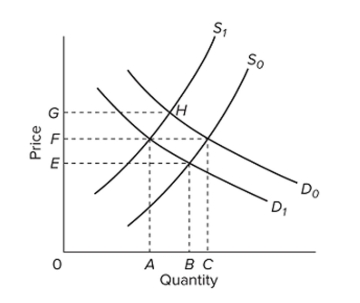 Refer to the diagram, which shows demand and supply conditions in the competitive market for product X. Given D0, if the supply curve moved from S0 to S1, then
 (Multiple Choice)
4.8/5 (94)
(94) 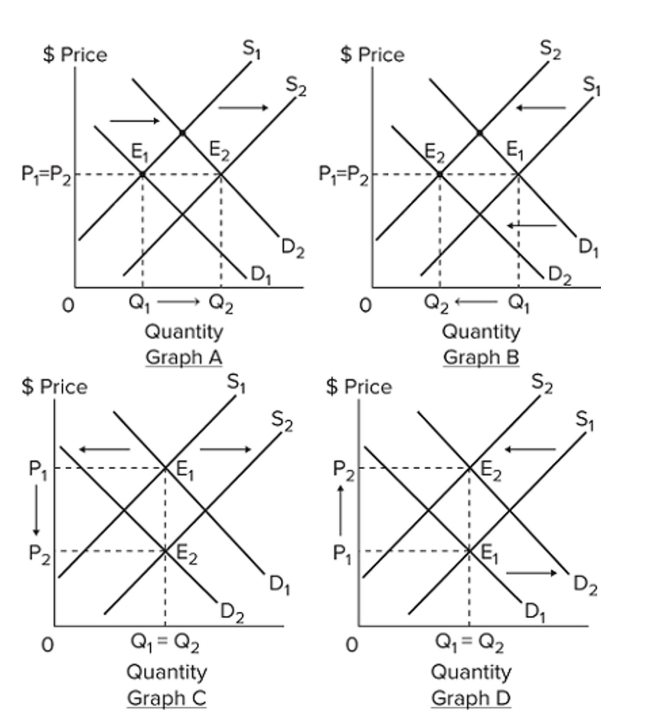 Refer to the four graphs above. In which graph would the indicated shifts cause equilibrium quantity to definitely rise, but the effect on price is indeterminate?
 (Multiple Choice)
4.8/5 (80)
(80) Because successive units of a good produce less and less additional satisfaction, the price must fall to encourage a buyer to purchase more units of the good. This statement is most consistent with
Which explanation for the law of demand?
(Multiple Choice)
4.7/5 (61)
(61) In the following question you are asked to determine, other things equal, the effects of a given change in a determinant of demand or supply for product X upon (1) the demand (D) for, or supply (S)
Of, X; (2) the equilibrium price (P) of X; and (3) the equilibrium quantity (Q) of X.
An increase in the price of a product that is a complement to X will
(Multiple Choice)
4.8/5 (75)
(75) 
Filters
- Essay(0)
- Multiple Choice(0)
- Short Answer(0)
- True False(0)
- Matching(0)