



 Chat with AI
Exam 15: Money Creation

Exam 2: The Market System and the Circular Flow274 Questions
Exam 3: Demand, Supply, and Market Equilibrium357 Questions
Exam 4: Market Failures Caused by Externalities Asymmetric Information222 Questions
Exam 5: Public Goods, Public Choice, and Government Failure242 Questions
Exam 6: An Introduction to Macroeconomics243 Questions
Exam 7: Measuring Domestic Output and National Income238 Questions
Exam 8: Economic Growth274 Questions
Exam 9: Business Cycles, Unemployment, and Inflation298 Questions
Exam 10: Basic Macroeconomic Relationships233 Questions
Exam 11: The Aggregate Expenditures Model126 Questions
Exam 12: Aggregate Demand and Aggregate Supply320 Questions
Exam 13: Fiscal Policy, Deficits, and Debt401 Questions
Exam 14: Money, Banking, and Financial Institutions265 Questions
Exam 15: Money Creation285 Questions
Exam 16: Interest Rates and Monetary Policy405 Questions
Exam 17: Financial Economics356 Questions
Exam 18: Extending the Analysis of Aggregate Supply268 Questions
Exam 19: Current Issues in Macro Theory and Policy279 Questions
Exam 20: International Trade339 Questions
Exam 21: The Balance of Payments, Exchange Rates, and Trade Deficits315 Questions
Exam 22: The Economics of Developing Countries269 Questions
Select questions type


Banks pursue two conflicting goals. Explain what they are and why the conflict.
(Essay)
4.9/5  (71)
(71) The primary purpose of the legal reserve requirement is to
(Multiple Choice)
4.8/5 (78)
(78) The claims of depositors of a bank against the bank's assets are called
(Multiple Choice)
4.9/5 (71)
(71) An individual deposits $12,000 in a commercial bank. The bank is required to hold 10 percent of all deposits on reserve at the regional Federal Reserve Bank. The deposit increases the loan capacity of the bank by
(Multiple Choice)
4.9/5 (88)
(88) The maximum deposit creation that can be made in the banking system is equal to the excess reserves divided by
the required reserve ratio.
(True/False)
4.8/5 (73)
(73) If the reserve ratio is 15 percent and commercial bankers decide to hold additional excess reserves equal to 5 percent of any newly acquired checkable deposits, then the relevant monetary multiplier for the banking system
Will be
(Multiple Choice)
4.8/5 (68)
(68) Reserve Requirement (\%) Checkable Deposits Actual Reserves Excess Reserves (1) \ 100,000 \ 10,000 \ 0 (2) 8 20,000 12,000 (3) 12 200,000 8,000 (4) 20 300,000 70,000 The accompanying table gives data for a commercial bank or thrift. In row 4, the number appropriate for space Z is
(Multiple Choice)
4.9/5 (87)
(87) 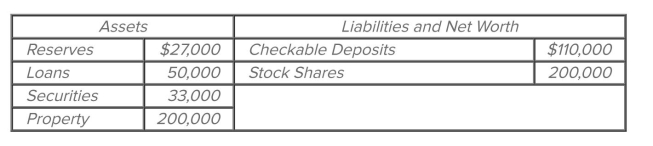 Refer to the accompanying balance sheet for the ABC National Bank. Assume the required reserve ratio is 20 percent. Assuming the bank loans out all of its remaining excess reserves as a checkable deposit and has a check
Cleared against it for that amount, its reserves and checkable deposits will now be
Refer to the accompanying balance sheet for the ABC National Bank. Assume the required reserve ratio is 20 percent. Assuming the bank loans out all of its remaining excess reserves as a checkable deposit and has a check
Cleared against it for that amount, its reserves and checkable deposits will now be (Multiple Choice)
5.0/5 (79)
(79) (1) (2) (3) Legal Reserve Ratio (\%) Checkable Deposits Actual Reserves 10 \ 40,000 \ 10,000 20 40,000 10,000 25 40,000 10,000 30 40,000 10,000 The accompanying table gives data for a commercial bank or thrift. When the legal reserve ratio is 30 percent, the monetary multiplier is
(Multiple Choice)
4.9/5 (74)
(74) If the required reserve ratio were 15 percent, the value of the monetary multiplier would be
(Multiple Choice)
4.8/5 (81)
(81)  The accompanying balance sheet is for the First Federal Bank. Assume the required reserve ratio is 20 percent. If the original bank balance sheet was for the whole commercial banking system rather than a single bank, loans
And deposits could have been expanded by a maximum of
The accompanying balance sheet is for the First Federal Bank. Assume the required reserve ratio is 20 percent. If the original bank balance sheet was for the whole commercial banking system rather than a single bank, loans
And deposits could have been expanded by a maximum of (Multiple Choice)
4.8/5 (84)
(84) The ABC Commercial Bank has $5,000 in excess reserves, and the reserve ratio is 30 percent. This information is consistent with the bank having
(Multiple Choice)
4.9/5 (79)
(79) If the reserve requirement is 20 percent, the monetary multiplier will be 4.
(True/False)
4.7/5 (82)
(82) What is one significant consequence of fractional reserve banking?
(Multiple Choice)
4.9/5 (82)
(82) If banks borrow from the Fed, the banking system's reserves will increase, but if banks borrow from one another,
the banking system's reserves will not change.
(True/False)
4.8/5 (89)
(89) The amount that a commercial bank can lend is determined by its
(Multiple Choice)
4.8/5 (85)
(85) 
Filters
- Essay(0)
- Multiple Choice(0)
- Short Answer(0)
- True False(0)
- Matching(0)