



 Chat with AI
Exam 15: Money Creation

Exam 2: The Market System and the Circular Flow274 Questions
Exam 3: Demand, Supply, and Market Equilibrium357 Questions
Exam 4: Market Failures Caused by Externalities Asymmetric Information222 Questions
Exam 5: Public Goods, Public Choice, and Government Failure242 Questions
Exam 6: An Introduction to Macroeconomics243 Questions
Exam 7: Measuring Domestic Output and National Income238 Questions
Exam 8: Economic Growth274 Questions
Exam 9: Business Cycles, Unemployment, and Inflation298 Questions
Exam 10: Basic Macroeconomic Relationships233 Questions
Exam 11: The Aggregate Expenditures Model126 Questions
Exam 12: Aggregate Demand and Aggregate Supply320 Questions
Exam 13: Fiscal Policy, Deficits, and Debt401 Questions
Exam 14: Money, Banking, and Financial Institutions265 Questions
Exam 15: Money Creation285 Questions
Exam 16: Interest Rates and Monetary Policy405 Questions
Exam 17: Financial Economics356 Questions
Exam 18: Extending the Analysis of Aggregate Supply268 Questions
Exam 19: Current Issues in Macro Theory and Policy279 Questions
Exam 20: International Trade339 Questions
Exam 21: The Balance of Payments, Exchange Rates, and Trade Deficits315 Questions
Exam 22: The Economics of Developing Countries269 Questions
Select questions type


When you deposit money at a bank, the bank will normally turn around and lend most of it to a borrower.
(True/False)
4.9/5  (85)
(85) 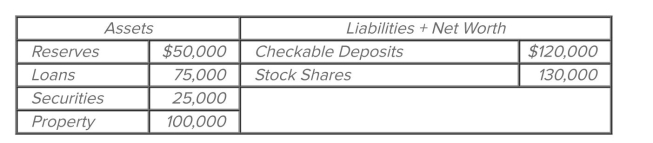 Refer to the accompanying balance sheet for the First National Bank. Assume the reserve ratio is 15 percent. If a check for $20,000 is drawn and cleared against this bank, it will then have excess reserves of
 (Multiple Choice)
4.8/5 (80)
(80) What are the two significant characteristics of the fractional reserve banking system?
(Essay)
4.8/5 (72)
(72) The multiple by which the commercial banking system can expand the supply of money is equal to the reciprocal of
(Multiple Choice)
4.8/5 (80)
(80) While the withdrawal of cash from banks does not affect money supply immediately, it will affect the banking
system's lending capacity, which will eventually lead to a contraction in money supply.
(True/False)
4.9/5 (72)
(72) The market for immediately available reserve balances at the Federal Reserve is known as the
(Multiple Choice)
4.9/5 (84)
(84) Type of Deposit Reserve Requirement Checkable Deposits \ 7.8 - 48.3 Million 3\% Over \4 8.3 Million 10 Noncheckable personal savings and time deposits 0 Refer to the accompanying table. If a bank has $60 million in savings deposits and $40 million in checkable deposits, then its required reserves are
(Multiple Choice)
4.9/5 (81)
(81) If actual reserves in the banking system are $50,000, excess reserves are $5,000, and checkable deposits are $225,000, then the monetary multiplier is
(Multiple Choice)
4.7/5 (72)
(72) Suppose the Northwestern Bank has excess reserves of $12,000 and checkable deposits of $125,000. If the reserve requirement is 20 percent, what are the bank's actual reserves?
(Multiple Choice)
4.9/5 (88)
(88) If the monetary multiplier is 6, then the reserve ratio must be
(Multiple Choice)
4.7/5 (83)
(83) A bank has reserves of $30,000 and deposits of $120,000. If the reserve ratio is 10 percent, then this bank can
lend out a maximum of $12,000 in new loans.
(True/False)
4.7/5 (72)
(72) 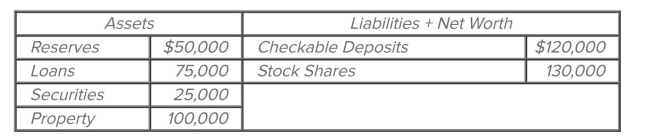 Refer to the accompanying balance sheet for the First National Bank. Assume the reserve ratio is 15 percent. If a check for $14,000 is drawn and cleared against this bank, then its reserves and checkable deposits will be
 (Multiple Choice)
4.7/5 (76)
(76) Assets Liabilities and Net Worth Stock Shares \ 400 Reserves 40 Property 300 Securities 160 Loans 80 Demand Deposits 180 The ?gures in the table are for a single commercial bank. All ?gures are in thousands of dollars. This bank has liabilities and net worth totaling
(Multiple Choice)
4.8/5 (89)
(89) A commercial bank has actual reserves of $1 million and checkable-deposit liabilities of $9 million, and the required reserve ratio is 10 percent. The excess reserves of the bank are
(Multiple Choice)
4.8/5 (85)
(85) 
Filters
- Essay(0)
- Multiple Choice(0)
- Short Answer(0)
- True False(0)
- Matching(0)