



 Chat with AI
Exam 15: Money Creation

Exam 2: The Market System and the Circular Flow274 Questions
Exam 3: Demand, Supply, and Market Equilibrium357 Questions
Exam 4: Market Failures Caused by Externalities Asymmetric Information222 Questions
Exam 5: Public Goods, Public Choice, and Government Failure242 Questions
Exam 6: An Introduction to Macroeconomics243 Questions
Exam 7: Measuring Domestic Output and National Income238 Questions
Exam 8: Economic Growth274 Questions
Exam 9: Business Cycles, Unemployment, and Inflation298 Questions
Exam 10: Basic Macroeconomic Relationships233 Questions
Exam 11: The Aggregate Expenditures Model126 Questions
Exam 12: Aggregate Demand and Aggregate Supply320 Questions
Exam 13: Fiscal Policy, Deficits, and Debt401 Questions
Exam 14: Money, Banking, and Financial Institutions265 Questions
Exam 15: Money Creation285 Questions
Exam 16: Interest Rates and Monetary Policy405 Questions
Exam 17: Financial Economics356 Questions
Exam 18: Extending the Analysis of Aggregate Supply268 Questions
Exam 19: Current Issues in Macro Theory and Policy279 Questions
Exam 20: International Trade339 Questions
Exam 21: The Balance of Payments, Exchange Rates, and Trade Deficits315 Questions
Exam 22: The Economics of Developing Countries269 Questions
Select questions type


One bank can borrow reserves from another bank, and the interest on the loan is called the federal funds rate.
(True/False)
4.9/5  (83)
(83) If a portion of the loans extended by commercial banks is taken as cash rather than as checkable deposits, the maximum money-creating potential of the commercial banking system will
(Multiple Choice)
4.9/5 (67)
(67) Assume that the required reserve ratio is 5 percent. If a commercial bank has $2 million cash in its vault, $1 million in government securities, $3 million on deposit at the Fed, and $60 million in checkable deposits, then its excess
Reserves equal
(Multiple Choice)
4.8/5 (76)
(76) The goldsmith's ability to create money was based on the fact that
(Multiple Choice)
4.9/5 (83)
(83) Reserve Requirement (\%) Checkable Deposits Actual Reserves Excess Reserves (1) \ 100,000 \ 10,000 \ 0 (2) 8 20,000 12,000 (3) 12 200,000 8,000 (4) 20 300,000 70,000 The accompanying table gives data for a commercial bank or thrift. In row 3, the number appropriate for space Y is
(Multiple Choice)
4.9/5 (84)
(84) In an uncontrolled or unregulated system, commercial bank lending will tend to intensify the business cycle.
(True/False)
4.9/5 (77)
(77) 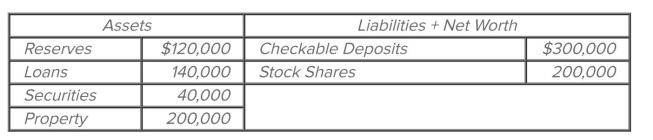 The accompanying table is the consolidated balance sheet for the commercial banking system. All figures are in billions. Assume that the required reserve ratio is 10 percent. The maximum amount by which this commercial
Banking system can expand the supply of money by lending is
The accompanying table is the consolidated balance sheet for the commercial banking system. All figures are in billions. Assume that the required reserve ratio is 10 percent. The maximum amount by which this commercial
Banking system can expand the supply of money by lending is (Multiple Choice)
4.8/5 (77)
(77) A bank has excess reserves of $5,000 and demand deposits of $50,000; the required reserve ratio is 20 percent. If the reserve ratio is raised to 25 percent, then this bank can lend a maximum of
(Multiple Choice)
4.8/5 (88)
(88) If a commercial banking system has $200,000 in checkable deposits, actual reserves of $70,000, and a reserve
ratio of 20 percent, then the banking system can expand the supply of money by a maximum of $180,000.
(True/False)
4.7/5 (74)
(74) The basic reason why the commercial banking system can increase its checkable deposits by a multiple of itscess reserves is that
A) reserves lost by any particular bank will be gained by some other bank.
B) the central banks follow policies that prevent reserves from falling below the level required by law.
C) the MPC of borrowers is greater than zero but less than 1.
D) the banking system must keep reserves equal to 100 percent of its checkable-deposit liabilities.
(Essay)
4.9/5 (82)
(82) If actual reserves in the banking system are $8,000, checkable deposits are $70,000, and the legal reserve ratio is 10 percent, then excess reserves are
(Multiple Choice)
4.7/5 (80)
(80) Given a 25 percent reserve ratio, assume the commercial banking system is loaned up. Now assume the reserve ratio is reduced to 20 percent. As a result of this reduction,
(Multiple Choice)
4.9/5 (90)
(90) A commercial bank has required reserves of $60 million and the reserve ratio is 20 percent. How much are the commercial bank's checkable-deposit liabilities?
(Multiple Choice)
4.8/5 (76)
(76) A commercial bank has no excess reserves until a depositor places $5,000 in cash at the bank. The commercial bank then lends $4,000 to a borrower. As a consequence of these transactions, the size of the money supply has
(Multiple Choice)
4.8/5 (69)
(69) When required reserves exceed actual reserves, commercial banks will be forced to have borrowers
(Multiple Choice)
4.8/5 (70)
(70) 
Filters
- Essay(0)
- Multiple Choice(0)
- Short Answer(0)
- True False(0)
- Matching(0)