



 Chat with AI
Exam 15: Money Creation

Exam 2: The Market System and the Circular Flow274 Questions
Exam 3: Demand, Supply, and Market Equilibrium357 Questions
Exam 4: Market Failures Caused by Externalities Asymmetric Information222 Questions
Exam 5: Public Goods, Public Choice, and Government Failure242 Questions
Exam 6: An Introduction to Macroeconomics243 Questions
Exam 7: Measuring Domestic Output and National Income238 Questions
Exam 8: Economic Growth274 Questions
Exam 9: Business Cycles, Unemployment, and Inflation298 Questions
Exam 10: Basic Macroeconomic Relationships233 Questions
Exam 11: The Aggregate Expenditures Model126 Questions
Exam 12: Aggregate Demand and Aggregate Supply320 Questions
Exam 13: Fiscal Policy, Deficits, and Debt401 Questions
Exam 14: Money, Banking, and Financial Institutions265 Questions
Exam 15: Money Creation285 Questions
Exam 16: Interest Rates and Monetary Policy405 Questions
Exam 17: Financial Economics356 Questions
Exam 18: Extending the Analysis of Aggregate Supply268 Questions
Exam 19: Current Issues in Macro Theory and Policy279 Questions
Exam 20: International Trade339 Questions
Exam 21: The Balance of Payments, Exchange Rates, and Trade Deficits315 Questions
Exam 22: The Economics of Developing Countries269 Questions
Select questions type


Suppose the ABC bank has excess reserves of $4,000 and outstanding checkable deposits of $80,000. If the reserve requirement is 25 percent, what is the size of the bank's actual reserves?
(Multiple Choice)
4.8/5  (85)
(85) 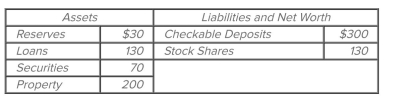 Refer to the accompanying consolidated balance sheet for the commercial banking system. Assume the required reserve ratio is 10 percent. All figures are in billions. After a deposit of $10 billion of new currency into a checking
Account in the banking system, excess reserves will increase by
Refer to the accompanying consolidated balance sheet for the commercial banking system. Assume the required reserve ratio is 10 percent. All figures are in billions. After a deposit of $10 billion of new currency into a checking
Account in the banking system, excess reserves will increase by (Multiple Choice)
4.9/5 (89)
(89) Reserves \ 100 Checkable Deposits 1,000 Loans (to customers) 300 Property 400 Securities (owned) 300 Stock Shares 100 Refer to the accompanying table of information for the Moolah Bank, and assume that Moolah Bank is "loaned up." If it receives a $100 deposit of currency, the banking system of which Moolah is a part could expand loans by
(Multiple Choice)
4.8/5 (83)
(83) The supply of money increases when the public buys government securities from commercial banks.
(True/False)
4.8/5 (85)
(85) The higher the reserve requirement, the lower is the monetary multiplier.
(True/False)
4.8/5 (77)
(77) A single commercial bank must meet a 25 percent reserve requirement. If it initially has no excess reserves and then $2,000 in cash is deposited in the bank, it can increase its loans by a maximum of
(Multiple Choice)
4.8/5 (76)
(76) 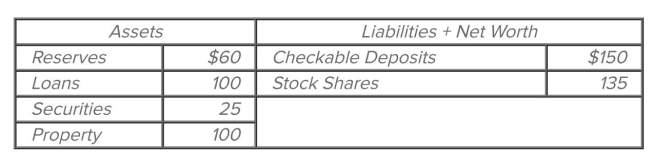 Refer to the accompanying consolidated balance sheet for the commercial banking system. Assume the required
reserve ratio is 12 percent. All figures are in billions of dollars. If commercial bankers decide to hold additionalcess reserves equal to 7 percent of any newly acquired deposits, then the relevant monetary multiplier for this
banking system will be
A) 8.33.
B) 6.66.
C) 5.26.
D) 4.76.
Refer to the accompanying consolidated balance sheet for the commercial banking system. Assume the required
reserve ratio is 12 percent. All figures are in billions of dollars. If commercial bankers decide to hold additionalcess reserves equal to 7 percent of any newly acquired deposits, then the relevant monetary multiplier for this
banking system will be
A) 8.33.
B) 6.66.
C) 5.26.
D) 4.76. (Essay)
4.8/5 (76)
(76) 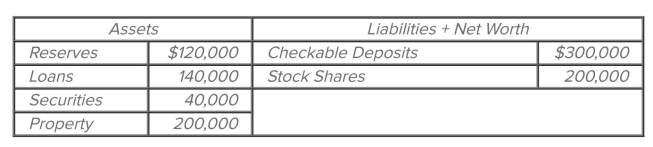 The accompanying table is the consolidated balance sheet for the commercial banking system. All figures are in billions. Assume that the required reserve ratio is 10 percent. If there is a deposit of $10 billion of new currency
Into checking accounts in the banking system, excess reserves will increase by
The accompanying table is the consolidated balance sheet for the commercial banking system. All figures are in billions. Assume that the required reserve ratio is 10 percent. If there is a deposit of $10 billion of new currency
Into checking accounts in the banking system, excess reserves will increase by (Multiple Choice)
4.8/5 (98)
(98) 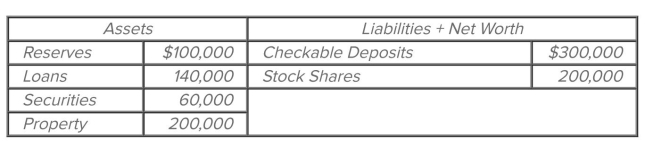 The accompanying balance sheet is for the First Federal Bank. Assume the required reserve ratio is 20 percent. This bank can safely expand its loans by a maximum of
 (Multiple Choice)
4.9/5 (74)
(74) In the federal funds market, a bank that needs to meet reserve requirements can borrow reserves, usually for
(Multiple Choice)
4.9/5 (93)
(93) The relative importance of various asset items on a commercial bank's balance sheet reflects a bank's pursuit of which two conflicting goals?
(Multiple Choice)
4.8/5 (81)
(81) Assume that the required reserve ratio is 20 percent. A business deposits a $50,000 check at Bank A; the check is drawn against Bank B. What happens to the excess reserves at Bank A and Bank B?
(Multiple Choice)
4.9/5 (76)
(76) The primary purpose of the reserve requirements for banks is not really to ensure liquidity to meet withdrawals,
but rather to allow the Fed some control over the money supply.
(True/False)
4.9/5 (78)
(78) When a bank grants a loan to a customer who then keeps the funds in her checking account at that bank, the bank's
(Multiple Choice)
4.8/5 (74)
(74) If the reserve requirement is 10 percent, what amount of excess reserves does a bank acquire when a business deposits a $500 check drawn on another bank?
(Multiple Choice)
4.9/5 (97)
(97) If the monetary authorities want to reduce the monetary multiplier, they should
(Multiple Choice)
4.9/5 (71)
(71) 
Filters
- Essay(0)
- Multiple Choice(0)
- Short Answer(0)
- True False(0)
- Matching(0)