



 Chat with AI
Exam 54: Care of Patients with Esophageal Problems

Exam 1: Introduction to Medical Surgical Nursing Practice15 Questions
Exam 2: Common Health Problems of Older Adults22 Questions
Exam 3: Assessment and Care of Patients with Pain35 Questions
Exam 4: Genetic and Genomic Concepts for Medical Surgical Nursing15 Questions
Exam 5: Evidence Based Practice in Medical Surgical Nursing14 Questions
Exam 6: Rehabilitation Concepts for Chronic and Disabling Health Problems18 Questions
Exam 7: End of Life Care18 Questions
Exam 8: Concepts of Emergency and Trauma Nursing18 Questions
Exam 9: Care of Patients with Common Environmental Emergencies19 Questions
Exam 10: Concepts of Emergency and Disaster Preparedness16 Questions
Exam 11: Assessment and Care of Patients with Fluid and Electrolyte Imbalances24 Questions
Exam 12: Assessment and Care of Patients with Acid-Base Imbalances20 Questions
Exam 13: Infusion Therapy24 Questions
Exam 14: Care of Preoperative Patients27 Questions
Exam 15: Care of Intraoperative Patients18 Questions
Exam 16: Care of Postoperative Patients21 Questions
Exam 17: Inflammation and Immunity19 Questions
Exam 18: Care of Patients with Arthritis and Other Connective Tissue Diseases49 Questions
Exam 19: Care of Patients with HIV Disease and Other Immune Deficiencies26 Questions
Exam 20: Care of Patients with Immune Function Excess: Hypersensitivity (Allergy)and Autoimmunity13 Questions
Exam 21: Cancer Development14 Questions
Exam 22: Care of Patients with Cancer32 Questions
Exam 23: Care of Patients with Infection21 Questions
Exam 24: Assessment of the Skin, Hair, and Nails15 Questions
Exam 25: Care of Patients with Skin Problems30 Questions
Exam 26: Care of Patients with Burns30 Questions
Exam 27: Assessment of the Respiratory System20 Questions
Exam 28: Care of Patients Requiring Oxygen Therapy or Tracheostomy18 Questions
Exam 29: Care of Patients with Noninfectious Upper Respiratory Problems20 Questions
Exam 30: Care of Patients with Noninfectious Lower Respiratory Problems35 Questions
Exam 31: Care of Patients with Infectious Respiratory Problems25 Questions
Exam 32: Care of Critically Ill Patients with Respiratory Problems30 Questions
Exam 33: Assessment of the Cardiovascular System27 Questions
Exam 34: Care of Patients with Dysrhythmias25 Questions
Exam 35: Care of Patients with Cardiac Problems33 Questions
Exam 36: Care of Patients with Vascular Problems39 Questions
Exam 37: Care of Patients with Shock21 Questions
Exam 38: Care of Patients with Acute Coronary Syndromes31 Questions
Exam 39: Assessment of the Hematologic System13 Questions
Exam 40: Care of Patients with Hematologic Problems38 Questions
Exam 41: Assessment of the Nervous System30 Questions
Exam 42: Care of Patients with Problems of the Central Nervous System: The Brain32 Questions
Exam 43: Care of Patients with Problems of the Central Nervous System: The Spinal Cord30 Questions
Exam 44: Care of Patients with Problems of the Peripheral Nervous System18 Questions
Exam 45: Care of Critically Ill Patients with Neurologic Problems43 Questions
Exam 46: Assessment of the Eye and Vision10 Questions
Exam 47: Care of Patients with Eye and Vision Problems18 Questions
Exam 48: Assessment and Care of Patients with Ear and Hearing Problems24 Questions
Exam 49: Assessment of the Musculoskeletal System14 Questions
Exam 50: Care of Patients with Musculoskeletal Problems28 Questions
Exam 51: Care of Patients with Musculoskeletal Trauma34 Questions
Exam 52: Assessment of the Gastrointestinal System18 Questions
Exam 53: Care of Patients with Oral Cavity Problems12 Questions
Exam 54: Care of Patients with Esophageal Problems20 Questions
Exam 55: Care of Patients with Stomach Disorders23 Questions
Exam 56: Care of Patients with Noninflammatory Intestinal Disorders30 Questions
Exam 57: Care of Patients with Inflammatory Intestinal Disorders30 Questions
Exam 58: Care of Patients with Liver Problems25 Questions
Exam 59: Care of Patients with Problems of the Biliary System and Pancreas26 Questions
Exam 60: Care of Patients with Malnutrition: Undernutrition and Obesity29 Questions
Exam 61: Assessment of the Endocrine System18 Questions
Exam 62: Care of Patients with Pituitary and Adrenal Gland Problems23 Questions
Exam 63: Care of Patients with Problems of the Thyroid and Parathyroid Glands20 Questions
Exam 64: Care of Patients with Diabetes Mellitus50 Questions
Exam 65: Assessment of the Renal/Urinary System23 Questions
Exam 66: Care of Patients with Urinary Problems34 Questions
Exam 67: Care of Patients with Kidney Disorders20 Questions
Exam 68: Care of Patients with Acute Kidney Injury and Chronic Kidney Disease36 Questions
Exam 69: Assessment of the Reproductive System11 Questions
Exam 70: Care of Patients with Breast Disorders22 Questions
Exam 71: Care of Patients with Gynecologic Problems21 Questions
Exam 72: Care of Patients with Male Reproductive Problems17 Questions
Exam 73: Care of Transgender Patients12 Questions
Exam 74: Care of Patients with Sexually Transmitted Diseases20 Questions
Select questions type


A client is 1 day postoperative after having Zenker's diverticula removed.The client has a nasogastric (NG)tube to suction,and for the last 4 hours there has been no drainage.There are no specific care orders for the NG tube in place.What action by the nurse is most appropriate?

Free
(Multiple Choice)
4.9/5  (92)
(92) Correct Answer: Verified
C
A client is in the emergency department with an esophageal trauma.The nurse palpates subcutaneous emphysema in the mediastinal area and up into the lower part of the client's neck.What action by the nurse takes priority?
Free
(Multiple Choice)
4.8/5 (86)
(86) Correct Answer:Verified
VerifiedA
A client has a nasogastric (NG)tube.What action by the nursing student requires the registered nurse to intervene?
Free
(Multiple Choice)
4.8/5 (86)
(86) Correct Answer:Verified
VerifiedC
The nurse is working with clients who have esophageal disorders.The nurse should assess the clients for which manifestations? (Select all that apply.)
(Multiple Choice)
4.7/5 (83)
(83) A client has returned to the nursing unit after an open Nissen fundoplication.The client has an indwelling urinary catheter,a nasogastric (NG)tube to low continuous suction,and two IVs.The nurse notes bright red blood in the NG tube.What action should the nurse take first?
(Multiple Choice)
4.8/5 (79)
(79) A client is scheduled to have a fundoplication.What statement by the client indicates a need to review preoperative teaching?
(Multiple Choice)
4.8/5 (82)
(82) The nurse is aware that which factors are related to the development of gastroesophageal reflux disease (GERD)? (Select all that apply.)
(Multiple Choice)
4.7/5 (86)
(86) A client has been discharged to an inpatient rehabilitation center after an esophagogastrectomy.What menu selections by the client at the rehabilitation center indicate a good understanding of dietary instructions? (Select all that apply.)
(Multiple Choice)
4.8/5 (88)
(88) A client with an esophageal tumor has difficulty swallowing and has been working with a speech-language pathologist.What assessment finding by the nurse indicates that the priority goal for this problem is being met?
(Multiple Choice)
4.8/5 (85)
(85) A client is scheduled for a traditional esophagogastrostomy.All preoperative teaching has been completed and the client and family show good understanding.What action by the nurse is best?
(Multiple Choice)
4.9/5 (81)
(81) A nurse works on the surgical unit.After receiving the hand-off report,which client should the nurse see first?
(Multiple Choice)
4.9/5 (93)
(93) After hiatal hernia repair surgery,a client is on IV pantoprazole (Protonix).The client asks the nurse why this medication is given since there is no history of ulcers.What response by the nurse is best?
(Multiple Choice)
4.9/5 (81)
(81) A client has a nasogastric (NG)tube after a Nissen fundoplication.The nurse answers the call light and finds the client vomiting bright red blood with the NG tube lying on the floor.What action should the nurse take first?
(Multiple Choice)
4.8/5 (75)
(75) The nurse is caring for a client who had an esophagectomy 3 days ago and was extubated yesterday.What actions may the nurse delegate to the unlicensed assistive personnel (UAP)? (Select all that apply.)
(Multiple Choice)
4.9/5 (74)
(74) A client has gastroesophageal reflux disease (GERD).The provider prescribes a proton pump inhibitor.About what medication should the nurse anticipate teaching the client?
(Multiple Choice)
4.8/5 (82)
(82) A client has been taught about alginic acid and sodium bicarbonate (Gaviscon).What statement by the client indicates that teaching has been effective?
(Multiple Choice)
5.0/5 (72)
(72) A client with an esophageal tumor is having extreme difficulty swallowing.For what procedure does the nurse prepare this client?
(Multiple Choice)
4.7/5 (84)
(84) The nurse has taught a client about lifestyle modifications for gastroesophageal reflux disease (GERD).What statements by the client indicate good understanding of the teaching? (Select all that apply.)
(Multiple Choice)
4.8/5 (75)
(75) The following data relate to an older client who is 2 hours postoperative after an esophagogastrostomy:
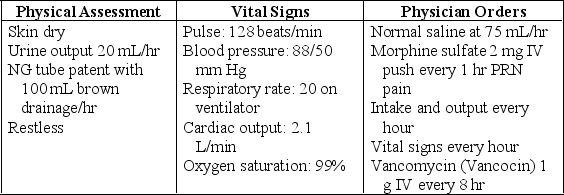 What action by the nurse is best?
 (Multiple Choice)
4.8/5 (79)
(79) A nurse is teaching clients with gastroesophageal reflux disease (GERD)about foods to avoid.Which foods should the nurse include in the teaching? (Select all that apply.)
(Multiple Choice)
4.9/5 (77)
(77) 
Filters
- Essay(0)
- Multiple Choice(0)
- Short Answer(0)
- True False(0)
- Matching(0)