



 Chat with AI
Exam 34: Care of Patients with Dysrhythmias

Exam 1: Introduction to Medical Surgical Nursing Practice15 Questions
Exam 2: Common Health Problems of Older Adults22 Questions
Exam 3: Assessment and Care of Patients with Pain35 Questions
Exam 4: Genetic and Genomic Concepts for Medical Surgical Nursing15 Questions
Exam 5: Evidence Based Practice in Medical Surgical Nursing14 Questions
Exam 6: Rehabilitation Concepts for Chronic and Disabling Health Problems18 Questions
Exam 7: End of Life Care18 Questions
Exam 8: Concepts of Emergency and Trauma Nursing18 Questions
Exam 9: Care of Patients with Common Environmental Emergencies19 Questions
Exam 10: Concepts of Emergency and Disaster Preparedness16 Questions
Exam 11: Assessment and Care of Patients with Fluid and Electrolyte Imbalances24 Questions
Exam 12: Assessment and Care of Patients with Acid-Base Imbalances20 Questions
Exam 13: Infusion Therapy24 Questions
Exam 14: Care of Preoperative Patients27 Questions
Exam 15: Care of Intraoperative Patients18 Questions
Exam 16: Care of Postoperative Patients21 Questions
Exam 17: Inflammation and Immunity19 Questions
Exam 18: Care of Patients with Arthritis and Other Connective Tissue Diseases49 Questions
Exam 19: Care of Patients with HIV Disease and Other Immune Deficiencies26 Questions
Exam 20: Care of Patients with Immune Function Excess: Hypersensitivity (Allergy)and Autoimmunity13 Questions
Exam 21: Cancer Development14 Questions
Exam 22: Care of Patients with Cancer32 Questions
Exam 23: Care of Patients with Infection21 Questions
Exam 24: Assessment of the Skin, Hair, and Nails15 Questions
Exam 25: Care of Patients with Skin Problems30 Questions
Exam 26: Care of Patients with Burns30 Questions
Exam 27: Assessment of the Respiratory System20 Questions
Exam 28: Care of Patients Requiring Oxygen Therapy or Tracheostomy18 Questions
Exam 29: Care of Patients with Noninfectious Upper Respiratory Problems20 Questions
Exam 30: Care of Patients with Noninfectious Lower Respiratory Problems35 Questions
Exam 31: Care of Patients with Infectious Respiratory Problems25 Questions
Exam 32: Care of Critically Ill Patients with Respiratory Problems30 Questions
Exam 33: Assessment of the Cardiovascular System27 Questions
Exam 34: Care of Patients with Dysrhythmias25 Questions
Exam 35: Care of Patients with Cardiac Problems33 Questions
Exam 36: Care of Patients with Vascular Problems39 Questions
Exam 37: Care of Patients with Shock21 Questions
Exam 38: Care of Patients with Acute Coronary Syndromes31 Questions
Exam 39: Assessment of the Hematologic System13 Questions
Exam 40: Care of Patients with Hematologic Problems38 Questions
Exam 41: Assessment of the Nervous System30 Questions
Exam 42: Care of Patients with Problems of the Central Nervous System: The Brain32 Questions
Exam 43: Care of Patients with Problems of the Central Nervous System: The Spinal Cord30 Questions
Exam 44: Care of Patients with Problems of the Peripheral Nervous System18 Questions
Exam 45: Care of Critically Ill Patients with Neurologic Problems43 Questions
Exam 46: Assessment of the Eye and Vision10 Questions
Exam 47: Care of Patients with Eye and Vision Problems18 Questions
Exam 48: Assessment and Care of Patients with Ear and Hearing Problems24 Questions
Exam 49: Assessment of the Musculoskeletal System14 Questions
Exam 50: Care of Patients with Musculoskeletal Problems28 Questions
Exam 51: Care of Patients with Musculoskeletal Trauma34 Questions
Exam 52: Assessment of the Gastrointestinal System18 Questions
Exam 53: Care of Patients with Oral Cavity Problems12 Questions
Exam 54: Care of Patients with Esophageal Problems20 Questions
Exam 55: Care of Patients with Stomach Disorders23 Questions
Exam 56: Care of Patients with Noninflammatory Intestinal Disorders30 Questions
Exam 57: Care of Patients with Inflammatory Intestinal Disorders30 Questions
Exam 58: Care of Patients with Liver Problems25 Questions
Exam 59: Care of Patients with Problems of the Biliary System and Pancreas26 Questions
Exam 60: Care of Patients with Malnutrition: Undernutrition and Obesity29 Questions
Exam 61: Assessment of the Endocrine System18 Questions
Exam 62: Care of Patients with Pituitary and Adrenal Gland Problems23 Questions
Exam 63: Care of Patients with Problems of the Thyroid and Parathyroid Glands20 Questions
Exam 64: Care of Patients with Diabetes Mellitus50 Questions
Exam 65: Assessment of the Renal/Urinary System23 Questions
Exam 66: Care of Patients with Urinary Problems34 Questions
Exam 67: Care of Patients with Kidney Disorders20 Questions
Exam 68: Care of Patients with Acute Kidney Injury and Chronic Kidney Disease36 Questions
Exam 69: Assessment of the Reproductive System11 Questions
Exam 70: Care of Patients with Breast Disorders22 Questions
Exam 71: Care of Patients with Gynecologic Problems21 Questions
Exam 72: Care of Patients with Male Reproductive Problems17 Questions
Exam 73: Care of Transgender Patients12 Questions
Exam 74: Care of Patients with Sexually Transmitted Diseases20 Questions
Select questions type


A nurse cares for a client who has a heart rate averaging 56 beats/min with no adverse symptoms.Which activity modification should the nurse suggest to avoid further slowing of the heart rate?

Free
(Multiple Choice)
4.8/5  (91)
(91) Correct Answer: Verified
B
A nurse prepares to defibrillate a client who is in ventricular fibrillation.Which priority intervention should the nurse perform prior to defibrillating this client?
Free
(Multiple Choice)
4.7/5 (66)
(66) Correct Answer:Verified
VerifiedD
The nurse is caring for a client on the medical-surgical unit who suddenly becomes unresponsive and has no pulse.The cardiac monitor shows the rhythm below:
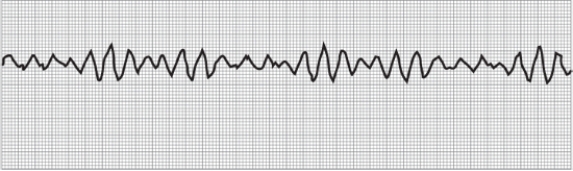 After calling for assistance and a defibrillator,which action should the nurse take next?
Free
(Multiple Choice)
4.8/5 (78)
(78) Correct Answer:Verified
VerifiedB
A nurse cares for a client with an intravenous temporary pacemaker for bradycardia.The nurse observes the presence of a pacing spike but no QRS complex on the client's electrocardiogram.Which action should the nurse take next?
(Multiple Choice)
4.8/5 (74)
(74) A nurse cares for a client with atrial fibrillation who reports fatigue when completing activities of daily living.What interventions should the nurse implement to address this client's concerns?
(Multiple Choice)
4.8/5 (89)
(89) A nurse assesses a client with atrial fibrillation.Which manifestation should alert the nurse to the possibility of a serious complication from this condition?
(Multiple Choice)
4.8/5 (81)
(81) A nurse prepares to discharge a client with cardiac dysrhythmia who is prescribed home health care services.Which priority information should be communicated to the home health nurse upon discharge?
(Multiple Choice)
4.7/5 (69)
(69) A nurse assesses a client with tachycardia.Which clinical manifestation requires immediate intervention by the nurse?
(Multiple Choice)
4.9/5 (81)
(81) A nurse cares for a client with congestive heart failure who has a regular cardiac rhythm of 128 beats/min.For which physiologic alterations should the nurse assess? (Select all that apply.)
(Multiple Choice)
4.8/5 (75)
(75) A nurse evaluates prescriptions for a client with chronic atrial fibrillation.Which medication should the nurse expect to find on this client's medication administration record to prevent a common complication of this condition?
(Multiple Choice)
5.0/5 (82)
(82) A nurse assesses a client's electrocardiogram (ECG)and observes the reading shown below:
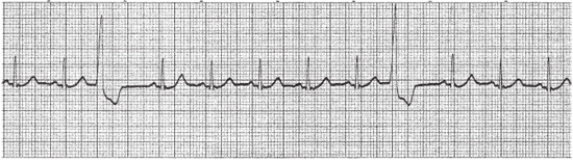 How should the nurse document this client's ECG strip?
 (Multiple Choice)
4.7/5 (83)
(83) A nurse assesses a client's electrocardiograph tracing and observes that not all QRS complexes are preceded by a P wave.How should the nurse interpret this observation?
(Multiple Choice)
4.9/5 (84)
(84) A nurse is teaching a client with premature ectopic beats.Which education should the nurse include in this client's teaching? (Select all that apply.)
(Multiple Choice)
4.8/5 (64)
(64) A nurse teaches a client who experiences occasional premature atrial contractions (PACs)accompanied by palpitations that resolve spontaneously without treatment.Which statement should the nurse include in this client's teaching?
(Multiple Choice)
4.9/5 (95)
(95) A nurse teaches a client with a new permanent pacemaker.Which instructions should the nurse include in this client's teaching? (Select all that apply.)
(Multiple Choice)
4.8/5 (82)
(82) A nurse administers prescribed adenosine (Adenocard)to a client.Which response should the nurse assess for as the expected therapeutic response?
(Multiple Choice)
4.9/5 (85)
(85) A nurse performs an admission assessment on a 75-year-old client with multiple chronic diseases.The client's blood pressure is 135/75 mm Hg and oxygen saturation is 94% on 2 liters per nasal cannula.The nurse assesses the client's rhythm on the cardiac monitor and observes the reading shown below:
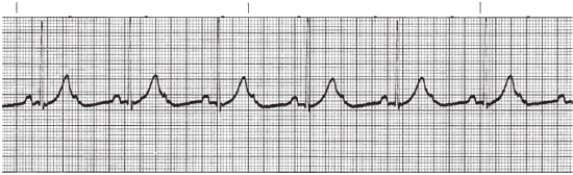 Which action should the nurse take first?
 (Multiple Choice)
4.9/5 (85)
(85) After teaching a client who has an implantable cardioverter-defibrillator (ICD),a nurse assesses the client's understanding.Which statement by the client indicates a correct understanding of the teaching?
(Multiple Choice)
4.8/5 (89)
(89) A nurse supervises an unlicensed assistive personnel (UAP)applying electrocardiographic monitoring.Which statement should the nurse provide to the UAP related to this procedure?
(Multiple Choice)
4.8/5 (83)
(83) A nurse cares for a client who is on a cardiac monitor.The monitor displayed the rhythm shown below:
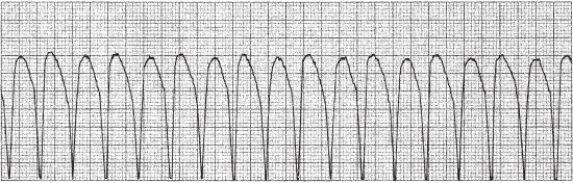 Which action should the nurse take first?
 (Multiple Choice)
4.7/5 (80)
(80) 
Filters
- Essay(0)
- Multiple Choice(0)
- Short Answer(0)
- True False(0)
- Matching(0)