



 Chat with AI
Exam 33: Assessment of the Cardiovascular System

Exam 1: Introduction to Medical Surgical Nursing Practice15 Questions
Exam 2: Common Health Problems of Older Adults22 Questions
Exam 3: Assessment and Care of Patients with Pain35 Questions
Exam 4: Genetic and Genomic Concepts for Medical Surgical Nursing15 Questions
Exam 5: Evidence Based Practice in Medical Surgical Nursing14 Questions
Exam 6: Rehabilitation Concepts for Chronic and Disabling Health Problems18 Questions
Exam 7: End of Life Care18 Questions
Exam 8: Concepts of Emergency and Trauma Nursing18 Questions
Exam 9: Care of Patients with Common Environmental Emergencies19 Questions
Exam 10: Concepts of Emergency and Disaster Preparedness16 Questions
Exam 11: Assessment and Care of Patients with Fluid and Electrolyte Imbalances24 Questions
Exam 12: Assessment and Care of Patients with Acid-Base Imbalances20 Questions
Exam 13: Infusion Therapy24 Questions
Exam 14: Care of Preoperative Patients27 Questions
Exam 15: Care of Intraoperative Patients18 Questions
Exam 16: Care of Postoperative Patients21 Questions
Exam 17: Inflammation and Immunity19 Questions
Exam 18: Care of Patients with Arthritis and Other Connective Tissue Diseases49 Questions
Exam 19: Care of Patients with HIV Disease and Other Immune Deficiencies26 Questions
Exam 20: Care of Patients with Immune Function Excess: Hypersensitivity (Allergy)and Autoimmunity13 Questions
Exam 21: Cancer Development14 Questions
Exam 22: Care of Patients with Cancer32 Questions
Exam 23: Care of Patients with Infection21 Questions
Exam 24: Assessment of the Skin, Hair, and Nails15 Questions
Exam 25: Care of Patients with Skin Problems30 Questions
Exam 26: Care of Patients with Burns30 Questions
Exam 27: Assessment of the Respiratory System20 Questions
Exam 28: Care of Patients Requiring Oxygen Therapy or Tracheostomy18 Questions
Exam 29: Care of Patients with Noninfectious Upper Respiratory Problems20 Questions
Exam 30: Care of Patients with Noninfectious Lower Respiratory Problems35 Questions
Exam 31: Care of Patients with Infectious Respiratory Problems25 Questions
Exam 32: Care of Critically Ill Patients with Respiratory Problems30 Questions
Exam 33: Assessment of the Cardiovascular System27 Questions
Exam 34: Care of Patients with Dysrhythmias25 Questions
Exam 35: Care of Patients with Cardiac Problems33 Questions
Exam 36: Care of Patients with Vascular Problems39 Questions
Exam 37: Care of Patients with Shock21 Questions
Exam 38: Care of Patients with Acute Coronary Syndromes31 Questions
Exam 39: Assessment of the Hematologic System13 Questions
Exam 40: Care of Patients with Hematologic Problems38 Questions
Exam 41: Assessment of the Nervous System30 Questions
Exam 42: Care of Patients with Problems of the Central Nervous System: The Brain32 Questions
Exam 43: Care of Patients with Problems of the Central Nervous System: The Spinal Cord30 Questions
Exam 44: Care of Patients with Problems of the Peripheral Nervous System18 Questions
Exam 45: Care of Critically Ill Patients with Neurologic Problems43 Questions
Exam 46: Assessment of the Eye and Vision10 Questions
Exam 47: Care of Patients with Eye and Vision Problems18 Questions
Exam 48: Assessment and Care of Patients with Ear and Hearing Problems24 Questions
Exam 49: Assessment of the Musculoskeletal System14 Questions
Exam 50: Care of Patients with Musculoskeletal Problems28 Questions
Exam 51: Care of Patients with Musculoskeletal Trauma34 Questions
Exam 52: Assessment of the Gastrointestinal System18 Questions
Exam 53: Care of Patients with Oral Cavity Problems12 Questions
Exam 54: Care of Patients with Esophageal Problems20 Questions
Exam 55: Care of Patients with Stomach Disorders23 Questions
Exam 56: Care of Patients with Noninflammatory Intestinal Disorders30 Questions
Exam 57: Care of Patients with Inflammatory Intestinal Disorders30 Questions
Exam 58: Care of Patients with Liver Problems25 Questions
Exam 59: Care of Patients with Problems of the Biliary System and Pancreas26 Questions
Exam 60: Care of Patients with Malnutrition: Undernutrition and Obesity29 Questions
Exam 61: Assessment of the Endocrine System18 Questions
Exam 62: Care of Patients with Pituitary and Adrenal Gland Problems23 Questions
Exam 63: Care of Patients with Problems of the Thyroid and Parathyroid Glands20 Questions
Exam 64: Care of Patients with Diabetes Mellitus50 Questions
Exam 65: Assessment of the Renal/Urinary System23 Questions
Exam 66: Care of Patients with Urinary Problems34 Questions
Exam 67: Care of Patients with Kidney Disorders20 Questions
Exam 68: Care of Patients with Acute Kidney Injury and Chronic Kidney Disease36 Questions
Exam 69: Assessment of the Reproductive System11 Questions
Exam 70: Care of Patients with Breast Disorders22 Questions
Exam 71: Care of Patients with Gynecologic Problems21 Questions
Exam 72: Care of Patients with Male Reproductive Problems17 Questions
Exam 73: Care of Transgender Patients12 Questions
Exam 74: Care of Patients with Sexually Transmitted Diseases20 Questions
Select questions type


A nurse reviews a client's laboratory results.Which findings should alert the nurse to the possibility of atherosclerosis? (Select all that apply.)

Free
(Multiple Choice)
4.8/5  (65)
(65) Correct Answer: Verified
A,C,E
A nurse assesses a client who is scheduled for a cardiac catheterization.Which assessment should the nurse complete prior to this procedure?
Free
(Multiple Choice)
4.9/5 (73)
(73) Correct Answer:Verified
VerifiedD
A nurse teaches a client with diabetes mellitus and a body mass index of 42 who is at high risk for coronary artery disease.Which statement related to nutrition should the nurse include in this client's teaching?
Free
(Multiple Choice)
4.9/5 (82)
(82) Correct Answer:Verified
VerifiedB
An emergency room nurse assesses a female client.Which assessment findings should alert the nurse to request a prescription for an electrocardiogram? (Select all that apply.)
(Multiple Choice)
4.9/5 (83)
(83) A nurse cares for a client who is recovering from a myocardial infarction.The client states,"I will need to stop eating so much chili to keep that indigestion pain from returning." How should the nurse respond?
(Multiple Choice)
4.9/5 (81)
(81) A nurse prepares a client with acute renal insufficiency for a cardiac catheterization.The provider prescribes 0.9% normal saline to infuse at 125 mL/hr for renal protection.The nurse obtains gravity tubing with a drip rate of 15 drops/mL.At what rate (drops/min)should the nurse infuse the fluids? (Record your answer using a whole number,and rounding to the nearest drop.)_____ drops/min
(Short Answer)
4.9/5 (90)
(90) A nurse assesses an older adult client who is experiencing a myocardial infarction.Which clinical manifestation should the nurse expect?
(Multiple Choice)
4.8/5 (71)
(71) A nurse cares for a client who has an 80% blockage of the right coronary artery (RCA)and is scheduled for bypass surgery.Which intervention should the nurse be prepared to implement while this client waits for surgery?
(Multiple Choice)
4.8/5 (69)
(69) A nurse assesses a client 2 hours after a cardiac angiography via the left femoral artery.The nurse notes that the left pedal pulse is weak.Which action should the nurse take?
(Multiple Choice)
4.9/5 (69)
(69) A nurse assesses a client who is recovering from a myocardial infarction.The client's pulmonary artery pressure reading is 25/12 mm Hg.Which action should the nurse take first?
(Multiple Choice)
4.8/5 (77)
(77) A nurse obtains the health history of a client who is newly admitted to the medical unit.Which statement by the client should alert the nurse to the presence of edema?
(Multiple Choice)
4.8/5 (79)
(79) A nurse cares for a client who has advanced cardiac disease and states,"I am having trouble sleeping at night." How should the nurse respond?
(Multiple Choice)
4.9/5 (77)
(77) A nurse auscultated heart tones on an older adult client.Which action should the nurse take based on heart tones heard?
(Click the media button to hear the audio clip.)
(Multiple Choice)
4.8/5 (78)
(78) A nurse assesses clients on a medical-surgical unit.Which client should the nurse identify as having the greatest risk for cardiovascular disease?
(Multiple Choice)
4.9/5 (88)
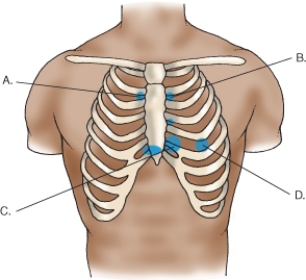
(88) A nurse assesses a client who has aortic regurgitation.In which location in the illustration shown below should the nurse auscultate to best hear a cardiac murmur related to aortic regurgitation?
(Multiple Choice)
4.9/5 (82)
(82) A nurse prepares a client for coronary artery bypass graft surgery.The client states,"I am afraid I might die." How should the nurse respond?
(Multiple Choice)
4.7/5 (69)
(69) A nurse cares for a client who is prescribed magnetic resonance imaging (MRI)of the heart.The client's health history includes a previous myocardial infarction and pacemaker implantation.Which action should the nurse take?
(Multiple Choice)
4.8/5 (76)
(76) A nurse assesses an older adult client who has multiple chronic diseases.The client's heart rate is 48 beats/min.Which action should the nurse take first?
(Multiple Choice)
4.9/5 (87)
(87) A nurse assesses a client who is recovering after a coronary catheterization.Which assessment findings in the first few hours after the procedure require immediate action by the nurse? (Select all that apply.)
(Multiple Choice)
4.8/5 (79)
(79) A nurse is caring for a client with a history of renal insufficiency who is scheduled for a cardiac catheterization.Which actions should the nurse take prior to the catheterization? (Select all that apply.)
(Multiple Choice)
4.7/5 (68)
(68) 
Filters
- Essay(0)
- Multiple Choice(0)
- Short Answer(0)
- True False(0)
- Matching(0)