



 Chat with AI
Exam 26: Care of Patients with Burns

Exam 1: Introduction to Medical Surgical Nursing Practice15 Questions
Exam 2: Common Health Problems of Older Adults22 Questions
Exam 3: Assessment and Care of Patients with Pain35 Questions
Exam 4: Genetic and Genomic Concepts for Medical Surgical Nursing15 Questions
Exam 5: Evidence Based Practice in Medical Surgical Nursing14 Questions
Exam 6: Rehabilitation Concepts for Chronic and Disabling Health Problems18 Questions
Exam 7: End of Life Care18 Questions
Exam 8: Concepts of Emergency and Trauma Nursing18 Questions
Exam 9: Care of Patients with Common Environmental Emergencies19 Questions
Exam 10: Concepts of Emergency and Disaster Preparedness16 Questions
Exam 11: Assessment and Care of Patients with Fluid and Electrolyte Imbalances24 Questions
Exam 12: Assessment and Care of Patients with Acid-Base Imbalances20 Questions
Exam 13: Infusion Therapy24 Questions
Exam 14: Care of Preoperative Patients27 Questions
Exam 15: Care of Intraoperative Patients18 Questions
Exam 16: Care of Postoperative Patients21 Questions
Exam 17: Inflammation and Immunity19 Questions
Exam 18: Care of Patients with Arthritis and Other Connective Tissue Diseases49 Questions
Exam 19: Care of Patients with HIV Disease and Other Immune Deficiencies26 Questions
Exam 20: Care of Patients with Immune Function Excess: Hypersensitivity (Allergy)and Autoimmunity13 Questions
Exam 21: Cancer Development14 Questions
Exam 22: Care of Patients with Cancer32 Questions
Exam 23: Care of Patients with Infection21 Questions
Exam 24: Assessment of the Skin, Hair, and Nails15 Questions
Exam 25: Care of Patients with Skin Problems30 Questions
Exam 26: Care of Patients with Burns30 Questions
Exam 27: Assessment of the Respiratory System20 Questions
Exam 28: Care of Patients Requiring Oxygen Therapy or Tracheostomy18 Questions
Exam 29: Care of Patients with Noninfectious Upper Respiratory Problems20 Questions
Exam 30: Care of Patients with Noninfectious Lower Respiratory Problems35 Questions
Exam 31: Care of Patients with Infectious Respiratory Problems25 Questions
Exam 32: Care of Critically Ill Patients with Respiratory Problems30 Questions
Exam 33: Assessment of the Cardiovascular System27 Questions
Exam 34: Care of Patients with Dysrhythmias25 Questions
Exam 35: Care of Patients with Cardiac Problems33 Questions
Exam 36: Care of Patients with Vascular Problems39 Questions
Exam 37: Care of Patients with Shock21 Questions
Exam 38: Care of Patients with Acute Coronary Syndromes31 Questions
Exam 39: Assessment of the Hematologic System13 Questions
Exam 40: Care of Patients with Hematologic Problems38 Questions
Exam 41: Assessment of the Nervous System30 Questions
Exam 42: Care of Patients with Problems of the Central Nervous System: The Brain32 Questions
Exam 43: Care of Patients with Problems of the Central Nervous System: The Spinal Cord30 Questions
Exam 44: Care of Patients with Problems of the Peripheral Nervous System18 Questions
Exam 45: Care of Critically Ill Patients with Neurologic Problems43 Questions
Exam 46: Assessment of the Eye and Vision10 Questions
Exam 47: Care of Patients with Eye and Vision Problems18 Questions
Exam 48: Assessment and Care of Patients with Ear and Hearing Problems24 Questions
Exam 49: Assessment of the Musculoskeletal System14 Questions
Exam 50: Care of Patients with Musculoskeletal Problems28 Questions
Exam 51: Care of Patients with Musculoskeletal Trauma34 Questions
Exam 52: Assessment of the Gastrointestinal System18 Questions
Exam 53: Care of Patients with Oral Cavity Problems12 Questions
Exam 54: Care of Patients with Esophageal Problems20 Questions
Exam 55: Care of Patients with Stomach Disorders23 Questions
Exam 56: Care of Patients with Noninflammatory Intestinal Disorders30 Questions
Exam 57: Care of Patients with Inflammatory Intestinal Disorders30 Questions
Exam 58: Care of Patients with Liver Problems25 Questions
Exam 59: Care of Patients with Problems of the Biliary System and Pancreas26 Questions
Exam 60: Care of Patients with Malnutrition: Undernutrition and Obesity29 Questions
Exam 61: Assessment of the Endocrine System18 Questions
Exam 62: Care of Patients with Pituitary and Adrenal Gland Problems23 Questions
Exam 63: Care of Patients with Problems of the Thyroid and Parathyroid Glands20 Questions
Exam 64: Care of Patients with Diabetes Mellitus50 Questions
Exam 65: Assessment of the Renal/Urinary System23 Questions
Exam 66: Care of Patients with Urinary Problems34 Questions
Exam 67: Care of Patients with Kidney Disorders20 Questions
Exam 68: Care of Patients with Acute Kidney Injury and Chronic Kidney Disease36 Questions
Exam 69: Assessment of the Reproductive System11 Questions
Exam 70: Care of Patients with Breast Disorders22 Questions
Exam 71: Care of Patients with Gynecologic Problems21 Questions
Exam 72: Care of Patients with Male Reproductive Problems17 Questions
Exam 73: Care of Transgender Patients12 Questions
Exam 74: Care of Patients with Sexually Transmitted Diseases20 Questions
Select questions type


After assessing an older adult client with a burn wound,the nurse documents the findings as follows:
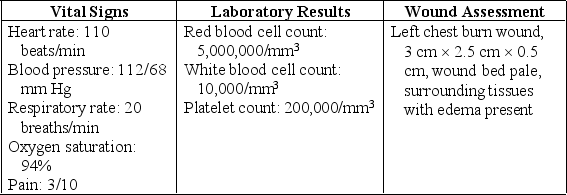 Based on the documented data,which action should the nurse take next?
Free
(Multiple Choice)
4.9/5  (86)
(86) Correct Answer: Verified
C
An emergency room nurse assesses a client who was rescued from a home fire.The client suddenly develops a loud,brassy cough.Which action should the nurse take first?
Free
(Multiple Choice)
4.8/5 (82)
(82) Correct Answer:Verified
VerifiedA
The nurse assesses a client who has a severe burn injury.Which statement indicates the client understands the psychosocial impact of a severe burn injury?
Free
(Multiple Choice)
4.8/5 (79)
(79) Correct Answer:Verified
VerifiedA
A nurse assesses a client admitted with deep partial-thickness and full-thickness burns on the face,arms,and chest.Which assessment finding should alert the nurse to a potential complication?
(Multiple Choice)
4.8/5 (86)
(86) A nurse cares for a client with burn injuries during the resuscitation phase.Which actions are priorities during this phase? (Select all that apply.)
(Multiple Choice)
4.9/5 (73)
(73) An emergency room nurse implements fluid replacement for a client with severe burn injuries.The provider prescribes a liter of 0.9% normal saline to infuse over 1 hour and 30 minutes via gravity tubing with a drip factor of 30 drops/mL.At what rate should the nurse administer the infusion? (Record your answer using a whole number and rounding to the nearest drop.)____ drops/min
(Short Answer)
5.0/5 (86)
(86) A nurse receives new prescriptions for a client with severe burn injuries who is receiving fluid resuscitation per the Parkland formula.The client's urine output continues to range from 0.2 to 0.25 mL/kg/hr.Which prescription should the nurse question?
(Multiple Choice)
4.9/5 (79)
(79) A nurse reviews the laboratory results for a client who was burned 24 hours ago.Which laboratory result should the nurse report to the health care provider immediately?
(Multiple Choice)
4.8/5 (81)
(81) The nurse teaches burn prevention to a community group.Which statement by a member of the group should cause the nurse the greatest concern?
(Multiple Choice)
4.8/5 (85)
(85) The nurse is caring for a client with an acute burn injury.Which action should the nurse take to prevent infection by autocontamination?
(Multiple Choice)
4.7/5 (77)
(77) A nurse uses the rule of nines to assess a client with burn injuries to the entire back region and left arm.How should the nurse document the percentage of the client's body that sustained burns?
(Multiple Choice)
4.9/5 (78)
(78) A nurse teaches a client being treated for a full-thickness burn.Which statement should the nurse include in this client's discharge teaching?
(Multiple Choice)
4.8/5 (87)
(87) A nurse plans care for a client with burn injuries.Which interventions should the nurse implement to prevent infection in the client? (Select all that apply.)
(Multiple Choice)
4.8/5 (71)
(71) A nurse assesses a client who has a burn injury.Which statement indicates the client has a positive perspective of his or her appearance?
(Multiple Choice)
4.9/5 (85)
(85) A nurse cares for a client with a burn injury who presents with drooling and difficulty swallowing.Which action should the nurse take first?
(Multiple Choice)
4.8/5 (65)
(65) The registered nurse assigns a client who has an open burn wound to a licensed practical nurse (LPN).Which instruction should the nurse provide to the LPN when assigning this client?
(Multiple Choice)
4.7/5 (76)
(76) A nurse assesses bilateral wheezes in a client with burn injuries inside the mouth.Four hours later the wheezing is no longer heard.Which action should the nurse take?
(Multiple Choice)
4.9/5 (79)
(79) A nurse cares for an older client with burn injuries.Which age-related changes are paired appropriately with their complications from the burn injuries? (Select all that apply.)
(Multiple Choice)
4.7/5 (92)
(92) An emergency room nurse cares for a client admitted with a 50% burn injury at 10:00 this morning.The client weighs 90 kg.Using the Parkland formula,calculate the rate at which the nurse should infuse intravenous fluid resuscitation when started at noon.(Record your answer using a whole number.)_____ mL/hr
(Short Answer)
4.8/5 (79)
(79) A nurse reviews the following data in the chart of a client with burn injuries:
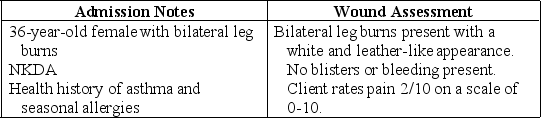 Based on the data provided,how should the nurse categorize this client's injuries?
 (Multiple Choice)
4.8/5 (87)
(87) 
Filters
- Essay(0)
- Multiple Choice(0)
- Short Answer(0)
- True False(0)
- Matching(0)