



 Chat with AI
Exam 68: Care of Patients with Acute Kidney Injury and Chronic Kidney Disease

Exam 1: Introduction to Medical Surgical Nursing Practice15 Questions
Exam 2: Common Health Problems of Older Adults22 Questions
Exam 3: Assessment and Care of Patients with Pain35 Questions
Exam 4: Genetic and Genomic Concepts for Medical Surgical Nursing15 Questions
Exam 5: Evidence Based Practice in Medical Surgical Nursing14 Questions
Exam 6: Rehabilitation Concepts for Chronic and Disabling Health Problems18 Questions
Exam 7: End of Life Care18 Questions
Exam 8: Concepts of Emergency and Trauma Nursing18 Questions
Exam 9: Care of Patients with Common Environmental Emergencies19 Questions
Exam 10: Concepts of Emergency and Disaster Preparedness16 Questions
Exam 11: Assessment and Care of Patients with Fluid and Electrolyte Imbalances24 Questions
Exam 12: Assessment and Care of Patients with Acid-Base Imbalances20 Questions
Exam 13: Infusion Therapy24 Questions
Exam 14: Care of Preoperative Patients27 Questions
Exam 15: Care of Intraoperative Patients18 Questions
Exam 16: Care of Postoperative Patients21 Questions
Exam 17: Inflammation and Immunity19 Questions
Exam 18: Care of Patients with Arthritis and Other Connective Tissue Diseases49 Questions
Exam 19: Care of Patients with HIV Disease and Other Immune Deficiencies26 Questions
Exam 20: Care of Patients with Immune Function Excess: Hypersensitivity (Allergy)and Autoimmunity13 Questions
Exam 21: Cancer Development14 Questions
Exam 22: Care of Patients with Cancer32 Questions
Exam 23: Care of Patients with Infection21 Questions
Exam 24: Assessment of the Skin, Hair, and Nails15 Questions
Exam 25: Care of Patients with Skin Problems30 Questions
Exam 26: Care of Patients with Burns30 Questions
Exam 27: Assessment of the Respiratory System20 Questions
Exam 28: Care of Patients Requiring Oxygen Therapy or Tracheostomy18 Questions
Exam 29: Care of Patients with Noninfectious Upper Respiratory Problems20 Questions
Exam 30: Care of Patients with Noninfectious Lower Respiratory Problems35 Questions
Exam 31: Care of Patients with Infectious Respiratory Problems25 Questions
Exam 32: Care of Critically Ill Patients with Respiratory Problems30 Questions
Exam 33: Assessment of the Cardiovascular System27 Questions
Exam 34: Care of Patients with Dysrhythmias25 Questions
Exam 35: Care of Patients with Cardiac Problems33 Questions
Exam 36: Care of Patients with Vascular Problems39 Questions
Exam 37: Care of Patients with Shock21 Questions
Exam 38: Care of Patients with Acute Coronary Syndromes31 Questions
Exam 39: Assessment of the Hematologic System13 Questions
Exam 40: Care of Patients with Hematologic Problems38 Questions
Exam 41: Assessment of the Nervous System30 Questions
Exam 42: Care of Patients with Problems of the Central Nervous System: The Brain32 Questions
Exam 43: Care of Patients with Problems of the Central Nervous System: The Spinal Cord30 Questions
Exam 44: Care of Patients with Problems of the Peripheral Nervous System18 Questions
Exam 45: Care of Critically Ill Patients with Neurologic Problems43 Questions
Exam 46: Assessment of the Eye and Vision10 Questions
Exam 47: Care of Patients with Eye and Vision Problems18 Questions
Exam 48: Assessment and Care of Patients with Ear and Hearing Problems24 Questions
Exam 49: Assessment of the Musculoskeletal System14 Questions
Exam 50: Care of Patients with Musculoskeletal Problems28 Questions
Exam 51: Care of Patients with Musculoskeletal Trauma34 Questions
Exam 52: Assessment of the Gastrointestinal System18 Questions
Exam 53: Care of Patients with Oral Cavity Problems12 Questions
Exam 54: Care of Patients with Esophageal Problems20 Questions
Exam 55: Care of Patients with Stomach Disorders23 Questions
Exam 56: Care of Patients with Noninflammatory Intestinal Disorders30 Questions
Exam 57: Care of Patients with Inflammatory Intestinal Disorders30 Questions
Exam 58: Care of Patients with Liver Problems25 Questions
Exam 59: Care of Patients with Problems of the Biliary System and Pancreas26 Questions
Exam 60: Care of Patients with Malnutrition: Undernutrition and Obesity29 Questions
Exam 61: Assessment of the Endocrine System18 Questions
Exam 62: Care of Patients with Pituitary and Adrenal Gland Problems23 Questions
Exam 63: Care of Patients with Problems of the Thyroid and Parathyroid Glands20 Questions
Exam 64: Care of Patients with Diabetes Mellitus50 Questions
Exam 65: Assessment of the Renal/Urinary System23 Questions
Exam 66: Care of Patients with Urinary Problems34 Questions
Exam 67: Care of Patients with Kidney Disorders20 Questions
Exam 68: Care of Patients with Acute Kidney Injury and Chronic Kidney Disease36 Questions
Exam 69: Assessment of the Reproductive System11 Questions
Exam 70: Care of Patients with Breast Disorders22 Questions
Exam 71: Care of Patients with Gynecologic Problems21 Questions
Exam 72: Care of Patients with Male Reproductive Problems17 Questions
Exam 73: Care of Transgender Patients12 Questions
Exam 74: Care of Patients with Sexually Transmitted Diseases20 Questions
Select questions type


The nurse is assessing a client with a diagnosis of pre-renal acute kidney injury (AKI).Which condition would the nurse expect to find in the client's recent history?

Free
(Multiple Choice)
4.9/5  (76)
(76) Correct Answer: Verified
B
A client has a long history of hypertension.Which category of medications would the nurse expect to be ordered to avoid chronic kidney disease (CKD)?
Free
(Multiple Choice)
4.9/5 (93)
(93) Correct Answer:Verified
VerifiedD
A marathon runner comes into the clinic and states "I have not urinated very much in the last few days." The nurse notes a heart rate of 110 beats/min and a blood pressure of 86/58 mm Hg.Which action by the nurse is the priority?
Free
(Multiple Choice)
4.9/5 (78)
(78) Correct Answer:Verified
VerifiedA
The nurse is teaching a client with diabetes mellitus how to prevent or delay chronic kidney disease (CKD).Which client statements indicate a lack of understanding of the teaching? (Select all that apply.)
(Multiple Choice)
4.7/5 (86)
(86) A male client comes into the emergency department with a serum creatinine of 2.2 mg/dL and a blood urea nitrogen (BUN)of 24 mL/dL.What question should the nurse ask first when taking this client's history?
(Multiple Choice)
4.9/5 (84)
(84) The nurse is taking the vital signs of a client after hemodialysis.Blood pressure is 110/58 mm Hg,pulse 66 beats/min,and temperature is 99.8° F (37.6° C).What is the most appropriate action by the nurse?
(Multiple Choice)
4.8/5 (86)
(86) A client is unsure of the decision to undergo peritoneal dialysis (PD)and wishes to discuss the advantages of this treatment with the nurse.Which statements by the nurse are accurate regarding PD? (Select all that apply.)
(Multiple Choice)
4.9/5 (61)
(61) The nurse is teaching the main principles of hemodialysis to a client with chronic kidney disease.Which statement by the client indicates a need for further teaching by the nurse?
(Multiple Choice)
5.0/5 (62)
(62) A client with acute kidney injury has a blood pressure of 76/55 mm Hg.The health care provider ordered 1000 mL of normal saline to be infused over 1 hour to maintain perfusion.The client is starting to develop shortness of breath.What is the nurse's priority action?
(Multiple Choice)
4.9/5 (64)
(64) The nurse is caring for five clients on the medical-surgical unit.Which clients would the nurse consider to be at risk for post-renal acute kidney injury (AKI)? (Select all that apply.)
(Multiple Choice)
4.9/5 (82)
(82) A nurse is caring for a client who is scheduled for a dose of cefazolin and vitamins at this time.Hemodialysis for this client is also scheduled in 60 minutes.Which action by the nurse is best?
(Multiple Choice)
4.8/5 (80)
(80) A 70-kg adult with chronic renal failure is on a 40-g protein diet.The client has a reduced glomerular filtration rate and is not undergoing dialysis.Which result would give the nurse the most concern?
(Multiple Choice)
4.9/5 (81)
(81) A client with chronic kidney disease states,"I feel chained to the hemodialysis machine." What is the nurse's best response to the client's statement?
(Multiple Choice)
4.9/5 (80)
(80) A nurse reviews these laboratory values of a client who returned from kidney transplantation 12 hours ago:
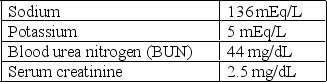 What initial intervention would the nurse anticipate?
 (Multiple Choice)
4.9/5 (84)
(84) A client has just had a central line catheter placed that is specific for hemodialysis.What is the most appropriate action by the nurse?
(Multiple Choice)
4.8/5 (76)
(76) A client is taking furosemide (Lasix)40 mg/day for management of chronic kidney disease (CKD).To detect the positive effect of the medication,what action of the nurse is best?
(Multiple Choice)
4.8/5 (88)
(88) The nurse is caring for four clients with chronic kidney disease.Which client should the nurse assess first upon initial rounding?
(Multiple Choice)
4.9/5 (78)
(78) A client is hospitalized in the oliguric phase of acute kidney injury (AKI)and is receiving tube feedings.The nurse is teaching the client's spouse about the kidney-specific formulation for the enteral solution compared to standard formulas.What components should be discussed in the teaching plan? (Select all that apply.)
(Multiple Choice)
4.8/5 (73)
(73) The charge nurse of the medical-surgical unit is making staff assignments.Which staff member should be assigned to a client with chronic kidney disease who is exhibiting a low-grade fever and a pericardial friction rub?
(Multiple Choice)
4.8/5 (75)
(75) A client is diagnosed with chronic kidney disease (CKD).What is an ideal goal of treatment set by the nurse in the care plan to reduce the risk of pulmonary edema?
(Multiple Choice)
4.7/5 (98)
(98) 
Filters
- Essay(0)
- Multiple Choice(0)
- Short Answer(0)
- True False(0)
- Matching(0)