



 Chat with AI
Exam 40: Care of Patients with Hematologic Problems

Exam 1: Introduction to Medical Surgical Nursing Practice15 Questions
Exam 2: Common Health Problems of Older Adults22 Questions
Exam 3: Assessment and Care of Patients with Pain35 Questions
Exam 4: Genetic and Genomic Concepts for Medical Surgical Nursing15 Questions
Exam 5: Evidence Based Practice in Medical Surgical Nursing14 Questions
Exam 6: Rehabilitation Concepts for Chronic and Disabling Health Problems18 Questions
Exam 7: End of Life Care18 Questions
Exam 8: Concepts of Emergency and Trauma Nursing18 Questions
Exam 9: Care of Patients with Common Environmental Emergencies19 Questions
Exam 10: Concepts of Emergency and Disaster Preparedness16 Questions
Exam 11: Assessment and Care of Patients with Fluid and Electrolyte Imbalances24 Questions
Exam 12: Assessment and Care of Patients with Acid-Base Imbalances20 Questions
Exam 13: Infusion Therapy24 Questions
Exam 14: Care of Preoperative Patients27 Questions
Exam 15: Care of Intraoperative Patients18 Questions
Exam 16: Care of Postoperative Patients21 Questions
Exam 17: Inflammation and Immunity19 Questions
Exam 18: Care of Patients with Arthritis and Other Connective Tissue Diseases49 Questions
Exam 19: Care of Patients with HIV Disease and Other Immune Deficiencies26 Questions
Exam 20: Care of Patients with Immune Function Excess: Hypersensitivity (Allergy)and Autoimmunity13 Questions
Exam 21: Cancer Development14 Questions
Exam 22: Care of Patients with Cancer32 Questions
Exam 23: Care of Patients with Infection21 Questions
Exam 24: Assessment of the Skin, Hair, and Nails15 Questions
Exam 25: Care of Patients with Skin Problems30 Questions
Exam 26: Care of Patients with Burns30 Questions
Exam 27: Assessment of the Respiratory System20 Questions
Exam 28: Care of Patients Requiring Oxygen Therapy or Tracheostomy18 Questions
Exam 29: Care of Patients with Noninfectious Upper Respiratory Problems20 Questions
Exam 30: Care of Patients with Noninfectious Lower Respiratory Problems35 Questions
Exam 31: Care of Patients with Infectious Respiratory Problems25 Questions
Exam 32: Care of Critically Ill Patients with Respiratory Problems30 Questions
Exam 33: Assessment of the Cardiovascular System27 Questions
Exam 34: Care of Patients with Dysrhythmias25 Questions
Exam 35: Care of Patients with Cardiac Problems33 Questions
Exam 36: Care of Patients with Vascular Problems39 Questions
Exam 37: Care of Patients with Shock21 Questions
Exam 38: Care of Patients with Acute Coronary Syndromes31 Questions
Exam 39: Assessment of the Hematologic System13 Questions
Exam 40: Care of Patients with Hematologic Problems38 Questions
Exam 41: Assessment of the Nervous System30 Questions
Exam 42: Care of Patients with Problems of the Central Nervous System: The Brain32 Questions
Exam 43: Care of Patients with Problems of the Central Nervous System: The Spinal Cord30 Questions
Exam 44: Care of Patients with Problems of the Peripheral Nervous System18 Questions
Exam 45: Care of Critically Ill Patients with Neurologic Problems43 Questions
Exam 46: Assessment of the Eye and Vision10 Questions
Exam 47: Care of Patients with Eye and Vision Problems18 Questions
Exam 48: Assessment and Care of Patients with Ear and Hearing Problems24 Questions
Exam 49: Assessment of the Musculoskeletal System14 Questions
Exam 50: Care of Patients with Musculoskeletal Problems28 Questions
Exam 51: Care of Patients with Musculoskeletal Trauma34 Questions
Exam 52: Assessment of the Gastrointestinal System18 Questions
Exam 53: Care of Patients with Oral Cavity Problems12 Questions
Exam 54: Care of Patients with Esophageal Problems20 Questions
Exam 55: Care of Patients with Stomach Disorders23 Questions
Exam 56: Care of Patients with Noninflammatory Intestinal Disorders30 Questions
Exam 57: Care of Patients with Inflammatory Intestinal Disorders30 Questions
Exam 58: Care of Patients with Liver Problems25 Questions
Exam 59: Care of Patients with Problems of the Biliary System and Pancreas26 Questions
Exam 60: Care of Patients with Malnutrition: Undernutrition and Obesity29 Questions
Exam 61: Assessment of the Endocrine System18 Questions
Exam 62: Care of Patients with Pituitary and Adrenal Gland Problems23 Questions
Exam 63: Care of Patients with Problems of the Thyroid and Parathyroid Glands20 Questions
Exam 64: Care of Patients with Diabetes Mellitus50 Questions
Exam 65: Assessment of the Renal/Urinary System23 Questions
Exam 66: Care of Patients with Urinary Problems34 Questions
Exam 67: Care of Patients with Kidney Disorders20 Questions
Exam 68: Care of Patients with Acute Kidney Injury and Chronic Kidney Disease36 Questions
Exam 69: Assessment of the Reproductive System11 Questions
Exam 70: Care of Patients with Breast Disorders22 Questions
Exam 71: Care of Patients with Gynecologic Problems21 Questions
Exam 72: Care of Patients with Male Reproductive Problems17 Questions
Exam 73: Care of Transgender Patients12 Questions
Exam 74: Care of Patients with Sexually Transmitted Diseases20 Questions
Select questions type


A nurse is preparing to administer a blood transfusion to an older adult.Understanding age-related changes,what alterations in the usual protocol are necessary for the nurse to implement? (Select all that apply.)
(Multiple Choice)
4.9/5  (100)
(100) A client with sickle cell disease (SCD)takes hydroxyurea (Droxia).The client presents to the clinic reporting an increase in fatigue.What laboratory result should the nurse report immediately?
(Multiple Choice)
4.9/5 (75)
(75) A nurse caring for a client with sickle cell disease (SCD)reviews the client's laboratory work.Which finding should the nurse report to the provider?
(Multiple Choice)
4.8/5 (80)
(80) A client has been admitted after sustaining a humerus fracture that occurred when picking up the family cat.What test result would the nurse correlate to this condition?
(Multiple Choice)
4.8/5 (72)
(72) A nurse working with clients with sickle cell disease (SCD)teaches about self-management to prevent exacerbations and sickle cell crises.What factors should clients be taught to avoid? (Select all that apply.)
(Multiple Choice)
4.7/5 (68)
(68) The nurse assesses a client's oral cavity and makes the discovery shown in the photo below:
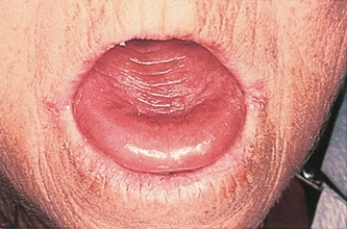 What action by the nurse is most appropriate?
 (Multiple Choice)
4.9/5 (69)
(69) A client has been treated for a deep vein thrombus and today presents to the clinic with petechiae.Laboratory results show a platelet count of 42,000/mm³.The nurse reviews the client's medication list to determine if the client is taking which drug?
(Multiple Choice)
4.8/5 (82)
(82) A client in sickle cell crisis is dehydrated and in the emergency department.The nurse plans to start an IV.Which fluid choice is best?
(Multiple Choice)
4.8/5 (83)
(83) The nurse is caring for a client with leukemia who has the priority problem of fatigue.What action by the client best indicates that an important goal for this problem has been met?
(Multiple Choice)
5.0/5 (71)
(71) A client admitted for sickle cell crisis is distraught after learning her child also has the disease.What response by the nurse is best?
(Multiple Choice)
5.0/5 (77)
(77) A nurse is preparing to hang a blood transfusion.Which action is most important?
(Multiple Choice)
4.9/5 (82)
(82) A client has Crohn's disease.What type of anemia is this client most at risk for developing?
(Multiple Choice)
4.9/5 (80)
(80) A client has thrombocytopenia.What client statement indicates the client understands self-management of this condition?
(Multiple Choice)
4.8/5 (82)
(82) A client has frequent hospitalizations for leukemia and is worried about functioning as a parent to four small children.What action by the nurse would be most helpful?
(Multiple Choice)
4.9/5 (90)
(90) A client with chronic anemia has had many blood transfusions.What medications does the nurse anticipate teaching the client about adding to the regimen? (Select all that apply.)
(Multiple Choice)
4.8/5 (74)
(74) A client has a platelet count of 9000/mm³.The nurse finds the client confused and mumbling.What action takes priority?
(Multiple Choice)
4.9/5 (82)
(82) A nursing student is struggling to understand the process of graft-versus-host disease.What explanation by the nurse instructor is best?
(Multiple Choice)
4.9/5 (80)
(80) The family of a neutropenic client reports the client "is not acting right." What action by the nurse is the priority?
(Multiple Choice)
4.8/5 (87)
(87) 
Filters
- Essay(0)
- Multiple Choice(0)
- Short Answer(0)
- True False(0)
- Matching(0)