



 Chat with AI
Exam 36: Care of Patients with Vascular Problems

Exam 1: Introduction to Medical Surgical Nursing Practice15 Questions
Exam 2: Common Health Problems of Older Adults22 Questions
Exam 3: Assessment and Care of Patients with Pain35 Questions
Exam 4: Genetic and Genomic Concepts for Medical Surgical Nursing15 Questions
Exam 5: Evidence Based Practice in Medical Surgical Nursing14 Questions
Exam 6: Rehabilitation Concepts for Chronic and Disabling Health Problems18 Questions
Exam 7: End of Life Care18 Questions
Exam 8: Concepts of Emergency and Trauma Nursing18 Questions
Exam 9: Care of Patients with Common Environmental Emergencies19 Questions
Exam 10: Concepts of Emergency and Disaster Preparedness16 Questions
Exam 11: Assessment and Care of Patients with Fluid and Electrolyte Imbalances24 Questions
Exam 12: Assessment and Care of Patients with Acid-Base Imbalances20 Questions
Exam 13: Infusion Therapy24 Questions
Exam 14: Care of Preoperative Patients27 Questions
Exam 15: Care of Intraoperative Patients18 Questions
Exam 16: Care of Postoperative Patients21 Questions
Exam 17: Inflammation and Immunity19 Questions
Exam 18: Care of Patients with Arthritis and Other Connective Tissue Diseases49 Questions
Exam 19: Care of Patients with HIV Disease and Other Immune Deficiencies26 Questions
Exam 20: Care of Patients with Immune Function Excess: Hypersensitivity (Allergy)and Autoimmunity13 Questions
Exam 21: Cancer Development14 Questions
Exam 22: Care of Patients with Cancer32 Questions
Exam 23: Care of Patients with Infection21 Questions
Exam 24: Assessment of the Skin, Hair, and Nails15 Questions
Exam 25: Care of Patients with Skin Problems30 Questions
Exam 26: Care of Patients with Burns30 Questions
Exam 27: Assessment of the Respiratory System20 Questions
Exam 28: Care of Patients Requiring Oxygen Therapy or Tracheostomy18 Questions
Exam 29: Care of Patients with Noninfectious Upper Respiratory Problems20 Questions
Exam 30: Care of Patients with Noninfectious Lower Respiratory Problems35 Questions
Exam 31: Care of Patients with Infectious Respiratory Problems25 Questions
Exam 32: Care of Critically Ill Patients with Respiratory Problems30 Questions
Exam 33: Assessment of the Cardiovascular System27 Questions
Exam 34: Care of Patients with Dysrhythmias25 Questions
Exam 35: Care of Patients with Cardiac Problems33 Questions
Exam 36: Care of Patients with Vascular Problems39 Questions
Exam 37: Care of Patients with Shock21 Questions
Exam 38: Care of Patients with Acute Coronary Syndromes31 Questions
Exam 39: Assessment of the Hematologic System13 Questions
Exam 40: Care of Patients with Hematologic Problems38 Questions
Exam 41: Assessment of the Nervous System30 Questions
Exam 42: Care of Patients with Problems of the Central Nervous System: The Brain32 Questions
Exam 43: Care of Patients with Problems of the Central Nervous System: The Spinal Cord30 Questions
Exam 44: Care of Patients with Problems of the Peripheral Nervous System18 Questions
Exam 45: Care of Critically Ill Patients with Neurologic Problems43 Questions
Exam 46: Assessment of the Eye and Vision10 Questions
Exam 47: Care of Patients with Eye and Vision Problems18 Questions
Exam 48: Assessment and Care of Patients with Ear and Hearing Problems24 Questions
Exam 49: Assessment of the Musculoskeletal System14 Questions
Exam 50: Care of Patients with Musculoskeletal Problems28 Questions
Exam 51: Care of Patients with Musculoskeletal Trauma34 Questions
Exam 52: Assessment of the Gastrointestinal System18 Questions
Exam 53: Care of Patients with Oral Cavity Problems12 Questions
Exam 54: Care of Patients with Esophageal Problems20 Questions
Exam 55: Care of Patients with Stomach Disorders23 Questions
Exam 56: Care of Patients with Noninflammatory Intestinal Disorders30 Questions
Exam 57: Care of Patients with Inflammatory Intestinal Disorders30 Questions
Exam 58: Care of Patients with Liver Problems25 Questions
Exam 59: Care of Patients with Problems of the Biliary System and Pancreas26 Questions
Exam 60: Care of Patients with Malnutrition: Undernutrition and Obesity29 Questions
Exam 61: Assessment of the Endocrine System18 Questions
Exam 62: Care of Patients with Pituitary and Adrenal Gland Problems23 Questions
Exam 63: Care of Patients with Problems of the Thyroid and Parathyroid Glands20 Questions
Exam 64: Care of Patients with Diabetes Mellitus50 Questions
Exam 65: Assessment of the Renal/Urinary System23 Questions
Exam 66: Care of Patients with Urinary Problems34 Questions
Exam 67: Care of Patients with Kidney Disorders20 Questions
Exam 68: Care of Patients with Acute Kidney Injury and Chronic Kidney Disease36 Questions
Exam 69: Assessment of the Reproductive System11 Questions
Exam 70: Care of Patients with Breast Disorders22 Questions
Exam 71: Care of Patients with Gynecologic Problems21 Questions
Exam 72: Care of Patients with Male Reproductive Problems17 Questions
Exam 73: Care of Transgender Patients12 Questions
Exam 74: Care of Patients with Sexually Transmitted Diseases20 Questions
Select questions type


A client is 4 hours postoperative after a femoropopliteal bypass.The client reports throbbing leg pain on the affected side,rated as 7/10.What action by the nurse takes priority?
(Multiple Choice)
4.9/5  (82)
(82) A client has peripheral arterial disease (PAD).What statement by the client indicates misunderstanding about self-management activities?
(Multiple Choice)
4.7/5 (86)
(86) The nurse is caring for four hypertensive clients.Which drug-laboratory value combination should the nurse report immediately to the health care provider?
(Multiple Choice)
4.9/5 (82)
(82) A student nurse is assessing the peripheral vascular system of an older adult.What action by the student would cause the faculty member to intervene?
(Multiple Choice)
4.9/5 (89)
(89) A client had a percutaneous transluminal coronary angioplasty for peripheral arterial disease.What assessment finding by the nurse indicates a priority outcome for this client has been met?
(Multiple Choice)
4.9/5 (91)
(91) What nonpharmacologic comfort measures should the nurse include in the plan of care for a client with severe varicose veins? (Select all that apply.)
(Multiple Choice)
4.9/5 (58)
(58) A nursing student is caring for a client with an abdominal aneurysm.What action by the student requires the registered nurse to intervene?
(Multiple Choice)
4.8/5 (85)
(85) A nurse is assessing an obese client in the clinic for follow-up after an episode of deep vein thrombosis.The client has lost 20 pounds since the last visit.What action by the nurse is best?
(Multiple Choice)
5.0/5 (84)
(84) A nurse is caring for four clients.Which one should the nurse see first?
(Multiple Choice)
4.8/5 (81)
(81) The nurse working in the emergency department knows that which factors are commonly related to aneurysm formation? (Select all that apply.)
(Multiple Choice)
4.8/5 (93)
(93) A client with a known abdominal aortic aneurysm reports dizziness and severe abdominal pain.The nurse assesses the client's blood pressure at 82/40 mm Hg.What actions by the nurse are most important? (Select all that apply.)
(Multiple Choice)
4.8/5 (86)
(86) A client has a deep vein thrombosis (DVT).What comfort measure does the nurse delegate to the unlicensed assistive personnel (UAP)?
(Multiple Choice)
4.8/5 (90)
(90) A nurse is caring for a client who weighs 220 pounds and is started on enoxaparin (Lovenox).How much enoxaparin does the nurse anticipate administering? (Record your answer using a whole number.)_____ mg
(Short Answer)
4.9/5 (94)
(94) A client has been bedridden for several days after major abdominal surgery.What action does the nurse delegate to the unlicensed assistive personnel (UAP)for deep vein thrombosis (DVT)prevention? (Select all that apply.)
(Multiple Choice)
4.8/5 (90)
(90) A client is being discharged on warfarin (Coumadin)therapy.What discharge instructions is the nurse required to provide? (Select all that apply.)
(Multiple Choice)
4.7/5 (78)
(78) A nurse is assessing a client with peripheral artery disease (PAD).The client states walking five blocks is possible without pain.What question asked next by the nurse will give the best information?
(Multiple Choice)
4.9/5 (80)
(80) A client has been diagnosed with a deep vein thrombosis and is to be discharged on warfarin (Coumadin).The client is adamant about refusing the drug because "it's dangerous." What action by the nurse is best?
(Multiple Choice)
4.8/5 (85)
(85) A client presents to the emergency department with a severely lacerated artery.What is the priority action for the nurse?
(Multiple Choice)
4.9/5 (86)
(86) The nurse is assessing a client on admission to the hospital.The client's leg appears as shown below:
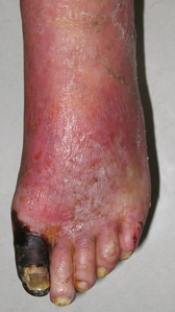 What action by the nurse is best?
 (Multiple Choice)
4.9/5 (80)
(80) 
Filters
- Essay(0)
- Multiple Choice(0)
- Short Answer(0)
- True False(0)
- Matching(0)